
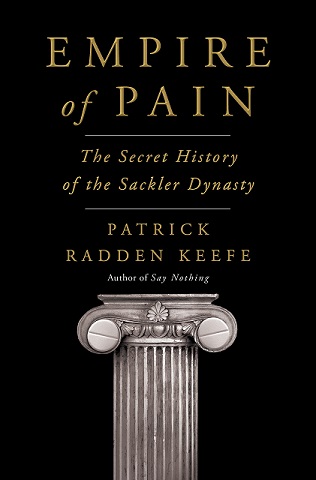
Empire of Pain is superb in its scope and breadth.
It is not just the story of the rise of prescription opioid use and abuse and OxyContin and Purdue Pharma in particular, but it is also the story of the Sackler family. The owners of Purdue Pharma. Their rise to wealth and power and their role in not only bring OxyContin to market, but their role in setting the stage of the opioid epidemic and crisis, and the multitude of lawsuits.
There is a lot to unpack in this book and a lot of lessons for society. However, what is of particular interest to me in Patrick Radden Keefe’s outstanding work is what Empire of Pain teaches us about company culture and values.
The Sackler’s have never admitted any wrongdoing for their role in the selling and distribution of Oxycontin, although Purdue Pharma has. This does not just stem from not wanting to go to prison, but from a cultural belief, both inside the family and at the highest levels of Purdue Pharma, that the Sackler’s could do no wrong. Even when marketing strategies inside the United States and outside the United States contradicted each other, the lack of any moral reevaluation of what they were doing to the detriment of millions, never seems to give any of the family pause or cause for reflection.
Even members of the Sackler Dynasty who had little to no involvement with Purdue Pharma were not prepared give thought as to the moral questions surrounding their wealth. Even when their work would seem to be directly involved in reflecting the human costs of the opioid crisis they seemed oblivious or to deliberately obfuscate. Madeleine Sackler is a filmmaker, who in 2018 made a fictional drama, O.G., and a documentary It’s a Hard Truth Ain’t It, entirely inside the level four Pendleton Correctional Facility. However, as the author states, Sackler “was able to weigh in, sagely, on the plight of America’s prison population without being asked to account for her own familial connection to one of the underlying drivers of that crisis.”
What is so surprising about the Sackler Story was the extent to which the Sackler family, while in theory only being board members of a private company, were able to co-opt and influence. This was not just decision making, marketing, and research on a day-to-day basis inside a company that others were supposed to be running, but the Sackler’s were able to influence the culture and thought of those at Purdue Pharma. Of course, money, power, and influence all played a part, but what is most remarkable, and disturbing, is just how much they were able to value loyalty above all else, and that loyalty meant thinking the same way.
It is clear from Empire of Pain, that while there are few who support the Sackler family today – they are virtual pariahs today in the art world, a world where their philanthropy had made them famous – there are still those who are colored by what Hanna Arendt called “the banality of evil.”
These were salespeople, marketers, CEOs, lawyers, secretaries, doctors, and researchers, who all bought into a view of the world so out of step with reality that it led to a crisis that some have stated is “bigger than the HIV epidemic.” The author even notes in his epilogue that the Sackler family story is bereft of whistleblowers. A testament to the family’s power? Or testament to how all-encompassing the culture was at Purdue Pharma.
For those wanting a proof positive macro view of why culture and values matter, you will be hard pressed to find a more glaring example.
 Mike Falconer