
So Facebook and Twitter, which we looked at last week, are now part of your lexicon, what now?
There are other social media tools out there which can be of significant benefit. For Business to Client (B2C) businesses such as veterinarians, Facebook and Twitter are the ones to be using. However, having a strategy for some of the other sites can set you apart from your competitors and provide some interesting opportunities.
A personal favorite of mine, Foursquare is a location based social media tool with game elements. What does all that mean? Well, Foursquare allows users to “Check-in” to businesses and other venues using their smart phone’s GPS functionality. By “Checking-in,” users of the service let friends, via the service itself or by sharing on Facebook and / or Twitter. know where they are and why they are there. The game element comes from trying to rack up the most check-ins, and there by points and “badges,” than your friends. Users of the service can also compete with strangers for the title of “Mayor” of businesses or locations. The Mayor title does not mean anything other than bragging rights and more points when checking in. Badges can sometimes be difficult to get and so the competition can drive behavior. An example of this is the “Gym Rat” badge, that can only be achieved by checking in at a gym 10 times in 30 days.
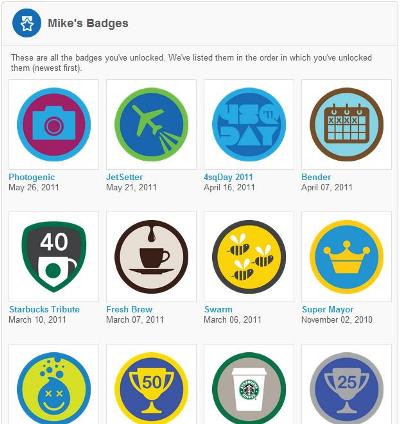
A selection of Foursquare badges
Businesses can offer specials to Foursquare users when they check-in. Chilli’s, for example, offers free chips and salsa to anyone checking in on Foursquare – customers just show their smart phone to their server. Businesses may also reward the mayor of their business, making the title more coveted and therefore create competition around their brand.
The grand theory of Foursquare is that it creates loyalty. If users have a choice between two businesses, one of whom there trying to become mayor of, they will choose that business or one is running a special for Foursquare users. Users of Foursquare can also leave tips, good and bad, about locations helping other users to choose where they might want to eat – for example. Because it is location based, it only offers places that are nearby, and allows the user to filter the results by type. This solves the information overload that can occur if smart phone users just trying to use Google.
Foursquare definitely has the potential to create a community of loyal users, and it has personal benefits (I use it to help keep track of my expenses!) However, the user base is small compared to other social media sites – particularly outside of major metropolitan areas. There are a number of other competitors in the location based world, the largest of whom is Facebook Places. The advantage of Facebook places is that it is part of Facebook, but it lacks a lot of the game elements that makes Foursquare fun and does not have the same controls on sharing.
Foursquare and other location based services have come under fire for the potential safety implications of letting your social media “friends” know where you are. This has been way overblown and as long as users are sensible, not creating a venue called “home” and checking into it for example, location based services will be around for a long time to come.
LinkedIn, is often called the professional Facebook and with good reason. Like Facebook, LinkedIn revolves around a profile. The difference is that your LinkedIn profile is essentially your resume. You can find mine here. Users of LinkedIn can then make connections with current, and former, colleagues to create a network. It is then possible to reach out to colleagues of colleagues more easily because you know which of your network knows them. LinkedIn has an introduction feature specifically for this. It is also possible to recommend, and get recommend, which also then appears on your profile.
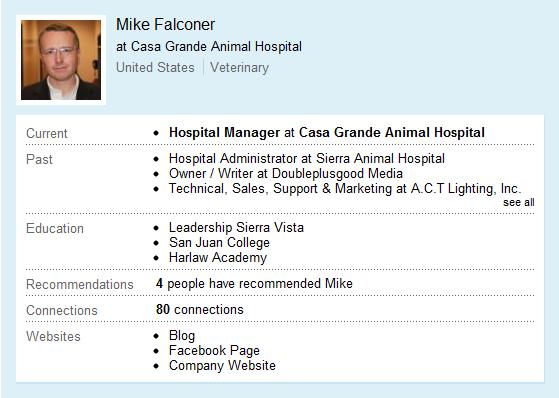
Part of my LinkedIn Profile
Groups on LinkedIn are pretty much just like other web forums, but by being directly in LinkedIn it is possible to be a member of large numbers of different groups, on different subjects, without having to login to multiple sites. The additional functionality of being able to make connections that can help you professionally in the real world is obvious.
A questions section does pretty much what you’d expect – allows for users to post questions and then other users to answer them. The advantage that LinkedIn has over other sites with a similar model, such as Quora, is that you are able to research the person giving the answer to see whether they know what they are talking about. You also then have a mechanism for connecting with them.
A recent, and extremely innovative feature from LinkedIn has been news. This allows users to browse and share news items with their connections based on popularity within professional categories. It also allows users to share these news stories via Twitter – expanding the reach of your network yet again.
LinkedIn does allow companies to have their own profiles, a bit like pages on Facebook, and this is interesting from a recruitment perspective. Groups are also being used successfully for recruitment and many feature a jobs section. LinkedIn also recently launched an “apply via LinkedIn” button that can be used for online job postings outside of the main LinkedIn site.
LinkedIn is a business to business tool (B2B), rather than the B2C tool that Facebook, Foursquare, and Twitter can be; however, don’t be surprised if LinkedIn does not become more and more a factor in recruitment of even minor posts in organizations. LinkedIn does have many issues (their mobile app is hopeless for anything other than news for example), but is a great professional tool for anyone interested in their career, or profession.
YouTube is the video sharing site on the web and although being social it not at its core, it is still social media. Users uploaded material which they, and other users, can then share and comment on. Users can even create their own channels of material making it easier for other users to find similar videos. YouTube also has a number of great tools allowing you to embed a video directly into a website or blog. Video dramatically increases your website’s visibility to search engines, like Google and clients love it – a win all round!
Where YouTube really comes into its own, however, is that it is very easy for a video to go viral – spread around the internet like a virus. Of course, the video has to have some kind of merit; be funny, very dramatic, or even just be very bad, but if your brand is attached to this video it can be great publicity or almost zero cost. For example, it is not unusual for clips of TV shows on YouTube to have dramatically higher ratings that on the channels they were produced for!
Above is a great example of a viral pet video – 10 1/2 million views as of this writing and massive mainstream media attention for Denver’s owners. All from a video shot upon getting home and finding someone got into the cat treats!
A great test of YouTube’s power is to pick any subject you like and search for a video on it at YouTube. Your are almost guaranteed that someone has shot and posted a video on that very subject. Thank you Corey for showing me this!
Video production is really outside the realm of this already overly long post, but it is simple, very low cost and an extremely effective way to market your business.
Some of these social media tools may appeal to you, and other may not. There is definitely a take it or leave it feel to the services that we have talked about today but it is important to understand that to not be involved in social media, particularly Facebook, Twitter and to an extent Foursquare does not mean that your brand and business are not affected by these mediums. Your clients are using these tools and so might your competitors you should at least have an awareness of what is being said and why. The genie is out of the bottle and without getting involved, it is possible for you to loose influence over your brand – the control probably went some time ago as it is now the customer who ultimately defines what your brand means.
Next week, a change of pace: Up to your neck in traditional media!
 Mike Falconer