
Let me tell you a secret about most business books – they are not about business. Oh yes, they claim to be about business, how to work with people, and affect change, but in reality a lot of them are not. They are often about the hard things – finance, cost control, selling, and product development, or the soft things – people management, team dynamics, and marketing. Rarely is a book about how all these things fit together, and how to grow while at the same time dealing with the realities of business day to day.
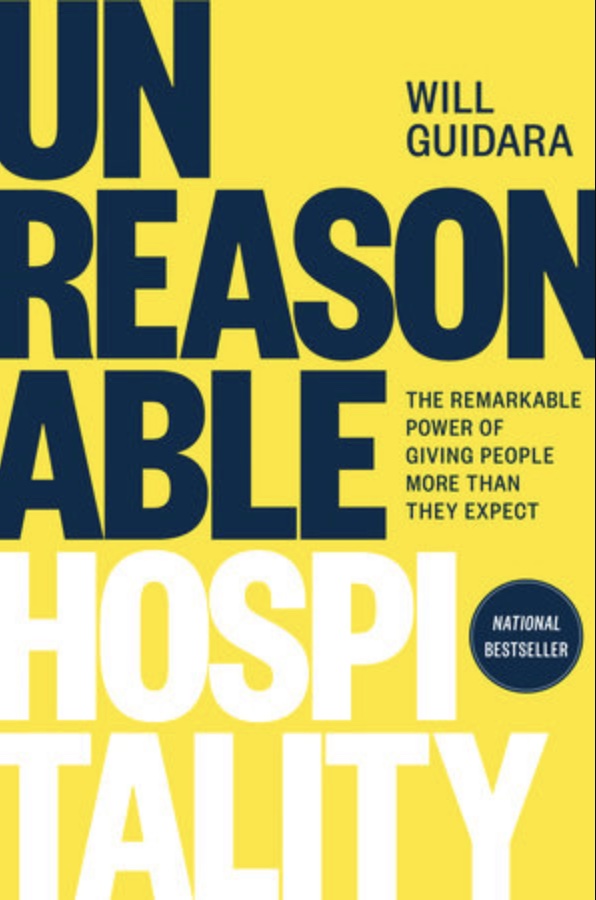
Which is why Will Guidara’s book “Unreasonable Hospitality: The Remarkable Power of Giving People More than They Expect” is so refreshing. This is part memoir of a restauranter and part business manual on blending soft and hard skills that all businesses try to do – with varied levels of success. Mr. Guidara was the general manager of a number of fantastic restaurants, including Eleven Madison Park which became the number one restaurant in the world.
For a book that talks a length about people, values, growth, and mission it is so unusual to hear the real world politick of “I’m also clear about what my job is, which is to do what’s best for the restaurant, not to do what’s best for any of you (the staff). More often than not, what’s best for the restaurant will include doing what’s best for you. But the only way I can take care of all of you as individuals is by always putting the restaurant first.” Just wow!
And that quote really sums up the problems with a lot of books on management and leadership – they are two different things people and not mutually exclusive (I can shout that louder for the hacks with the crappy memes) – we are often being asked to hold ourselves to an impossible standard. People are sometimes not the right fit, sometimes we just have to get through the shift, sometimes we are not going to be perfect. An illuminating passage deals with the idea that while it is often trotted out that employees have a language of appreciation, they may also have a language of criticism – people may need feedback in different ways depending on their personality and work history.
I love the advise to “not let things slide – those small things become personal slights.” This is often ignored because every manager today fears being labeled a micro manager. Just like I also appreciate Mr. Guidara’s works to be maniacal on cost control for 95% of your costs and then to spurge for the last 5% to make a difference to the guest experience.
There are times when this book feels like it is written by the staff from the movie “The Menu,” yet at the same time one has to appreciate what Mr. Guidara was trying to do with his business and why he was doing it. The book says, there is nothing wrong with striving for perfection, as long as perfection is not the standard – little things are always going to go wrong. That does not mean one should not try, but it means managers and leaders have to accept realities.
It may seem extreme and over the top, and it is, but that is the whole point of being “unreasonable.” To give people more than they ever expected in a controlled manner so it can be systemized and scalable. I’ve been banging on about scalability for years, and so to read it in this book was like having to tell the author to get out of my head.
This book should be required reading for managers and leaders of any business who want to deliver a better experience for everyone – including the owner of the business. This is appreciation that businesses are businesses. They must make money and they have to be able to work when you are not there. There has to be systems in place, protocols and procedures, so that everyone knows what to do and new people can be easily trained on what to do.
Unreasonable Hospitality is what business books should be. Simon Sinek, who wrote the introduction and I have been on record for forever as having no time for, could learn a lot from this book for example.
This is where the rubber meets the road. For those who want to add to their passion, or just rekindle it, it is hard to find a better way to do so than to read this wonderful book.
 Mike Falconer