Archives for posts with tag: Leadership

Let me tell you a secret about most business books – they are not about business. Oh yes, they claim to be about business, how to work with people, and affect change, but in reality a lot of them are not. They are often about the hard things – finance, cost control, selling, and product development, or the soft things – people management, team dynamics, and marketing. Rarely is a book about how all these things fit together, and how to grow while at the same time dealing with the realities of business day to day.

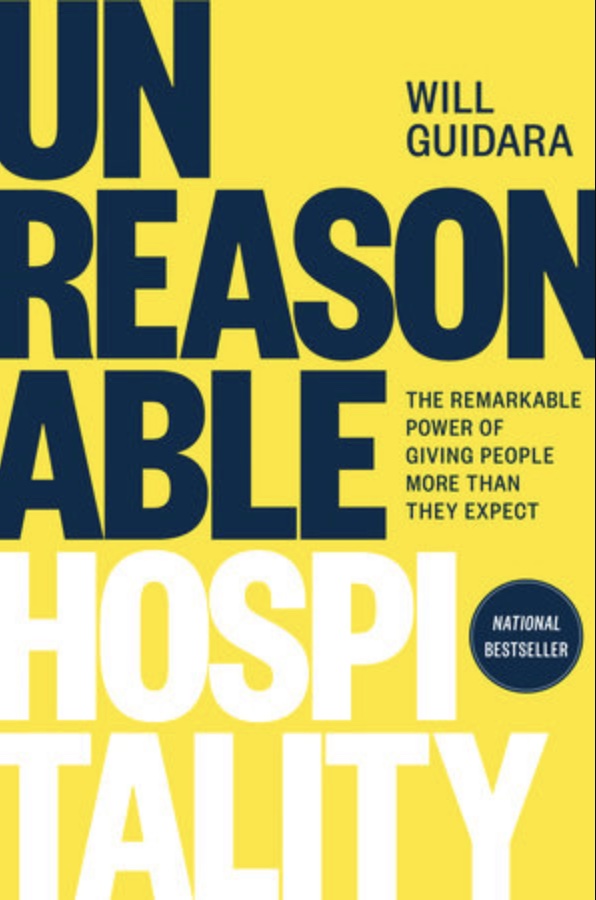
Which is why Will Guidara’s book “Unreasonable Hospitality: The Remarkable Power of Giving People More than They Expect” is so refreshing. This is part memoir of a restauranter and part business manual on blending soft and hard skills that all businesses try to do – with varied levels of success. Mr. Guidara was the general manager of a number of fantastic restaurants, including Eleven Madison Park which became the number one restaurant in the world.

For a book that talks a length about people, values, growth, and mission it is so unusual to hear the real world politick of “I’m also clear about what my job is, which is to do what’s best for the restaurant, not to do what’s best for any of you (the staff). More often than not, what’s best for the restaurant will include doing what’s best for you. But the only way I can take care of all of you as individuals is by always putting the restaurant first.” Just wow!

And that quote really sums up the problems with a lot of books on management and leadership – they are two different things people and not mutually exclusive (I can shout that louder for the hacks with the crappy memes) – we are often being asked to hold ourselves to an impossible standard. People are sometimes not the right fit, sometimes we just have to get through the shift, sometimes we are not going to be perfect. An illuminating passage deals with the idea that while it is often trotted out that employees have a language of appreciation, they may also have a language of criticism – people may need feedback in different ways depending on their personality and work history.

I love the advise to “not let things slide – those small things become personal slights.” This is often ignored because every manager today fears being labeled a micro manager. Just like I also appreciate Mr. Guidara’s works to be maniacal on cost control for 95% of your costs and then to spurge for the last 5% to make a difference to the guest experience.

There are times when this book feels like it is written by the staff from the movie “The Menu,” yet at the same time one has to appreciate what Mr. Guidara was trying to do with his business and why he was doing it. The book says, there is nothing wrong with striving for perfection, as long as perfection is not the standard – little things are always going to go wrong. That does not mean one should not try, but it means managers and leaders have to accept realities.  

It may seem extreme and over the top, and it is, but that is the whole point of being “unreasonable.” To give people more than they ever expected in a controlled manner so it can be systemized and scalable. I’ve been banging on about scalability for years, and so to read it in this book was like having to tell the author to get out of my head.

This book should be required reading for managers and leaders of any business who want to deliver a better experience for everyone – including the owner of the business. This is appreciation that businesses are businesses. They must make money and they have to be able to work when you are not there. There has to be systems in place, protocols and procedures, so that everyone knows what to do and new people can be easily trained on what to do.

Unreasonable Hospitality is what business books should be. Simon Sinek, who wrote the introduction and I have been on record for forever as having no time for, could learn a lot from this book for example.

This is where the rubber meets the road. For those who want to add to their passion, or just rekindle it, it is hard to find a better way to do so than to read this wonderful book.   

The following is a short talk I delivered at the Uncharted Veterinary Conference in April 2018 as part of their Mic Drop Series.

How valuable is experience when it comes to leadership?

Should we value experience?

Is it a benefit or a hindrance?

So let’s define some terminology…

A leader is someone who is followed.

A visionary is someone with an idea or ideas.

And a manager is someone who makes things happen.

All of these can be combined, or not, depending on a persons personality, experience, or skill set.

Some examples of Visionary leaders…

Steve Job of Apple,

Elon Musk of Tesla and Space X,

Jeff Bezos of Amazon.

Visionaries who have, literally, changed the world.

they are all looked up to and considered gods of technology. People regularly compete to work for these people and to work on those products.

They also all have the reputation for being awful managers of people to the point of cruelty.

If Visionary leaders are horrible managers then what about managers who have vision?

Tony Blair – former British Prime Minister,

Michael Eisner – Former CEO and President of the Walt Disney “Company,

George Lucas – Film Director and former owner of Lucasfilm.

Tony Blair was elected in 1997 on a wave of hope and goodwill, he transformed his labor party in “New Labor” which had been out of power for 18 years. Despite some major successes, Blair resigned in 2007 and labor lost the next election and has not been in power since. New Labor is in ashes and Blair is widely reviled in the UK, and even by those in his own party, for his tone deaf approach to the Iraq war and for his corporate connections.

Michael Eisner led the Walt Disney Company from 1984 and 2005. He revitalized the company in the eighties and nineties with “Who Framed Roger Rabbit,” “The Little Mermaid, “The Lion King,” the expansion of the theme park business, cruise ships, and the creation of stage shows. He ultimately split with his long time collaborator Jeffery Katzenberg and Roy Disney and saw an unprecedented shareholder revolt in 2004 that lead to his resignation in 2005.

George Lucas – transformed the movie industry with the original Star Wars trilogy. Arguably then did more than anyone else to sink it with his widely panned prequel trilogy. He is criticized for having a singular vision and for not listening to the feedback of others.

If visionary leaders are horrible managers and managers with vision ultimately self destruct,what about managers who just manage?

Bob Iger – Current President and CEO of the Walt Disney Company,

Bill Gates – Former CEO and President of Microsoft,

Tim Cook – Current CEO of Apple.

When was the last great breakout product from any of these companies, who are led by these managers, that was not bought it?

These companies are profitable, they make good products, just not great ones.

Why do some mangers, particularly those with vision fail, when managers without vision can succeed?

How come some visionary leaders can break all the rules and still win?

This is my story.

The period of time I’m taking about I’d been in my job for about 4 years.

I knew the answers to all the questions I was asked.

I’d tried most of what is suggested by others and had strong opinions about those suggestions.

The ghosts of what had happened in the past in the workplace haunted my current interactions.

I anticipated the responses of others and therefore do not even try to have new interactions.

I overvalued my own experience.

I believed my own story, my own press.

The things that made me a good manager – a manger with vision, a leader, I now actively rejected since I had the experience to no longer need them.

And the staff, and the people I worked with, pushed back.

I became the bad guy.
I became the roadblock.
I became the one who would not listen.
I became less and less effective.
I became the manger who kept his own counsel on everything.
I was the most capable – but I was he least able.

Some call this burnout.

I call it not learning from the experience of others.

The first step in recovery is to acknowledge that there is a problem.

Interestingly during this time I, the experienced world traveler, for the first time in my life, missed four flights because I knew, knew, when my flights were and that I didn’t need to double check.

Solving this problem is not hard, you’ve, I’ve already been that person. You just need to find them again and be aware of the trap that you are currently trying to climbing out of.

The tools that made you a good manager, a great leader, when you started are the same tools that allow you to continue being so. You just have to remember that the process can be as important as result.

Capability only has value if you have the ability to use it.

Capability only has value if you have the ability to use it.

And it is those around you, those that you lead, that give you that ability. You undervalue it at your peril.

Thank you.