Archives for posts with tag: service

Let me tell you a secret about most business books – they are not about business. Oh yes, they claim to be about business, how to work with people, and affect change, but in reality a lot of them are not. They are often about the hard things – finance, cost control, selling, and product development, or the soft things – people management, team dynamics, and marketing. Rarely is a book about how all these things fit together, and how to grow while at the same time dealing with the realities of business day to day.

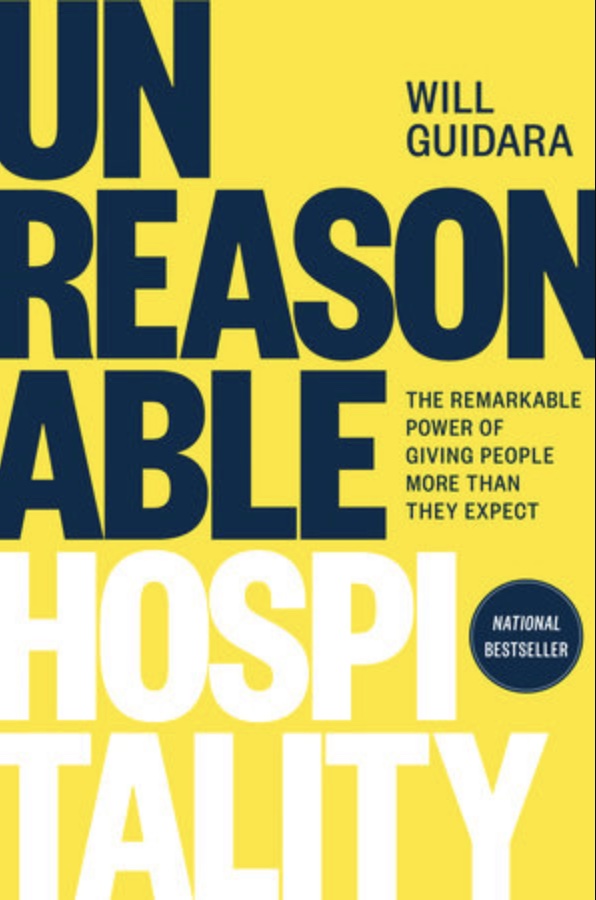
Which is why Will Guidara’s book “Unreasonable Hospitality: The Remarkable Power of Giving People More than They Expect” is so refreshing. This is part memoir of a restauranter and part business manual on blending soft and hard skills that all businesses try to do – with varied levels of success. Mr. Guidara was the general manager of a number of fantastic restaurants, including Eleven Madison Park which became the number one restaurant in the world.

For a book that talks a length about people, values, growth, and mission it is so unusual to hear the real world politick of “I’m also clear about what my job is, which is to do what’s best for the restaurant, not to do what’s best for any of you (the staff). More often than not, what’s best for the restaurant will include doing what’s best for you. But the only way I can take care of all of you as individuals is by always putting the restaurant first.” Just wow!

And that quote really sums up the problems with a lot of books on management and leadership – they are two different things people and not mutually exclusive (I can shout that louder for the hacks with the crappy memes) – we are often being asked to hold ourselves to an impossible standard. People are sometimes not the right fit, sometimes we just have to get through the shift, sometimes we are not going to be perfect. An illuminating passage deals with the idea that while it is often trotted out that employees have a language of appreciation, they may also have a language of criticism – people may need feedback in different ways depending on their personality and work history.

I love the advise to “not let things slide – those small things become personal slights.” This is often ignored because every manager today fears being labeled a micro manager. Just like I also appreciate Mr. Guidara’s works to be maniacal on cost control for 95% of your costs and then to spurge for the last 5% to make a difference to the guest experience.

There are times when this book feels like it is written by the staff from the movie “The Menu,” yet at the same time one has to appreciate what Mr. Guidara was trying to do with his business and why he was doing it. The book says, there is nothing wrong with striving for perfection, as long as perfection is not the standard – little things are always going to go wrong. That does not mean one should not try, but it means managers and leaders have to accept realities.  

It may seem extreme and over the top, and it is, but that is the whole point of being “unreasonable.” To give people more than they ever expected in a controlled manner so it can be systemized and scalable. I’ve been banging on about scalability for years, and so to read it in this book was like having to tell the author to get out of my head.

This book should be required reading for managers and leaders of any business who want to deliver a better experience for everyone – including the owner of the business. This is appreciation that businesses are businesses. They must make money and they have to be able to work when you are not there. There has to be systems in place, protocols and procedures, so that everyone knows what to do and new people can be easily trained on what to do.

Unreasonable Hospitality is what business books should be. Simon Sinek, who wrote the introduction and I have been on record for forever as having no time for, could learn a lot from this book for example.

This is where the rubber meets the road. For those who want to add to their passion, or just rekindle it, it is hard to find a better way to do so than to read this wonderful book.   

Why does being a customer suck?

Does it at your business?

Are you being honest?

How would you know if it did?

What happens when you walk into a restaurant you’ve never been to before? Do you stand there for a moment wondering whether you need to seat yourself or wait to be seated? Do you go up to the counter and order? How open are they going to be to changing one of their dishes to meet your needs?

O.K., enough question marks.

As a restaurant owner, or any business owner for that matter, it is obvious how your business works to you, but your clients almost certainly don’t walk through those doors every day -mores the pity.

Education of the client is often held up as a key component in a lot of service industries to solve these issues (yes veterinarians, I’m looking at you). Our job, as delivers of services however, should be to hold our clients hands through this process and make it as painless as possible. Clients should not need to become experts in how to deal with us, or the industries in which we work.

As I discussed at some length in this post about marketing and branding, what you sell is not necessarily what your clients are buying. The customer experience should reflect this. I had a recent customer service experience that brought this all into sharper light. Because the owner of the business is a friend, I’m not going to go into that particular experience directly, but it did cause me to re-evaluate what I do, how I respond to clients who do have issues, and do some thinking at length about what “customer service” actually is. Instead, let me tell you about my bathroom…

A while back I had a bathroom tiled. I spent a significant amount of time picking out exactly the right shade of tile that I wanted and the size. At the end of day one of the installation however, I come to find out that the tiles are actually two slightly different shades. I talk with the installer and the answer is “Well that is how they come – It is to give the effect of real marble.” Well, I did not want two tone tiles, I wanted them all the same color. Who is right here, and who is wrong? The store, and the installer, are both perfectly right – the tiles are manufactured that way and I’m sure that for most installations it would have made lots of sense, but that was not what I was purchasing! I was purchasing my bathroom tiled in a particular shade!

Interestingly, I was was in a locally owned and operated store a little while later and happened to look at their tiles. Their display was actually setup so that for tiles of the type I was looking at, all the shades of the same batch of tile were shown together as a single piece rather than just an individual tile. This removed the “different shade shock” that I had experienced when I had bought tiles for my bathroom.

Other than showing my bad taste in tiles, what does this experience tell us? It tells us that it is very difficult to forget information or view things as if we don’t know about that information. Chip and Dan Heath, in their book “Switch – How to Change things when change is hard,” have an excellent exercise that you can use with staff – or even just friends – that shows this in action. Give a volunteer a piece of paper with the name of a very common tune written on it and get them to ‘knock’ out the rhythm of the tune on a table and see if the others in the room can guess what tune it is. Try it with a number of different tunes and people. Those knocking the tune out will find it really hard to understand why everyone else in the room can’t guess correctly. The reason for this is that they are hearing the tune in their own heads along with the knocking. They have knowledge which everyone else in the room does not. Not only are they unable to communicate that knowledge, but they don’t understand how or why everyone else in room does not have that knowledge – it is an alien perspective to them.

This is just like my tile sales man and installer who could not understand why I did not know what they knew about tiles. It is also the same phenomenon that has you hesitant and unsure in the lobby of a restaurant you’ve never been to before – the big sign saying “please wait to be seated” can be a huge relief. I’d also argue that this is one of the reasons why chains are so successful. Familiarity is easy!

So what does this all tell us?

Well perhaps we need to start really listening to our clients and thinking about their experience and how it is not our experience. It might sound trite but customer service is about serving the customer. If we have a lot of education deliver to a client, perhaps the problem is that we have not made things simple enough. Of course, if the client wants more information they need to have it, and we need to have the resources to hand to help deliver. But we also know, from numerous studies, that very little information is actually retained when we deliver large amounts of it in person. We also know that lots of choices actually result is less decisions being made.

Clients are not stupid, but they don’t have, and shouldn’t need, a manual to use our businesses or get the services we are trying to deliver to them. One of the reasons why Apple’s iPod, iPhone and iPad are so successful is that anyone can use them from day one with the minimum of instruction. Our businesses and services should be the same way.

Being a customer can suck – but it is our job to ensure that it doesn’t!


A check list for removing suckyness from the customer experience

  • If we have have to explain things over and over how can we stop the need for explaining?

  • Do we get frustrated with our clients lack of knowledge – perhaps they are not the problem?

  • What do our clients complain about?

  • How successful are we with our recommendations?

  • Do we have compliance issues?

  • When issues arise, how could they have been avoided?

If you have any additions to this list, or have any customer service stories to share, please let me know in the comments!