Archives for posts with tag: training

Chef 1:- I just… I don’t think it’s fair (talking to Chef 2)

Kiki: Chef!

Kiki: Chef!

Chef 1: Yes, Kiki, what is that?

Kiki: A man on table six wants an eggless omelette. He wants an egg…

Chef 1: Kiki you can’t have an eggless omelette, can you?

Kiki: Why do we not have any?

Chef 1: No, they don’t exist, do they? Because there’s no… Breadsticks, what are they made of?

Kiki: Bread.

Chef 1: Bread, very good. OK, take away the bread, what are you left with?

Kiki: Sticks?

Chef 1: No, Kiki! (Sprinkles a few herbs on an empty plate) There you go, that’s an eggless omelet.

Kiki: Okay (takes plate)

Chef 1: No, don’t take the plate, Kiki, what are you doing? Please!

Chef 2: Kiki, just ask the nice man if he’d like his omelet made with whole eggs or just egg whites. (Kiki smiles and goes to leave)

Chef 2: You can leave the plate.

When I was first shown this scene from the British restaurant-based sitcom “Whites” I found it amusing like I’m sure most of you did. How we can laugh at how silly Kiki is being and how she lacks all common sense. And the scene is funny, but it reflects a real behavior that we see every day, admittedly pushed to extremes.

But this is an attitude that needs to change. Just like to scene where the security guard gets humiliated for not stopping the scruffy young man from entering the fancy building and not recognizing that he in-fact owns the building and is ultimately is the security guard’s employer. The poor guard is just doing his job. Just because you walk around like you own the building does not automatically mean you actually do. We’ve all seen the videos that prove you can get it almost anywhere if you are carrying a ladder. Employees, just like clients, can suffer from being of the loosing end of the curse of knowledge.

The curse of knowledge is where we humans can’t understand that others may not have the same life, education, and training as us and therefore may not know the same things. What is obvious and, in that most awful of phrases, “common sense” may not in fact be widely known or common sense. For more on my hatred of “common sense” you can read this post.

But yet we do this all the time. The client who does not know to vaccinate their new puppy. The coffee drinker who does not know that Starbucks calls its large “Venti” or a regular coffee an “Americano.” There is a whole video just about that too.

With employees a lack of knowledge is a teaching moment. Of course, it can be frustrating and if we find ourselves teaching the same thing over and over again we have a different problem, but we can’t criticize, or worse snap at, for a lack of knowledge – even when we think employees should have this knowledge. In any other environment, we would recognize this behavior for what it is; bullying.

Recognizing that teams need be able to express when they don’t know something helps to create a safe space for learning. Teachable moments should be embraced for what they are – a chance to get better, to improve. Its also just the decent thing do to. There can also be more going on than just not knowing something.

New employees, for example, don’t know the limits of their knowledge yet. So while they may not of heard of something does not mean that it does not exist. We don’t want them to guess – so employees ask. They need to praised for checking and confirming that what we think is obvious is actually not. We all need to be better about this. I for one know that I can be bad at this but, as with most things, recognizing when you have a problem is the first step in fixing it.

The Kiki’s of the world deserve that we try.
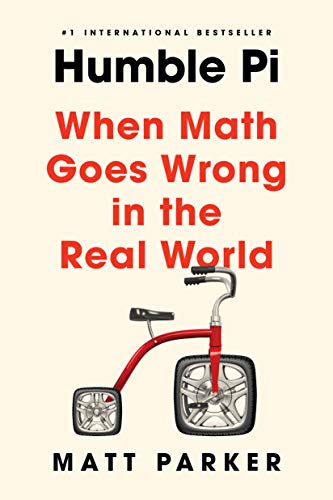
There are few people who would argue with the statement that math is at the heart for most of our modern world. What is less well understood is what happens when that math goes wrong. And it does. All the time!

Mr. Parker’s highly amusing and thought-provoking book is about math and computers, but what becomes clearer as the book goes on is that this is also a book about systems and how and why systems can fail. There are lots of examples of people adding up numbers incorrectly or trying to take shortcuts to make the math simpler, which in turn leads to devastating and sometimes lethal consequences. However, it the subtler applications of mathematics where “Humble Pi” really scores.

For example, looking at 30- or 40-year-old kitchen appliance, still in use, is often accompanied by a phrase such as “they don’t make things today like they used to.” While this might seem obvious at first glance given that we are talking about an appliance working well beyond its expected lifespan, this is actually an example of “Survivor Bias.” If we looked at how many of the appliances had been manufactured, and then looked at how many were still in daily use, the chances are that we would recognize that this surviving appliance is an outlier and that the vast majority of the appliances have actually long been replaced or broken down. It is only the existence of this surviving outlier that prompts the idea even though we would likely not comment on its existence were more of the appliances in existence. The appliance’s rarity generates a false narrative that can only be understood by understanding the underlying math of the number of appliances produced.

For managers there is much to take away from Humble Pi. Mr. Parker encourages us to look at systems like layers of sliced Swiss cheese. All systems should be made of multiple layers – the checks and balances of any good system. But it is important to understand that there are possibilities for mistakes in every layer of a system – the holes in the cheese. The challenge as designers of systems is to ensure that the holes in each layer do not align. The author uses the example of two different nurses in a hospital performing a complicated drug calculation the same way and both making the same math mistake leading to a medical error.

Related to this idea of errors being a natural part of a system is the impact of a lack of tolerance for errors on new employee training. If managers terminate employees for making mistakes, the people who are left to train new employees are those who are must less likely to make mistakes. These are probably the worst people to train new employees who are obviously more prone to making mistakes. If instead, we teach employees to work a system that can detect mistakes and provide feedback, a system where the holes do not line up, then we will overall have far less mistakes – even when people are new. As the books says, humans can be very resourceful in finding ways to make mistakes.

This is not just a book about rounding errors, and why you should turn your computer off regularly. It is a book about what it means to be human in a world that relies and is built on mathematics, which humans are inherently not very good at. It is a fun and interesting read that will stay with you long after you put it down.

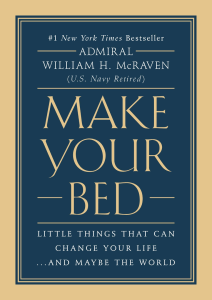
make your bed

A slim volume, Make Your Bed – Little Things That Can Change Your Life …And Maybe The World, is and expanded version of a commencement address that the author gave to the graduating class at the University of Texas at Austin in 2014.

A retired Admiral, who had been a Navy Seal, and ultimately severed as the ninth commander of the United States Special Operations Command, Admiral McRaven is an interesting person who’s life story is one worthy of biography. Unfortunately, although this book does contain a number of anecdotes about his experiences in SEAL training and his life in general, it does not really meet the definition of a work of biography. It therefore needs to stand on the advice that it imparts and there is little here that is new or refreshing. In fact, there is a lot that is hokey or debunked.

The first lesson in the book is actually the one that works the best: to make your bed very morning. The idea being that it meant you started your day with a job well done, something you can could be proud of, whatever came next you will be better prepared for it. There is some merit to this idea, not necessarily making your bed, but starting your day with a task that can be completed successfully and that you can be proud of for the rest of the day. However, the author pushes the example too far, even noting when visiting Sadam Hussain in prison that his bed was not made and so therefore he must be a bad guy. Ignoring Sadam’s appalling crimes for a moment, I’m not sure that there are many leaders of countries, prisoners facing the death penalty, or politicians of any persuasion who make their beds.

Don’t give up, take risks, don’t complain, etc. the lessons are pretty much what you would expect from a career military officer. As mentioned before, there is a story to be told here. Just not with the structure and marketing of a leadership / self-help book. Perhaps the most frustrating element of the book is that the examples can be interpreted in such a way that they can contradict each other. For example, the author tells the story of being injured during a parachute jump and how his boss pulled strings to allow him to stay in the SEALs, thereby preserving his career. The author uses this as an example of why you need to be able to rely on your team. However, later on the book talks about accepting misfortunes that happen to you and that life is not fair so get used to it.

 I’ll buy an auto-biography or biography of Admiral McRaven. He has led an interesting life filled with interesting people and experiences. I’m just not sure I’m ready to take distilled life lessons from him at this time.