Archives for category: Poltics

There are a lot of books about Twitter out there right now. That is perhaps not a surprise given (Spoiler Alert) that it has become a corporate / Silicon Valley dumpster fire.

Mr. Wagner’s account is balanced and well researched; however, one cannot feel while reading the work that it is missing the insider juicy details that make tech CEOs squirm. Perhaps because so much of Twitter’s (now X’s) dirty laundry has already been aired there is little new revelations in the work.

What” Battle of the Bird” does do is provide a clinical timeline from Twitter’s founding through to the events leading up to its purchase by Elon Musk and the unravelling of the technology institution under his stewardship. This in turn provides insights into the failure of Jack Dorcey (Twitter’s former CEO and co-founder) and Elon Musk’s failures with X.

As I talked about in my review of “Kingdom of Happiness” by Amiee Groth which referenced the failures at Zappos and the Downtown Project, both Dorsey and Musk in hindsight have had a failure of leadership due to a lack of management. It is all very well being able to persuade people to jump out of a plane, but you have to ensure that they have parachutes and know how to use them.

There is no doubt that Dorsey and Musk both do, or more appropriately have at one time, loved Twitter and what it has brought to the world. While Dorsey, according to Mr. Wagner’s book, seems to have lost interest in Twitter as a company once the reality of being a public company set in. Musk on the other hand, seems far too interested in his own press and ego once he understood the challenges Twitter faced and continues to face even after his pointless rebranding to X. It is hard to feel sorry for billionaires when the world does not work the way they want it to.

There is a theme throughout the book that perhaps Twitter can’t be a company. Dorsey in particular laments that what Twitter should be is a technology like email, that allows for the exchange of information, but that is not gatekept by any one platform. This is the kind of wishful thinking of people who have been made rich by the decisions to take their company public and have second thoughts. That they wish the world could be a different place. It can be, but only if different decisions are taken – the kind of decisions that don’t make entrepreneurs and venture capitalists rich.

Like I said, it is hard to feel sorry for billionaires when things don’t go their way.

Mr. Wagner does go into some reasonable depth as to the ethical dilemmas brought up by Donald Trump’s tweeting and his eventual banning from the platform. These are bigger issues than Twitter, but the impact on Twitter for both Dorsey and Musk were profound and still rancor the platform to this day. I’m not sure I want a committee of Twitter employees making decisions on whether what a world leader says is appropriate for public consumption, but at the same time I am positive I don’t want Elon Musk making those decisions.

As a grounding in the backstory and drama that is Twitter, now X, Battle for the Bird is a great document. Not a thrill ride or exposé, but a methodical grounding in the facts.

This is probably for the best given its subject matter and the turgid realities of Twitter’s recent past.

Perhaps this is the account we need rather than the one we might want.
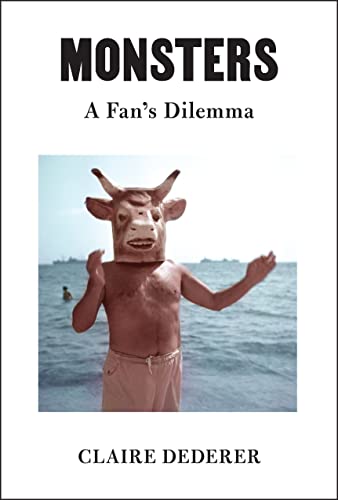
How should we feel about those whose work we admire, or even love, when they turn out to be awful human beings or even just deeply flawed? Are you a better artist if you become more selfish? This is the subject of Claire Dederer’s exceptional book – Monsters: A Fans Dilemma.

Do great artists become assholes (or monsters) because of their singular commitment to their art or do assholes / monsters become great artists because they know their transgressions will be forgiven? How should we feel about Wagner, Miles Davis, Roman Polanski, Woody Allan, David Bowie, Sylvia Plath, Joni Mitchell, Valerie Solanas, Doris Lessing, and many, many more?

Male artists who are considered monsters are usually considered so because of violence or abuse. When female artists are considered monsters, it is usually because they have abandoned their children – something that male artists do without seeming consequence or judgement. There is also an added dimension of racism. As Ms. Dederer points out by quoting the often-maligned Kanye West; “I’m not a rap star, I’m a rock star.” Why? Because rock stars generally do not experience what Kanye West has experienced ad nauseam: repercussions. A fact that Ms. Dederer points out by not covering the army of white make rock stars accused of sexual predatory behavior.

This is perhaps one of the most complex questions of our times. Claire Dederer does a superlative job of sorting through the mixed emotions we all feel about such figures, and she herself feels as an artist with the choices she has made on her own artistic journey as a writer, a mother, a partner, and as an alcoholic. She also tackles whether this is a price too high for the #metoo movement (spoiler alert: it’s not.)

At its core, Monster is an exploration of the meetings of biographies; the biographies of those with fans and the biographies of the individual fans themselves. It also embraces the fracture points of our society, racism, sexism, and violence. Our reactions to the transgressions of those who make the art we love are subjective and are based on both the artist and the viewer. We can still consume the art of terrible people because there is a difference between what we feel – the emotional response to great art – and moral thoughts. We can look at great art and see the stain left by the actions of its creator. For some the stain will ruin the piece, for others they will see past the stain. What is right for one person will not necessarily be right for someone else.

Monster also places this discussion in a historical context. We often feel that we are in an enlightened time. That we are in an apolitical present where we know better than the past. As Ms. Dederer states – we don’t know better because we woke up, we know better because some people spoke up. We can all look back on the past and say we would have spoken up, however, how many of us do when the world around us burns? The things we thought we had transcended are still there – minority communities have always known this. It is not helped by the fact that everyone still loves an asshole. How any of our beloved characters in book, television, and film we would abhor in real life if we had to deal with them? “Don’t you know who I am,” is an awful and entitled addition to any disagreement. Yet we all love the scene where the clueless front desk clerk tries to stop someone from entering the building they actually own, and the clerk works in.

Stepping away from the art discussion for a moment. Monster is also an excellent discussion of the pressure of career vs. motherhood and the goals of careers in general. Returning to Kanye West for a moment, the line; “People want power and vacations” is an insightful view of what drives people in the modern world. But the balance of motherhood and career is where Monster shines brightest. If it is a real choice to trade levels of career success for the time a mother spends with their children – how does that express itself with professionals? How do both employers and employees recognize this dilemma and neutralize its effects for everyone to get what they want and need?

While the author eschews the term “cancel culture” as non-useful it permeates the book. Is a love of a piece of art enough to make up for the transgressions of the past by the artist? The is the fans dilemma – the subtitle of the book. Ms. Dederer gives no easy answers here but does give us a lot to think about. Is art, or career, worth the price that the artist (or professional) will have to pay or make others pay? Both the viewer and artist need to make that decision.

Monsters is a start to that conversation.  

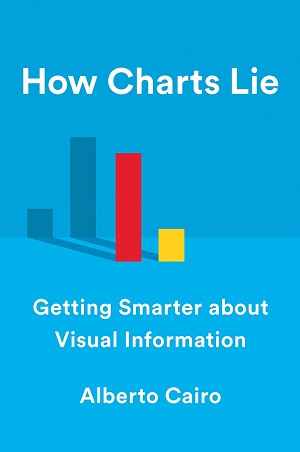
Subtitled “Getting Smarter about Visual Information,” How Charts Lie is a plea for the public to educate itself as to how we are misled everyday but the very tools that are there to make our understanding easier. As the economist Ronald Coase once stated, and then was forever quoted or misattributed to others, “If you torture the data long enough, it will confess.”

How Charts Lie is a sublime book. A book that actually makes you smarter, or certainly appear so. Reading it leads to an understanding of how statistics, and in particular charts, are misused to bolster some cases and discredit others. Using real world examples, Mr. Cairo shows how charts are often the unwilling accomplices as data is cherry picked, zoomed too far in on, zoomed too far out on, and data sets that have no business being used together are presented as unquestionable truths because they come in the form of a chart.

This is less a book about how charts themselves lie than how they are misused and how to read charts properly in the first place. A chart only shows what is there is an often-used refrain throughout. How Charts Lie is also a great introduction into some of the most often used charts and how they should, and should not, be used. That it is easy to produce a chart that seems to show that smoking leads to long life spans throughout the world is an example that should give us all pause and adopt “correlation is not causation” as our mantra.

An easy and fun read, How Charts Lie is colorfully illustrated with charts, both good and bad, which make what could be a dry academic text come alive in the mind of the reader. It should be noted that this is my second reading of “How Charts Lie.” The audio edition I originally purchased did not come with the PDF of charts and illustrations as it was supposed to – I’m looking at you estories.com. This rendered the book, interesting but fatally flawed and led to me also purchasing the latest hardback edition. I am so glad I did as it contains a new afterward written on May 3rd, 2020. This inclusion of how charts have affected the world’s response to the COVID-19 pandemic – he postulates that the CDC’s “flattening the curve” graphic will become one of the most iconic visuals in history – brings added urgency to our quest for better visual data.

In a world where fake news, false equivalency, bad charts, and just plain lies are daily scourges which have real world consequences it is great to see a non-partisan work standing up for facts and truth.

That people have a seemingly unquenchable thirst for data presented visually, means that increasing our visual vocabulary has never been more important. Not adding to the problem and ensuring that our own charts are truthful and accurate is a great place to start.

How Charts Lie is guide to doing that and so much more.

Any book that tries to deal with a subject that is as current as the COVID 19 pandemic is going to face an uphill battle. It will be out of date as soon as it is written, never mind published.


With that in mind, Nicholas A. Christakis has done a remarkable job. An epidemiologist, Dr. Christakis in Apollo’s Arrow places the COVID 19 pandemic into is historical context as a plague and also provides a definitive account of how this pandemic played out and where mistakes were made – spoiler alert; there is plenty of blame to go around. Where Apollo’s Arrow really shines, however, is in its examination of the social impact, both positive and negative of COVID 19 on individuals, countries, and our culture.


Due to his background, Dr. Christakis is able to not only make sense of the confusing early decisions made by multiple parties, but also in understanding the motivations behind those decisions. There is also no coddling of the reader in Apollo’s Arrow. In a time when most people’s expertise in epidemics comes from the movie “Contagion” – and I have to include myself in those numbers – it is refreshing to gain an understanding of why more well know terms are problematic, such as R-0, and others that are less well known such as NPI (non-pharmaceutical interventions) are used and why.


While it is impossible the remove the politics of the response to COVID 19, particularly in the United States, Dr. Christakis does try his best and it is noticeable that in his initial timeline he tries to keep politicians out of the picture. That’s is not to say that there is any mincing of words; “If the United States had been a student in my class, I would have failed them,” is an early example.
The debunking of wrongheaded ideas from politicians is also a key element of Apollo’s Arrow. The Swedish solution – “herd immunity” as soon as possible, is an example. Sweden has small healthy population, universal health care, and low levels of poverty; all of which make it distinctly different from the United States. Testing and the approach to testing is also examined in depth. If you only test those with symptoms, the ratio of positives to negatives will be high. If you only test those that are worried, the ratio will below. Randomized samples are the only way to know levels of infection.


As mentioned above, it is in the social science arena that Apollo’s Arrow really shines. That “fear has its own epidemiology, its own spreading dynamics,” is one such revelatory idea. Dr. Christakis does not spare the conspiracy theorists; “There is a feeling that we can change our reality if we change the words or images – the virus is real. Reality matters.” A surprising part of Apollo’s Arrow is how positive it is, with a recognition of the successes we have had and also that our species is capable of extreme examples of altruism. We probably do not hear enough about that.


Where Apollo’s Arrow fails is in relationship to the vaccine. It points out that while there is hope, the quickest previously created vaccine as for Ebola; and that took five years. That a significant proportion of the population of the United States, and several other countries, has been vaccinated for COVID 19 by early 2021 is an almost impossible hope by the vantage point of the author at the time of writing. This is a very welcome shortcoming; however, and given the variants that now exist and the unknown levels of protection that the various vaccines may provide to these variants, we should probably not be so smug.


For anyone who wants to stand back and view the early days of the COVID 19 pandemic, and its effects on our society, it hard to imagine a better book; written without the benefit of hindsight, to read on the subject than Apollo’s Arrow. I can’t recommend it enough.

The following is a short talk I delivered at the Uncharted Veterinary Conference in April 2018 as part of their Mic Drop Series.

How valuable is experience when it comes to leadership?

Should we value experience?

Is it a benefit or a hindrance?

So let’s define some terminology…

A leader is someone who is followed.

A visionary is someone with an idea or ideas.

And a manager is someone who makes things happen.

All of these can be combined, or not, depending on a persons personality, experience, or skill set.

Some examples of Visionary leaders…

Steve Job of Apple,

Elon Musk of Tesla and Space X,

Jeff Bezos of Amazon.

Visionaries who have, literally, changed the world.

they are all looked up to and considered gods of technology. People regularly compete to work for these people and to work on those products.

They also all have the reputation for being awful managers of people to the point of cruelty.

If Visionary leaders are horrible managers then what about managers who have vision?

Tony Blair – former British Prime Minister,

Michael Eisner – Former CEO and President of the Walt Disney “Company,

George Lucas – Film Director and former owner of Lucasfilm.

Tony Blair was elected in 1997 on a wave of hope and goodwill, he transformed his labor party in “New Labor” which had been out of power for 18 years. Despite some major successes, Blair resigned in 2007 and labor lost the next election and has not been in power since. New Labor is in ashes and Blair is widely reviled in the UK, and even by those in his own party, for his tone deaf approach to the Iraq war and for his corporate connections.

Michael Eisner led the Walt Disney Company from 1984 and 2005. He revitalized the company in the eighties and nineties with “Who Framed Roger Rabbit,” “The Little Mermaid, “The Lion King,” the expansion of the theme park business, cruise ships, and the creation of stage shows. He ultimately split with his long time collaborator Jeffery Katzenberg and Roy Disney and saw an unprecedented shareholder revolt in 2004 that lead to his resignation in 2005.

George Lucas – transformed the movie industry with the original Star Wars trilogy. Arguably then did more than anyone else to sink it with his widely panned prequel trilogy. He is criticized for having a singular vision and for not listening to the feedback of others.

If visionary leaders are horrible managers and managers with vision ultimately self destruct,what about managers who just manage?

Bob Iger – Current President and CEO of the Walt Disney Company,

Bill Gates – Former CEO and President of Microsoft,

Tim Cook – Current CEO of Apple.

When was the last great breakout product from any of these companies, who are led by these managers, that was not bought it?

These companies are profitable, they make good products, just not great ones.

Why do some mangers, particularly those with vision fail, when managers without vision can succeed?

How come some visionary leaders can break all the rules and still win?

This is my story.

The period of time I’m taking about I’d been in my job for about 4 years.

I knew the answers to all the questions I was asked.

I’d tried most of what is suggested by others and had strong opinions about those suggestions.

The ghosts of what had happened in the past in the workplace haunted my current interactions.

I anticipated the responses of others and therefore do not even try to have new interactions.

I overvalued my own experience.

I believed my own story, my own press.

The things that made me a good manager – a manger with vision, a leader, I now actively rejected since I had the experience to no longer need them.

And the staff, and the people I worked with, pushed back.

I became the bad guy.
I became the roadblock.
I became the one who would not listen.
I became less and less effective.
I became the manger who kept his own counsel on everything.
I was the most capable – but I was he least able.

Some call this burnout.

I call it not learning from the experience of others.

The first step in recovery is to acknowledge that there is a problem.

Interestingly during this time I, the experienced world traveler, for the first time in my life, missed four flights because I knew, knew, when my flights were and that I didn’t need to double check.

Solving this problem is not hard, you’ve, I’ve already been that person. You just need to find them again and be aware of the trap that you are currently trying to climbing out of.

The tools that made you a good manager, a great leader, when you started are the same tools that allow you to continue being so. You just have to remember that the process can be as important as result.

Capability only has value if you have the ability to use it.

Capability only has value if you have the ability to use it.

And it is those around you, those that you lead, that give you that ability. You undervalue it at your peril.

Thank you.