
Archives for posts with tag: apple

I have a problem.

I love my smart phone a little too much, and I hate that.

A cell phone has been my constant companion for over 30 years. I never had one of the giant brick phones of 80s yuppies but my first phone was one of the first that made those phones look ancient even then.

However, the advent of the iPhone and social media changed all that.

I’ve spent a significant portion of my career working, at least tangentially, with social media. I still enjoy social media and find it to have value, but I am more and more aware of the downsides. I think the real turning point was TikTok. The pull of those short form video snippets was often just too much on days where not much was going on. Losing hours to the app, while not all valueless (poetry, politics, history, and religious scholarship can all be mixed in with the stupid cat videos and hilarious footage of people hurting themselves) was disconcerting. Like the borderline alcoholic that realizes that perhaps always having beer in the house is not such a good idea, when the app starts warning you that perhaps you’ve been on it too long, you know there is a problem.

I should make clear that I still like and enjoy social media. I’ve been making content for social media and the internet for well over two decades. Call me shallow, but I have much in my life to thank social media for. I also feel that its current place in society is so firmly cemented that to be without it would be detrimental to how I live.

But something had to change.

I’d turned off notifications years ago, no longer being the frontline person responsible for the hospitals’ I manage social media and reviews, has its advantages. For my own personal pages and sites, a brief check whenever I had a moment would do.

But the checking got way out of hand.

Sitting at my desk and getting sucked into checking the groups I was a part of, my social channels, and even personal email seemed to consume more and more time. Even more insidious, was the “always on” home display on my iPhone 14 Pro.

I’d managed to resist the draw of Apple Watch and other smart watches. Partly due to my affinity for real watches, but also because the constant checking seemed even more intrusive than I was already experiencing and harboring qualms about. It also helped to have coworkers who love their Apple Watches and them checking them while mid conversation was annoying enough to “not be one of those people.”

However, the extremely useful always on of my new, at the time, iPhone 14 Pro with its time and date display along with a cute picture of one of my dogs was gateway and constant reminder of the joys of browsing my phone.

But how to change.

When I travel, which I do a lot of for significant portions of the year, the scene in airports is one of obvious Smart Phone addiction. Rows and rows of people, not talking, not reading a book, but low level browsing of social media. I’m not judging, I still am happy to while away the time lost in this miracle of our modern age – the interconnection of smartphone, the internet, and social media.  However, the sheer scale of how much these little devices of glass, metal, and plastic have come to be extensions of our modern selves can be shocking when one takes the place of an outside observer.

But what to do.

It seemed, I was not alone in wanting to make a change in the cycle of cellphone social media and attention-grabbing content intruding on life. Multiple celebrities were announcing their ditching of social media, and there were even a few who were getting rid of their smartphones altogether. But this removal of this seeming essential device of the 21st century seemed to reek of privilege. For every celebrity who is removing the stress of social media and the constant interruptions of a smart phone, you know there is an assistant and / or a marketing team who filter access and are ever more locked to their smartphones as they juggle their own needs and that of those who employ them.

So what for mere mortals?

I had become aware of the Light Phone when it first launched, and I laughed like most people at the idea of wanting a Dumify phone and there being value in that. Now on its third generation, the Light Phone contains a lot of the conveniences of modern smartphones but with a monochromatic interface, limited apps, and no social media.

The downside of course being that I want and need social media in my life. I want and need various apps on my smart phone, to control alarm systems, remote access to work computers, control of my smart home, control of my electric car, notifications of the location of my keys, wallet, and dogs, and any number of other things that make up a connected life and work.  I was not ready to give up all that. I’ve read Ted Kaczynski and the Luddites, and I have sympathy with those arguments, I’m just not ready for the inconvenience, the disconnection, or in a place of that level of privilege, to make such a radical change.

An option would be to slave my iPhone to a Light phone as a hotspot. Meaning my iPhone could stay in my car or bag until I wanted it, but I could carry around a Light phone for day-to-day use. This seemed a needlessly complicated solution and I was also unconvinced that the temptation of the iPhone would not be too much and I would be back to square one but $500 poorer.

Then I found Dumify.
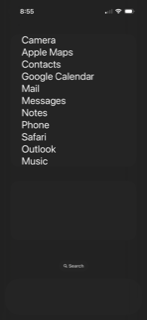
Dumify is an iPhone app, also available for Android users but you are on your own from here on out, that mimics the simpler interface of the Light phone, but does not impact the functionality of or even the regular interface of the iPhone.

By adjusting a few settings, and then just entering the apps you want daily / easy access to, the user can create a non-engaging, and thereby not tempting, interface for the things that matter most to you in a smart phone.

After a few weeks of use here is what I have found.

My smart phone screen time at work has plummeted making me far more productive when I am at my desk.

I still use and enjoy social media but it is as a choice rather than a need. I am therefore finding it limited to specific times of the day.

My simplified lock screen – see below – still can be a temptation but far less so.
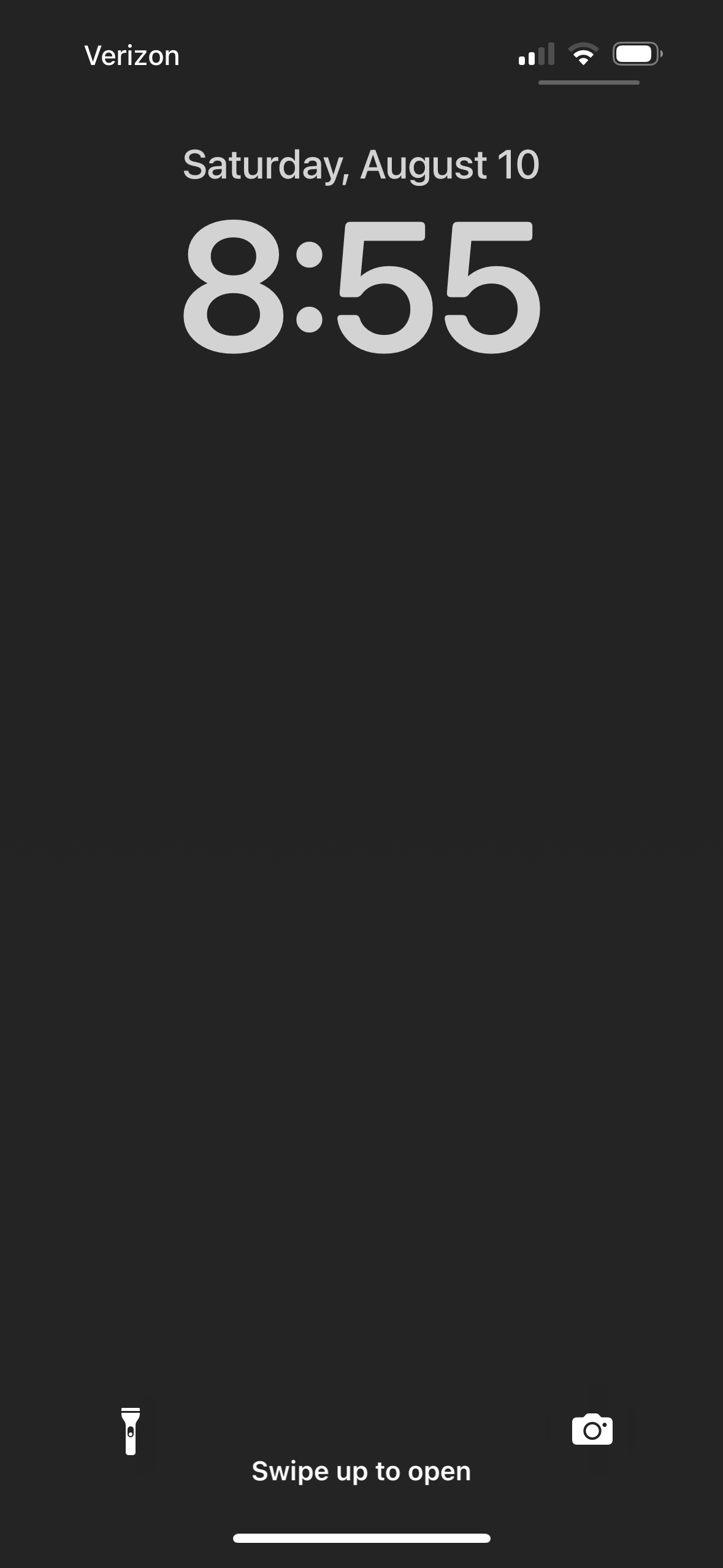
In addition, when I open my phone, I get an immediate reminder that I really don’t need to be checking Instagram, Goodreads, LinkedIn, or whatever, right now due to the interface. That simple reminder, a reminder of virtuous smartphone usage if you like, is all I need to put my phone down.

Many people, when using a tool like Dumify, delete a lot of their other apps. I have not done this. I still like my iPhone. I just use it differently. A bit like being smart about alcohol consumption while driving. An unexpected bonus has been that I have been finding myself leaving my phone in my jacket pocket when I’m in the car. The temptation to check an app while at a set of traffic lights is now gone.
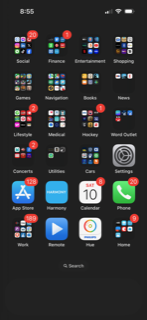
While the setup of Dumify is simple, and the app contains shortcuts to most popular apps, some research for company specific apps may be required. There are also multiple short videos embedded into the app to help the customization process. On the iPhone, the app uses URL Schemes and while it blithely suggests “just search on Google” for anything the app does not already have, I found this a little more complicated than I would have hoped. This might say more about the appalling state of Google search right now, than a lack of awareness by the app developers.

I found this article on URL Schemes extremely useful, however I did end up finding a few on my own either through searching or trial and error. It should be noted that the app uses a very basic implementation of URL schemes, and a lot of the documentation is about how developers can hack iPhone apps to do very specific things. When this is the case, I found just stripping the URL to its most basic form worked great.

These are the URL schemes I ended up having to make myself. I made most of them through trial and error as they are pretty simple.

Harmony Remote          harmony://                       

Hertz                                    hertz://

Lyft                                        lyft://

Music                                   music://

Open Table                        opentable://

Outlook                               ms-outlook://

RingCentral                       rcapp://

Southwest                         southwest://

Wallet                                  wallet://

Itunes Remote                 remote://

Dumify will also make you download a second app for some links. But this is seamless once it is downloaded.

Dumify is a onetime $4.99 purchase – another reason to love it. There are couple of other apps out there that do similar things to Dumify, but they follow a subscription model, and I was less impressed when I looked at them.

Dumbing down your smart phone is not for everyone. Just like being always connected is not for everyone. But it is nice to have choices, and I feel genuinely more in control of my time and feel that access to this wonder of the modern age is now on my terms and not on its terms.
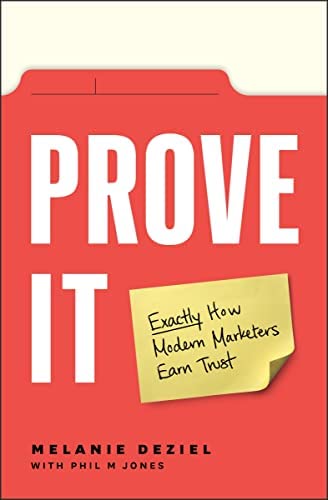
Prove It by Melanie Deziel with Phil M Jones: Exactly How Modern Marketers Earn Trust, is the follow-up to Ms. Deziel excellent The Content Fuel Framework which I reviewed last year.

Like its predecessor, Prove It is a how to guide that many marketers will find familiar for the ideas and concepts are not really new and are the fodder that modern marketing is based on. However, like her previous book, what Ms. Deziel and Mr. Jones do in Prove It is to create an overarching framework and concept that put these ideas into context and provides a guide to future ideas and processes.

The main thrust of Prove Its is that today’s customers don’t want to be told why they should buy a product or service but to be shown why they should with concrete and provable examples. This process then becomes the underpinning for a brand as a whole. Where Prove It really works its magic is by showing rather than telling. It uses the slogans and catchphrases that the reader will be all too familiar with to make its points crystal clear.  “Fifteen minutes could save you 15% or more on car insurance” for example is Geico’s way of proving that they are easy and convenient to deal with while also potentially being able to save the customer money – ‘give us a little of your time and we’ll lower your car insurance rate.’

Prove it is full of these examples for every type of business or service and how these claims can be discovered about your business, and how that discovery process in turn leads into a marketing / branding strategy. The book also encourages the reader to back up these claims with documentation and to use this a method of re-enforcing the brand’s identity by doing so. Where Prove It really scores on this front is by pointing out that businesses often already have access this documentation in other forms. Reviews on sites such as Yelp, customer service surveys, or just by talking to customers themselves can yield not only great content but can also provide witness to the claims that a brand is making and therefore backup the branding process itself.

What I personally found very interesting was a dissection of how Apple ‘coached’ its client base to not necessarily believe the claims of its competitors when it came to the differences between using a Mac or another computer brand with its “I’m a Mac and I’m a PC” series of TV ads. The idea that an ad can be coaching a customer to ask the difficult questions that the competition may not want to answer is fascinating and subtly brilliant.

Prove It is a short and engaging book for both marketing professionals and beginners alike. It demystifies how modern advertising and content marketing work. This is not a nuts and bolts “place this type of ad at this type of time” kind of book; but more about mindset. This is a book to understand how to sell a product or service so that a customer can easily identity the ‘why’ they are prepared to buy.

To sum up it so very worth your time and its place on your bookshelf.

Notes on Startups, or how to build the future – with Blake Masters.


(Clicking on the image above will take you to Amazon where a tiny percentage goes to help fund my book buying habit.)

Some will know Peter Thiel (pronounced teal) as one of the founders of PayPal, or maybe even as an Silicon Valley investor. However, it is much more likely that you recognize his name from his brief portrayal in the movie: “The Social Network.” Wherever you know is name from, even if it is from my blog, he is a man worth listening to. Blake Masters certainly thought so when he attended a series of lectures that Theil gave at Stanford and took more copious notes than anyone else. These notes started to circulate to a much wider audience than the student body and so a book project was born.

Zero to One is a reference to the ability of a technology company to go from nothing to something and thereby change the world. Interestingly, Theil defines a technology company as any company with new ideas – doing more with less. This generally means software startups in the mold of Google, Apple, and Facebook, but he is at pains to stress it does not have to be.

Zero to One is interesting because the ideas it contains about business are quite contrarian to what we believe as outsiders about startups and Silicon Valley (and I’m sure to a number insiders as well). We have all been brought up to believe that competition is a good thing; however, Theil makes a convincing case for competition as a destructive force. “Monopoly is the condition of every successful business” and “Every business is successful to exactly to the extent that it does something that others cannot.”

He is on less firm ground when he tries to apply his startup thinking to the wider geo-political world. Although he is undoubtedly on to something with defining groups of people as “indefinite optimists” “indefinite pessimists” “definite optimists” and “definite pessimists” – particularly as it relates to politicians, and finance – it is hard to buy this as it relates to entire continents.

It is interesting to note that a lot of the ideas contained in Zero to One are self evident but are so against standard business thinking (it is a brave man who says Malcolm Gladwell needs to rethink his ideas) that they have the favor of heresy. Why should you expect any business to succeed without a plan? A business that cannot provide a ten fold improvement in technology over its competitors is doomed to competition death. Don’t disrupt – avoid competition. The history of progress is one of monopolistic innovation.

What helps sell these heresies is how Theil relates these to the high tech modern fables that we have all grown to know, but not understand: Google vs. Microsoft. Microsoft vs. the United States Government. The rise of Facebook. And the reemergence of Apple.

One thing that explains a lot of the success of the Silicon Valley startup is the focus and vision of founders. However, as Theil points out this comes with its own drawbacks and potential pitfalls – particularly as you try to apply his thinking to general business environments.

“…(the) strange way that new technology companies often resemble feudal monarchies rather than organizations that are supposedly more modern. A unique founder can make authoritative decisions. Inspire strong personal loyalty. And plan ahead for decades. Paradoxically, impersonal bureaucracies staffed by trained professionals can last longer than any lifetime but usually act on short time horizons.”

The cult of personality can come at a cost for both the founder and the companies they have created. Founders are important not because they are the only ones who’s work and add value but because they can bring out the best work in other people. Adulation of a founder has to be tempered by the fact that it can turn into demonization and notoriety at any point. Theil indeed makes a striking comparison between founders and the worshiping of scapegoats and sacrifices of ancient peoples.

Zero to One is that most rare of things, a business book that actually contains new and interesting ideas about companies and markets that you felt you already knew about. It also has some stark lessons for those who seek to emulate the success of the startup model, without understanding what makes it successful in the first place. Hint: it is not the perks!

This is less a manual for the modern startup, and more a cautionary tale about borrowing ideas without understanding context. Whatever you take from it, it is certainly a book worth reading and Theil is a thinker we should hear more from outside of Silicon Valley.

I am all for Return On Investment (ROI).

However, defining ROI in any small service business, particularly in marketing, can be incredibly difficult to be even remotely useful. Most businesses don’t bother except when it is easy. But for some reason, when it comes to social media, ROI is mission critical.

Why?

You can place an ad for discounted services, with a coupon, running for a month, and a unique web address, and  a unique phone number, and track that (but honestly how many actually do this?) But how can you track the person who becomes aware of your business through that ad, spots your sign one day while driving by, and then six months later needs and uses your services unrelated to the ad?

What is the ROI of your fax machine?

What is the ROI of customer service?

What is the ROI of a strong brand?

How do you place a value on communicating with a significant proportion of your clients every day?

Most businesses consider word of mouth one of the most important forms of promotion. It is essentially free and it is highly effective. With social media, we have the opportunity to insert our businesses into the “word of mouth” of our customers, and thereby their friends, and their friends friends. Why would you not get involved and take advantage of that?

Facebook for my business probably takes up 15 minutes of my day on average. An email, or even a call by the time I’ve documented it, to an upset client can easily take an hour. Should I not deal with an upset client when I don’t have to because the ROI is lousy? Yes, you can place a value on a client and on retaining that client. You can even track that you do get some clients from Facebook, but you may also get clients because you have an email address or a telephone number. When was the last time that anyone figured out the ROI of their email system? Even when buying a new phone system most businesses to not justify it with ROI, but rather than as the cost of doing business.

Small businesses often look up to companies such as Nike and Apple and see their devoted, and almost rabid, fan bases as evidence of marketing in action. I would argue, however, that companies like Apple and Nike create devoted fan bases is by being approachable and interacting with their clients – Apple in particular. I’m not the greatest Steve Jobs fan, but there are lots of examples of Steve taking the time to reply to ordinary consumers and being very interested in what they had to say. HP, Dell, et al. for a number of years, sold dramatically more computers than Apple, but it was Apple who held Mac World every year. Nike became cool because they did not go after deals, they went after people who actually used their shoes – athletes. They engaged their most high profile target market.

Of course, there is a lot of other marketing involved, but remember Apple’s most famous ad only ran once in most markets. Apple, and Nike for that matter, opened their own stores that operate on a quite a different model from other retail outlets. There is some argument that this was to help control the customer experience, but I also feel it was to be able to respond, and engage, with customers. Like all companies, they do not always get it right, but I do think that it is the willingness to attempt true engagement, and a real concern for the customer experience, that breeds fierce loyalty.

Social media is not a strategy – engagement, however, is.

So how to do social media and get some results and some traction?

To me, a major issue for small businesses is when they are on Facebook, Twitter, Google +, YouTube, and are doing all of them badly. Focus on one, and only one, and do it well. Then you can move on to another one.

Create things,or provide a service, using social media that other people will value.

Share other people’s content sparingly.

Self promotion has to have value, or at least not look like self promotion.

Don’t be afraid to ask questions of your fan base or ask them to share.

Drive fans to your website, or blog, from places like Facebook or YouTube not the other way round.

Pick your social media sites carefully. In my opinion, YouTube, for example, is very useful and can expose you to an enormous audiences, but the attention span is fleeting and the sense of community is almost non-existent. Embed videos in your site or page. Facebook works for my business and my previous business. Twitter does not. However, Twitter will almost certainly work for my new business, and it works for me personally. This has a lot to do with the small towns versus large cities and the  nature of my business – it may well be different for yours. Google+ has some personal value, and some SEO benefits, but has little real world value at this point in time in my opinion. But it does look very pretty!

Numbers of likes or followers are pretty irrelevant. It is the level of engagement that counts. I’d much rather have two hundred relevant, and engaged, fans or followers than 6,000 just making up the numbers. As someone much smarter than me once said: “If you believe business is built on relationships, make building them your business.”

And finally, don’t cross post, post from one social network to another, unless you really know what you are doing.

And even then just don’t do it.

Please.

I beg of you.

I see people I respect and who should really know better, cross posting and it is counterproductive. Content for Facebook does not translate well to Twitter because of the character limit. Twitter’s special characters are not understood by most Facebook users.

There are social networks where cross posting seems to work pretty well, but again, it is a black art, and if you are questioning the ROI of any social network, cross posting from a different network is not any kind of an investment.

To sum up this long, and sprawling post, the ROI of social media is the ROI of engagement. If talking to existing and new customers is not for you then I wish you well.

That just means more customers for the rest of us.

Many thanks to my friends and colleagues on the Marking in Veterinary Medicine LinkedIn group for the conversation that this post was cannibalized from. Also many thanks to Ali Burden-Blake (@inkspotsocial) for her excellent blog post: “Stop! Why using social media won’t work for your veterinary practice.” which inspired the conversation in the first place.