Archives for category: Content Marketing

I am all for Return On Investment (ROI).

However, defining ROI in any small service business, particularly in marketing, can be incredibly difficult to be even remotely useful. Most businesses don’t bother except when it is easy. But for some reason, when it comes to social media, ROI is mission critical.

Why?

You can place an ad for discounted services, with a coupon, running for a month, and a unique web address, and  a unique phone number, and track that (but honestly how many actually do this?) But how can you track the person who becomes aware of your business through that ad, spots your sign one day while driving by, and then six months later needs and uses your services unrelated to the ad?

What is the ROI of your fax machine?

What is the ROI of customer service?

What is the ROI of a strong brand?

How do you place a value on communicating with a significant proportion of your clients every day?

Most businesses consider word of mouth one of the most important forms of promotion. It is essentially free and it is highly effective. With social media, we have the opportunity to insert our businesses into the “word of mouth” of our customers, and thereby their friends, and their friends friends. Why would you not get involved and take advantage of that?

Facebook for my business probably takes up 15 minutes of my day on average. An email, or even a call by the time I’ve documented it, to an upset client can easily take an hour. Should I not deal with an upset client when I don’t have to because the ROI is lousy? Yes, you can place a value on a client and on retaining that client. You can even track that you do get some clients from Facebook, but you may also get clients because you have an email address or a telephone number. When was the last time that anyone figured out the ROI of their email system? Even when buying a new phone system most businesses to not justify it with ROI, but rather than as the cost of doing business.

Small businesses often look up to companies such as Nike and Apple and see their devoted, and almost rabid, fan bases as evidence of marketing in action. I would argue, however, that companies like Apple and Nike create devoted fan bases is by being approachable and interacting with their clients – Apple in particular. I’m not the greatest Steve Jobs fan, but there are lots of examples of Steve taking the time to reply to ordinary consumers and being very interested in what they had to say. HP, Dell, et al. for a number of years, sold dramatically more computers than Apple, but it was Apple who held Mac World every year. Nike became cool because they did not go after deals, they went after people who actually used their shoes – athletes. They engaged their most high profile target market.

Of course, there is a lot of other marketing involved, but remember Apple’s most famous ad only ran once in most markets. Apple, and Nike for that matter, opened their own stores that operate on a quite a different model from other retail outlets. There is some argument that this was to help control the customer experience, but I also feel it was to be able to respond, and engage, with customers. Like all companies, they do not always get it right, but I do think that it is the willingness to attempt true engagement, and a real concern for the customer experience, that breeds fierce loyalty.

Social media is not a strategy – engagement, however, is.

So how to do social media and get some results and some traction?

To me, a major issue for small businesses is when they are on Facebook, Twitter, Google +, YouTube, and are doing all of them badly. Focus on one, and only one, and do it well. Then you can move on to another one.

Create things,or provide a service, using social media that other people will value.

Share other people’s content sparingly.

Self promotion has to have value, or at least not look like self promotion.

Don’t be afraid to ask questions of your fan base or ask them to share.

Drive fans to your website, or blog, from places like Facebook or YouTube not the other way round.

Pick your social media sites carefully. In my opinion, YouTube, for example, is very useful and can expose you to an enormous audiences, but the attention span is fleeting and the sense of community is almost non-existent. Embed videos in your site or page. Facebook works for my business and my previous business. Twitter does not. However, Twitter will almost certainly work for my new business, and it works for me personally. This has a lot to do with the small towns versus large cities and the  nature of my business – it may well be different for yours. Google+ has some personal value, and some SEO benefits, but has little real world value at this point in time in my opinion. But it does look very pretty!

Numbers of likes or followers are pretty irrelevant. It is the level of engagement that counts. I’d much rather have two hundred relevant, and engaged, fans or followers than 6,000 just making up the numbers. As someone much smarter than me once said: “If you believe business is built on relationships, make building them your business.”

And finally, don’t cross post, post from one social network to another, unless you really know what you are doing.

And even then just don’t do it.

Please.

I beg of you.

I see people I respect and who should really know better, cross posting and it is counterproductive. Content for Facebook does not translate well to Twitter because of the character limit. Twitter’s special characters are not understood by most Facebook users.

There are social networks where cross posting seems to work pretty well, but again, it is a black art, and if you are questioning the ROI of any social network, cross posting from a different network is not any kind of an investment.

To sum up this long, and sprawling post, the ROI of social media is the ROI of engagement. If talking to existing and new customers is not for you then I wish you well.

That just means more customers for the rest of us.

Many thanks to my friends and colleagues on the Marking in Veterinary Medicine LinkedIn group for the conversation that this post was cannibalized from. Also many thanks to Ali Burden-Blake (@inkspotsocial) for her excellent blog post: “Stop! Why using social media won’t work for your veterinary practice.” which inspired the conversation in the first place.


A QR Code - I dare you to scan it!

QR Codes are those funny square barcodes that have popping up on magazine ads all over the place for couple of years now. The idea is to allow an easy way for smart phone users to enter a web address or contact information by just “scanning” the code on the printed page. A paper hyperlink if you like. Unfortunately, there seems to be huge misunderstanding about how QR Codes are actually used in the real world. This leads to an unsatisfactory user experience which hurts the brands involved and the entire concept of QR codes. QR codes have enough problems without brands making things worse!

QR codes are a short term fix until smart phones are clever enough to read and follow printed links for themselves. This technology is very nearly there, but until it is all the way there we are stuck with QR Codes. To make matters worse, there are two competing systems: the Microsoft Tag and the more conventional black and white QR codes that everyone but the Microsoft fan boys use.

There are four huge implementation mistakes that I see on a daily basis – I have got into the habit scanning every QR code I see in the hopes of seeing something cool, but mostly so I can feel superior to whomever implemented yet another bad QR code.

QR Code Mortal Sin #1 – Making the QR code too small to scan

Yes, I kid you not. Considering how expensive ad space is in most magazines and newspapers it always amazes me when I see QR codes that are so small that my iPhone 4S (arguably one of the most advanced smart phones currently out) cannot focus on them. I do understand that ads get re-sized for different magazines and different months but that copy often stays the same, but it all just feels lazy. Get rid of the QR code for crying out loud if you are going to perform a major re-size on a regular basis. Think of it as printing the wrong phone number or web address.

QR Code Mortal Sin #2 – Not having a landing page that is optimized for mobile devices.

What is the basic concept of a QR Code? To get a user to take out their smart phone and try to interact with your brand! So why make the experience horrible by making them constantly re-size and peer at a tiny writing on a tiny screen?!

QR Code Mortal Sin #3 – Using QR codes in Stupid Places.

Why, oh why, oh why, would you put a QR code in your email signature? Who is it for?! Are you really expecting a user to open up an email from you on their computer, see the QR code in your email signature, and then get out their smart phone and then try and scan the code from screen of your PC?! How about a simple link in your signature instead that you can just click on, or when you get the email on your smart phone, just touch! Because you can add a QR Code to your emails doesn’t not mean you should. This also goes for using a QR code for a picture on social media sites or on billboards on the side of the freeway.

QR Code Mortal Sin #4 – QR Codes that give a page not found error (also known as a complete waste of everyone’s time).

*sigh*

Nobody wants to do this!

As a little experiment, I scanned all nine QR Codes in the May 2012 edition of Veterinary Practice News that flopped onto my desk the other day. I used my iPhone 4S and the QR Reader for iPhone App by Tap Media (one of the most popular readers on the App Store) and if I encountered problems I also tried Red Laser App that includes a QR code reader. For Microsoft Tags I used Microsoft’s own reader App.

I only one bad URL during this test, and that was solved by using a different app do kudos to everyone involved for avoiding the most heinous of the QR Code mortal sins! Unfortunately, the new app just brought me to a slightly more involved , but admittedly mobile friendly, version of the same ad I was already looking at  (this actually happened to me twice during this experiment). Points for mobile friendly chaps, but a little originality would not go amiss either. I only had one QR code that was too small and therfore impossible to scan with any of the apps – they shall remain nameless but will surely burn in hell. Sadly, five of the QR Codes I scanned led to non optimized sites that were difficult to interact with on a mobile device. That leads me to believe that someone in a meeting somewhere said “we need to have QR codes on our ads because they are cool,” but did not actually think about what they were actually going to use the QR Codes for.

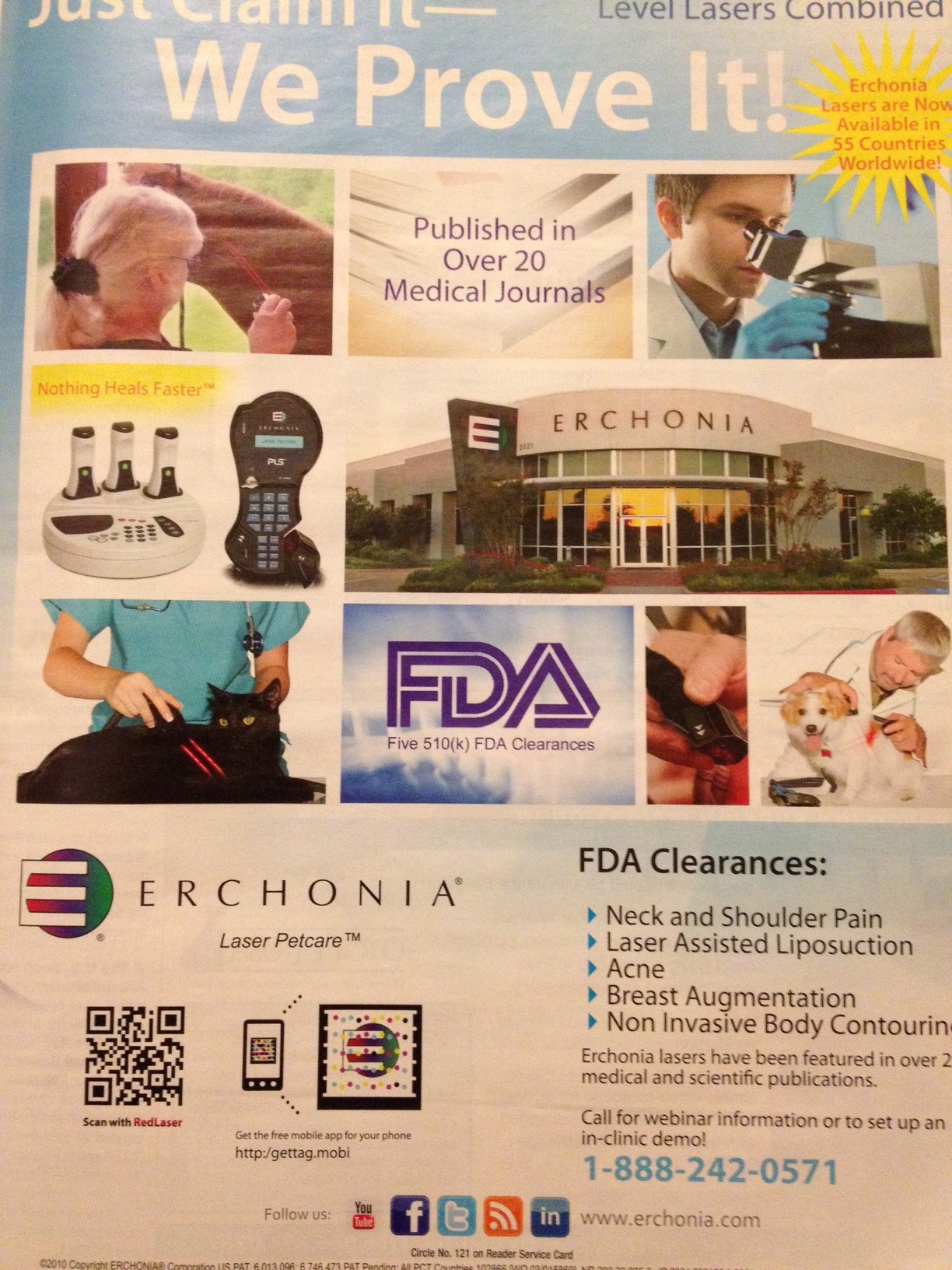
One company, however, did a really nice job however: Erchonica – who make cold lasers for wound therapy. They used both a standard QR Code and the Microsoft Tag which led to an optimized YouTube page with videos of Erchonica’s lasers in action. Very simple idea , and gave the reader something that they could not get with the printed page – video. Interestingly enough, another QR Code I scanned also took me to a YouTube page – however it had not been defined as a mobile page which seemed like significant missed opportunity. So nice job Erchonica – I even watched the video!

The rather nice implimentation of QR codes on the Erchonia ad in this month's Veterinary Practice News.

The bottom line of all this is that QR Codes can be a great little tool but are seriously misused. This hurts wide scale adoption and wastes a lot of time, energy, and money. As for the title of this post? I invite you to watch the great Scott Stratton, who is responsible for my current obsession with QR Codes, on the subject.

For those who do not use Twitter, you might not know about Friday Follows. The idea is that on Fridays, Twitter users recommend other Twitter users to follow.

It has fallen out of favor of late a little, the Twitterverse can be fickle, and I’ve never been a big believer anyway – preferring to retweet (repost others messages) on a regular basis. But it has always been nice to get one.

Yesterday, however, I got the best Friday Follow ever from Jim Dougherty who goes by the name @leaderswest on Twitter.

Jim’s Friday Follow took the form of a short – talking to camera – video, explaining to users why they should follow me, and others, on Twitter. The genius of the idea is that each subject gets their own short video making it very easy to view and share by the subject.

This is great content marketing.

Easy to consume, relevant, and selfless – which of course reflects very well on the content creator like all great content marketing. It would be interesting to see if all recommendations will eventually be like this: personal, short, and on video. It has certainly got my wheels turning considering just how effective I find the video below. Interestingly, Jim used Keek for this project. Keek is hoping to be video Twitter.

Please follow @leaderswest on Twitter, after you follow me!

Video Friday Follow about @mike_falconer from @leaderswest

(Keek's embedding does not work very well in WordPress yet - just click on the image to take you to Jim's Keek page and his video post about me!)

Well, what did you think?

Let me know in the comments and take a look at Jim’s other Friday Follows in the same page.

This week, I take pot shots at webinars and why I think they are a waste for speaker, and the virtual attendee.

Webinars, where a speaker presents over the Internet, at a predetermined time to an audience sitting at home or at their desks, have always seemed to be a classic example of having your cake and eating it too. By the way – that expression makes no sense whatsoever. If I’m having cake you better believe that I want to eat it!

Anyway, I digress…

The problem with webinars is that they have all the disadvantages of actually going to see someone speak, with none of the advantages. The timming of the webinar is decided by the speaker, or organizer. The transfer of information is limited to that timing window and whatever notes are issued.

From the speaker side, webinars offer the possibility of actual interaction with participants. However, because the interaction is one way, unless initiated by the viewer, the speaker has no idea as to how well the presentation is going and therefore how to tailor it to address potential issues.

I also cannot help shaking the notion that webinars are, for the most part, the lazy way out. If online delivery is what is required, let’s have proper content. Presentations that can be downloaded, shared, and watched again and again on the viewers schedule. YouTube, Slideshare, or even PowerPoint all make this very easy.

While saying all this, I do think there is great value in physical meetings and presentations- particularly for the conversations that happen before and after the meeting. Social media, is an excellent way of approximating this offline interaction of a physical meeting- online, but the realtime contraints of a webinar don’t really lend themselves to this interaction.

Plus, who doesn’t need more great content.

You build a marketing strategy, craft your brand, have a good grasp of your online identity, lots of likes and followers on the various social media platforms, and even have developed great connections to your local media…and then you do something really stupid that could potentially blow it all.

Nobody is perfect, and we all makes mistakes – I’ve made some doozers. But there is a real difference between making mistakes, admitting those mistakes and then trying to fix the problem, as opposed to declaring war on your customers and ultimately your own business.

Lets take this little Twitter gem for starters courtesy of the Daily Mail. A customer in your restaurant overhears a waiter being rude about another restaurant owner who the customer happens to know personally. Your customer is not to thrilled with the service already, and finds this behavior to be rather off, so they Tweet about it. What you do not do, as a restaurant owner, is call up from home, ask to speak to the customer in question, curse at them down the phone, and then demand they leave. That, however, is exactly what happened. In the ensuing Twitter onslaught, the restaurant came off far worse and created a massive (the restaurant is in Texas, the Daily Mail is a UK newspaper as an example) amount of negative publicity over a customer service issue. An apology, and a courtesy meal or bottle of wine, could have turned this incident into a minor win instead of this major fail.

Next up, the auto-body shop that after using a photographer’s work on their Facebook page without permission, proceeded to threaten and abuse the photographer on their own Facebook page for all to see. Needless to say, the page went viral over Twitter and Facebook. With the almost universally courteous, and intelligent, posts from supporters of the photographer, and gangsta inspired vitriol from the body shop it could only be seen as a massive marketing failure right in front of the businesses own 500+ fans. I believe the page is now been taken down as I can no longer find it, but if anyone knows if it is still up please drop me a line so I can share the link.

The Airbnb saga, has been done to death but is instructive because even very smart people can do really dumb things. The basic outline is that Airbnb is a service that allows homeowners to rent out a room on a short term basis like a hotel. Unfortunately, when an owner returned to find their apartment trashed, and their identity stolen, Airbnb basically stuck their heads in the sand and appeared to try and discredit the victim to stop her blogging about her experience. After a major backlash, Airbnb added safeguards, an insurance policy, and tried to do the right thing by the victim. But it could be too little too late considering their model is very easy to copy and already has a number of competitors. Most people had never even heard of Airbnb until this story exploded.

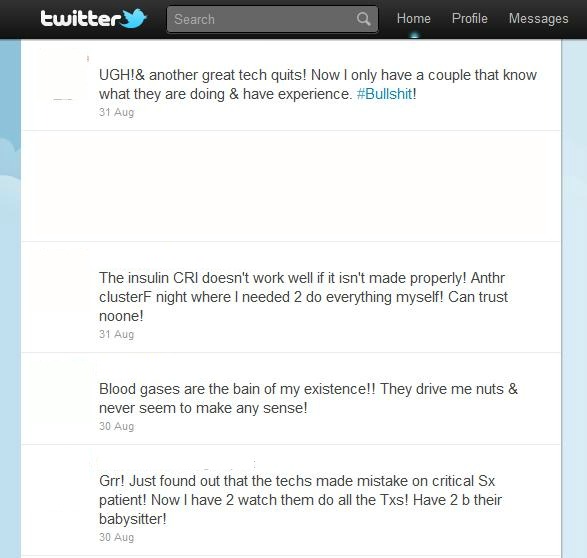
Finally, something a bit closer to home, how would you, or your staff, feel about having this tweeted from your hospital by a doctor, or about your pet?

Twitter vet image blanked out

Not only is this amazingly unprofessional, but all it will take is a single person to make the connection between hospital and Twitter account (the account does not identify the hospital, or the doctor, but I have still blanked out what is there in the interests of fairness) and this will become a huge problem. I’m sure it violates the hospital’s social media policy and I’m sure you could make an argument for it also being damaging to the profession to boot!

The bottom line is that your reputation and your brand are fragile. It is very easy for it to be damaged by just forgetting the basics of customer service. Never do anything, or say anything online, that you wouldn’t want on the front page of the paper or on a billboard. This is an age where it is easier to get your message out than ever before, but it is also just as easy for everyone else. And nothing travels, or goes viral, quite as well as scandal or bad news.

Does anyone have disastrous stories they would like to share or other examples they have seen online? Share with the rest of us in the comments!

Everyone wants good PR (public relations) or good press to put it simply. But how to get it?

The answer is actually really rather simple, and follows a lot of the same rules as social media and content marking: give your audience what it wants!

Your audience in this case is that odd mixture of reporter, editor, and reader. For the most part, in this blog post, I’m discussing newspapers and magazines. But the same rules generally apply to radio, television and web-based news sites.

Your Target

I often hear the complaint from businesses that it is impossible to get the major media interested in small business. It is not impossible, just hard. It is also making sure that you are targeting the right reporters, and right media outlets in the first place. Small local papers are much more likely to be interested in things that will affect the local community. Magazines, and in some cases television, are much more likely to be interested in “human interest” stories. Business journals, including industry specific magazines, are probably most interested in ideas or services that other business can use or learn from.

If you are a small business in a distinct community – as opposed to the big city – focus on your local newspaper or area paper. That might be a free weekly paper, or a daily traditional newspaper. If you are a major business for your community, it is quite possible that your reach will be greater and you can aim higher.

The Press Release

A press release is exactly what sounds like – a release of information to the press. They tend to be short, written in the third person (as if a reporter had written them) and should include quotes from key people involved as well and any and all information that might be considered pertinent to the reader. Remember this is about what a reporter, or editor, will think their readers will be interested in – not what you think is interesting. Long scientific diatribes filled with difficult to spell words are probably not going to work for the local free paper. A press release needs to be newsworthy, or it needs to comment on something that is newsworthy. If you can provide some background to a major story that is already being covered, you have an excellent excuse for a press release!

It is not the goal of a press release to have it reprinted in full – although that would be nice – but rather to give a reporter a jumping off point for their own article or to give additional information for something that they are already working on.

These days emailed press releases are the way to go – preferably with pictures. But don’t send gigantic photos through email. Attach medium sized images and link to high resolution ones.

The Pitch

Journalists are always looking for story ideas. If you have a good one, even if it is a little self serving, you can always call, email, or even write in miniature a “pitch” for how you imagine the story working. I’ve found that pitches work best when you can talk with the writer concerned and then email over some quotes for them to use. Pitches also work best if you can target a particular reporter. Read / watch / listen to your target media outlets and find out which reporters like writing about subjects that align with your interests. Perhaps there is a business reporter who writes about interesting business models. Perhaps another reporter likes writing about pets and animals – if you are a veterinarian that is probably someone you want to get acquainted with.

Information When They Need It

Over the years, the single biggest thing that has allowed me to get great press is the simple act of returning phone calls and responding when I’m asked. A reporter calls up on a busy day and wants to interview someone about the dangers pets face during the holiday season – that reporters request is now my number one priority. I might give that interview myself, email some quotes over or drag a veterinarian out of what they are doing for five minutes, but I will get that reporter what they are asking for. The simple truth is that reporters work to deadlines and simply don’t have the time to mess around and wait for a couple of days for you to get back to them. Most newspaper articles are written that day for the following days paper or maybe the following day of you are lucky. If you respond, the chances are they will call back the next time they need something because they know you’ll work with them and not let them down.

I’ve actually had letters to the editor, in a local paper, complaining that my hospital was always in the paper and what was the connection between the two businesses. I was in the paper, because I would issue press releases when I had news, and I was always respond when asked. Reporters know that the exposure from a newspaper article is important, so they are not going to beg for your input.

Bad Press

If you talk to the press there is a chance of bad publicity. And if you don’t talk to the press there is a chance of bad publicity. There is some merit in the idea that by making yourself more visible, you become more of a target and it is easier for reporters to inquire about something that you would just as rather they forget. However, any reporter worth their salt is going to chase a story down that involves issues or problems, because that is what sells papers and other media.

I’ve found that, on the whole, local media are pretty good about sorting out the normal disputes that occur with all businesses from time-to-time with the real stories that might have “legs.” Having good relations with your local media will not insulate you from bad press, and reporters will bristle at even if inference that it might, but decent relationships will make it easier to get your point across.

Never, under any circumstances, use the words “no-comment.” It sounds awful, and just makes reporters much more interested, because if you are saying no comment that means you don’t want to talk about something that is probably very interesting. Simple, straight forward, and above all short answers to questions are your best defense when being asked about something you’d rather they didn’t. If you genuinely don’t know, say; “I don’t know at the moment, but I’ll be more than happy to find that out for you.” or “Let me put you in touch with someone who can answer that better than I can.” Of course, make sure that you get back to them, because if you don’t now you’ve just made them mad.

And I hope it goes without saying that nothing is ever off the record, even when it is.

Crisis

Crisis management is really beyond the scope of this blog post, but I wanted to briefly touch on it as it really an extension of bad press. When a crisis, that involves the press, happens it is important to get out in front of it – just like with any bad press. No waffling – either in terms of your response or your statements. Don’t hide – it is very easy to feel like the world is collapsing around you, but the media are going to report something and it should be that you are dealing with the situation – not that you are holed up and not speaking. It is far better to give to much away too soon, to try and defuse a crisis, than to give away too little and have to increase it later after the press have had a field day with your reputation.

Toyota’s handling of their recall is often help up as a prime example of doing too little at first. In the end, Toyota were able to recover but only by doing what they should have done in the first place and untold damage to their brand in the process.

The media will always find you should problems occur in your business that they deem to be newsworthy. Building bridges to the media, however, will allow you to open a dialog for both good and bad news. The media can definitely be your friend, and for the most part, they are not looking to be your enemy – so why not create those relationships to help build your business?

Have had good or bad experiences with the press? Have you had crises that you have been able to handle well? Let me know in the comments section I’d love to hear from you!  

Next Week: Please don’t do this…

(Click on the image above to view the book on Amazon!)
With possibly the longest subtitle ever: “Move your business forward through the convergence of search, social & content marketing,” Accelerate! cannot be accused of false advertising.

Quiet simply, Accelerate is a blueprint for successfully using 21st century tools for small business online marketing. Written by Arnie Kuenn, the president of Vertical Measures in Phoenix, and a co-founder of the Arizona Interactive Marketing Association; Mr. Kuenn certainly knows his stuff. In fact, it is one of the few criticism of the book that I have, is that it gets a little dense at times, particularly early on. The Search Engine Optimization (SEO) section while being very detailed gets to be a little much and will require a couple of readings for all but the most experienced of readers. However, the style does settle down, and it would be a mistake to give up on the book as and what you are left with in the end is, a user friendly handbook for search, social media, and content marketing.

The book covers all the major players as you might expect; Facebook, Twitter, LinkedIn and Google; but is also covers a lot of the less mainstream sites. Accelerate! plucks a number online tools out from the magic geek SEO toolbox to help with almost every aspect of the radical overhaul of your marketing strategy that will undoubtedly unfold once you have finished the book. I myself, am already looking carefully at how I put posts together for my site and have joined a number of social bookmarking sites directly because of this book.

A self published book, also available in a Kindle edition, I was initially concerned about the physical binding on Accelerate! I’ve had problems in the past with the spines of self published books cracking and then loosing pages after a single reading. I’m happy to report that this is not the case with Accelerate! I did take care not to be too absusive to the spine, but i needn’t have worried, the book is in great shape and looks the same as when it arrived.

I mention the self publishing issue, not just because of quality, but also because the text of the book directly references it as well. With a subject such as search and social media marketing, it is easy to get very out of date very quickly – Google+, for example, is not mentioned once. As the text explains, being a self published book, in addition to being an E-book, allows for easier updates than traditional publishing. I, for one, hope we do get new editions on a fairly regular basis, because this a great resource and one I know I will be referring to for quite some time. In fact, I found it quite odd to see URLs in the footnotes and be unable to click on them – should have got the Kindle version!

Mr. Kuenn’s book will not tell you how to brand and create a marketing strategy for your business – hopefully that is why you read my blog! What Accelerate! will do, however, is tell you how to navigate the waters of the increasingly complex world of search, social media, and content marketing. This still might not mean that you still don’t need to hire someone of Mr. Kuenn’s caliber, or the man himself, to work with you on these magic things. But if you do you’ll at least know what they are talking about and why.

If you want to get serious about search, social media and content marketing, you need to buy this book – it does what is says on the cover!

(Clicking on the cover above will take you to the book’s Amazon page and contribute to my book buying habit / problem.)

(Click on the image above to download the book from Amazon!)

Being, essentially, 128 pages long (the appendix takes it up to 163 pages) and a free download it would be difficult to complain too much about the e-book: “Winning the Zero Moment of Truth.” Luckily you really don’t have to, as it makes for an engaging, and brief, read. It also has the potential to become an important work for those of us who care about marketing our businesses and the tools that we use to achieve that.

The Zero Moment of Truth is an attempt to update a model, first coined by Procter and Gamble in 2005, used to describe the marketing’s effect on the consumer. The model goes something like this: Stimulus; in the form of an advertisement, First Moment of Truth; when the consumer sees the product on the shelf in the store, and Second Moment of Truth; when the customer experiences the product they have bought. Although the terms were coined in the 21st century, the concept would be understood by a character on the TV show Mad Men. Zero Moment of Truth is an attempt to explain and define how search, and social media, has changed our buying and consuming habits as now there is now an additional step to this marketing model. This additional step is that advertising is now prodding us, the consumer, to research, ask our friends, and ask even complete strangers, about the product online before we get anywhere near the store or an e-commerce site.

Inter-spaced with video introductions to each chapter by marketers and search professionals, the book neatly dissects what the Zero Moment of Truth means for all of us – including consumers. It particularly, has no time for manufacturers who feel that their product does not generate the interest for social media – I wish my business had as many fans as “Bounce dryer sheets” to give you an example!

Another, potentially even more important, concept in the book is the idea that customers do not talk about bad experiences online. Obviously, it is not always the case, but Mr. Lecinski puts forward a compelling case that in the majority of circumstances, clients want to give good reviews far more than they want to give bad ones – preferring to forget about bad experiences. This being the case, the book argues, that unless you have a serious problem in your business (and you’d probably want to know about it if you did) reviews and comments are a chance to engage your clients and should not be ignored.

Since Mr. Lecinski is managing director, U.S. Sales & Service, for Google a book that extolls the virtues of search and reviews (Google places anyone?) could be seen as a little self-serving. This is probably fair, but it does not make anything that is said in the book any more relevant and important. Although, it does have to be said that the lack of mentions of Facebook (mentioned five times) and Twitter (mentioned twice) can be a bit jarring when compared to Google (mentioned 72 times). This is a minor gripe, however, and a great book from a very clever marketer.

I do, however, have a major gripe about this book and others of its ilk.

I read a lot, and when I do I listen to music – like I imagine most people do. Adding video into the mix is a logical extension of the e-book medium and I think it has a place – particularly in a book such as this – is logical. The problem with video content in books, however, is when the producers decide that they have to add background music as they would if they were producing a spot for television. Some basic understanding of the way your product is being consumed please people! I don’t want to have to mute what I’m listening to at the start of each chapter just so I can listen to someone speak!

This is still a very good book and well worth your time even if you never watch the videos – which I suggest you do – just remember to keep the remote for the music handy.

So Facebook and Twitter, which we looked at last week, are now part of your lexicon, what now?

There are other social media tools out there which can be of significant benefit. For Business to Client (B2C) businesses such as veterinarians, Facebook and Twitter are the ones to be using. However, having a strategy for some of the other sites can set you apart from your competitors and provide some interesting opportunities.

Foursquare

A personal favorite of mine, Foursquare is a location based social media tool with game elements. What does all that mean? Well, Foursquare allows users to “Check-in” to businesses and other venues using their smart phone’s GPS functionality. By “Checking-in,” users of the service let friends, via the service itself or by sharing on Facebook and / or Twitter. know where they are and why they are there. The game element comes from trying to rack up the most check-ins, and there by points and “badges,” than your friends. Users of the service can also compete with strangers for the title of “Mayor” of businesses or locations. The Mayor title does not mean anything other than bragging rights and more points when checking in. Badges can sometimes be difficult to get and so the competition can drive behavior. An example of this is the “Gym Rat” badge, that can only be achieved by checking in at a gym 10 times in 30 days.

Foursquare Badges

A selection of Foursquare badges

 Businesses can offer specials to Foursquare users when they check-in. Chilli’s, for example, offers free chips and salsa to anyone checking in on Foursquare – customers just show their smart phone to their server. Businesses may also reward the mayor of their business, making the title more coveted and therefore create competition around their brand.

 The grand theory of Foursquare is that it creates loyalty. If users have a choice between two businesses, one of whom there trying to become mayor of, they will choose that business or one is running a special for Foursquare users. Users of Foursquare can also leave tips, good and bad, about locations helping other users to choose where they might want to eat – for example. Because it is location based, it only offers places that are nearby, and allows the user to filter the results by type. This solves the information overload that can occur if smart phone users just trying to use Google.

Foursquare definitely has the potential to create a community of loyal users, and it has personal benefits (I use it to help keep track of my expenses!) However, the user base is small compared to other social media sites – particularly outside of major metropolitan areas. There are a number of other competitors in the location based world, the largest of whom is Facebook Places. The advantage of Facebook places is that it is part of Facebook, but it lacks a lot of the game elements that makes Foursquare fun and does not have the same controls on sharing.

Foursquare and other location based services have come under fire for the potential safety implications of letting your social media “friends” know where you are. This has been way overblown and as long as users are sensible, not creating a venue called “home” and checking into it for example, location based services will be around for a long time to come.

LinkedIn

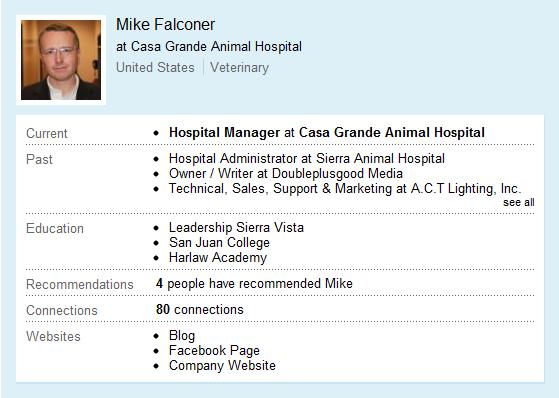
LinkedIn, is often called the professional Facebook and with good reason. Like Facebook, LinkedIn revolves around a profile. The difference is that your LinkedIn profile is essentially your resume. You can find mine here. Users of LinkedIn can then make connections with current, and former, colleagues to create a network. It is then possible to reach out to colleagues of colleagues more easily because you know which of your network knows them. LinkedIn has an introduction feature specifically for this. It is also possible to recommend, and get recommend, which also then appears on your profile.

Mike's LinkedIn Profile

Part of my LinkedIn Profile

Groups on LinkedIn are pretty much just like other web forums, but by being directly in LinkedIn it is possible to be a member of large numbers of different groups, on different subjects, without having to login to multiple sites. The additional functionality of being able to make connections that can help you professionally in the real world is obvious.

 A questions section does pretty much what you’d expect – allows for users to post questions and then other users to answer them. The advantage that LinkedIn has over other sites with a similar model, such as Quora, is that you are able to research the person giving the answer to see whether they know what they are talking about. You also then have a mechanism for connecting with them.

 A recent, and extremely innovative feature from LinkedIn has been news. This allows users to browse and share news items with their connections based on popularity within professional categories. It also allows users to share these news stories via Twitter – expanding the reach of your network yet again.

 LinkedIn does allow companies to have their own profiles, a bit like pages on Facebook, and this is interesting from a recruitment perspective. Groups are also being used successfully for recruitment and many feature a jobs section. LinkedIn also recently launched an “apply via LinkedIn” button that can be used for online job postings outside of the main LinkedIn site.

LinkedIn is a business to business tool (B2B), rather than the B2C tool that Facebook, Foursquare, and Twitter can be; however, don’t be surprised if LinkedIn does not become more and more a factor in recruitment of even minor posts in organizations. LinkedIn does have many issues (their mobile app is hopeless for anything other than news for example), but is a great professional tool for anyone interested in their career, or profession.

YouTube

YouTube is the video sharing site on the web and although being social it not at its core, it is still social media. Users uploaded material which they, and other users, can then share and comment on. Users can even create their own channels of material making it easier for other users to find similar videos. YouTube also has a number of great tools allowing you to embed a video directly into a website or blog. Video dramatically increases your website’s visibility to search engines, like Google and clients love it – a win all round!

Where YouTube really comes into its own, however, is that it is very easy for a video to go viral – spread around the internet like a virus. Of course, the video has to have some kind of merit; be funny, very dramatic, or even just be very bad, but if your brand is attached to this video it can be great publicity or almost zero cost. For example, it is not unusual for clips of TV shows on YouTube to have dramatically higher ratings that on the channels they were produced for!

Above is a great example of a viral pet video – 10 1/2 million views as of this writing and massive mainstream media attention for Denver’s owners. All from a video shot upon getting home and finding someone got into the cat treats!

 A great test of YouTube’s power is to pick any subject you like and search for a video on it at YouTube. Your are almost guaranteed that someone has shot and posted a video on that very subject. Thank you Corey for showing me this!

 Video production is really outside the realm of this already overly long post, but it is simple, very low cost and an extremely effective way to market your business.

Some of these social media tools may appeal to you, and other may not. There is definitely a take it or leave it feel to the services that we have talked about today but it is important to understand that to not be involved in social media, particularly Facebook, Twitter and to an extent Foursquare does not mean that your brand and business are not affected by these mediums. Your clients are using these tools and so might your competitors you should at least have an awareness of what is being said and why. The genie is out of the bottle and without getting involved, it is possible for you to loose influence over your brand – the control probably went some time ago as it is now the customer who ultimately defines what your brand means.

Next week, a change of pace: Up to your neck in traditional media!