Archives for category: Veterinary

In this ongoing, and occasional, series I discuss the process of learning to be a manager. Since my background is for the most part in the veterinary field we will mostly focus on the peculiarities of that industry; however, the majority of points made here are transferable to other professions / industries.

In the previous post, we looked at the initial steps in becoming a new manager. In this post we look at potential areas of responsibility.

New managers, or rather managers who are new to managing, can face a couple of dilemmas in their first few days in the job. The unlucky ones face both!

The first is being overwhelmed by all the areas of responsibility that have now landed squarely upon your shoulders. The second is not knowing what your responsibilities actually are, and therefore, not really knowing what your job is.

Take a deep breath and relax.

The first is easy – you will be overwhelmed, you will always be overwhelmed. It is the middle name of all managers. Split your days up, as much as you can, by focusing on different areas each day (see below), and prioritize.

The second is also easy – the buck stops with you. If it doesn’t, then you need to act like it does unless instructed to by your owner, or a more senior manager. You may not know anything about Information Technology (I.T.) other than it is a fancy term for computers. But if the computers are not working then you are the one responsible and in all likelihood fixing them or calling the person who can.

I have identified a number of areas that managers may, or may not, be responsible for. Depending on your particular circumstance, some of these will not apply, or you may share the responsibility with another person. If nobody is looking after that area then guess what? That area is now your responsibility.

We will look some of these areas in more depth in future posts, but for now, welcome to your new world…

The Building

I have worked in buildings that are over 100 years old and in buildings that are brand new and they all had one thing in common: things always break down, never worked properly, or need upgrading. In other words buildings, and the equipment inside them, need looking after. Few things can grind a business to a halt as quickly as a building problem. Having no water, no electricity, or no access to your building, means that in very short order you are closed. This does not mean that you have to understand plumbing, electricity, how quickly concrete sets, or the basics of I.T. (however a little knowledge is very useful) but it does mean you need to work closely with those that do and ensure that you trust them. You do also have to listen to them, and not just hear what you want to hear. They know nothing about veterinary medicine, for example, so they know more about their field than you do.

Staff

We are going to cover managing people in a future post; however, it is important to note that the staff look to you to be there for them. Remember the only stupid question is the one not asked and communication can never be a bad thing. So encourage the staff to talk to you.

H.R.

Human Resources (or H.R.) is the general catchall term given to the hiring, firing, benefits, coaching, and disciplining of employees. It is usually a job that requires a lot of paperwork and attention to detail. Depending on your circumstances, H.R. can make up a significant proportion of your time and it can also land you in hot water if handled incorrectly. I consult colleagues regarding H.R. issues more than any other subject.

Payroll can also sometimes fall under H.R. although this may be more of a support roll to either an outside company or in-house accountant. If you do find yourself handling payroll in its entirety and you do not know what you are doing – STOP! There are computer programs, companies, and accountants who can all help with this. Nothing will undermine you quicker than getting payroll disastrously wrong. 

Belonging to an organization such as your local SHRM (The Society for Human Resource Management) chapter is also a great way to get tips, C.E. and to build a support network in what in itself can be an overwhelming area of the manager’s responsibilities.

 Financial

You don’t need to be an accountant to have a significant interest and impact on the financial management of your business. The days takings need to be reconciled and deposited with the bank. Credit cards need to reconciled both daily and monthly when the statements come in. If they are not already in place, controls need to be developed so that nobody, including you, has too much access and unsupervised control over any financial area. Bills need paid, money put aside for taxes and payroll, but an eye also need to be kept on how the business is doing. Are we doing better than last year or worse? Not are we busier, but is more money coming in the door?

Marketing

I’ve covered starting a marketing program in this series of posts; however it is important to remember that marketing can be as simple as making sure that your opening hours are correct on the front door and, for a veterinary hospital, that your vaccine and appointment reminders are going out.

Inventory

Supplies need to be ordered, expired stock needs to be removed / returned, and checks and balances need to be put in place so that pilfering can be noticed and stopped.

Safety

Safety is more than making sure that all of OSHA’s boxes are ticked. Although this in itself can be a monumental task depending on where you are starting from. Being responsible of the safety of the employees, and your clients, means that you have to be the bad guy. It is not enough to tell staff to wear the proper Personal Protective Equipment (PPE) you are now responsible for ensuring that they do.

San Juan College have a great presentation on OSHA and the veterinary practice that forms part of their Veterinary Technician program – well worth checking out.

Scheduling

Even if you do not handle the mechanics of your hospital’s schedule, you may well have to give guidance as to staffing levels and when is a good time to give vacation time and when is not – for example. It may not be your fault that you do not have enough staff on a busy day or time of year but it is your responsibility.

Regulatory Compliance

Taking a critical eye to a practice, or any business for that matter, and ensuring that things are being done in a correct and legal way can be a seriously challenging task. This is particularly true when you may be asking people to change how they have done things for a significant period of time. However, it is part of the job and is one of the areas where getting it wrong can have significant consequences for both the business and you personally.

State Veterinary and Pharmacy boards vary widely in how helpful they are in response to questions about interpretation, but as a rule it never hurts to ask.  Certainly reading the practice acts that govern your state is a great start and reaching out to other managers through a local organization as we discussed in the last post will also be extremely useful.

Clients

All businesses are ultimately about clients. You can have the best veterinary practice in the world but without client’s you’ll close. Ensuring that they are looked after and that they have a great experience at your facility is outside the remit of this post; however, it is part of yours as manager. If you want a starting point take a look at this earlier post of mine about getting the basics right.

Managers can have an extremely wide, and challenging, portfolio of responsibilities. The most challenging ones; however, are the ones you don’t know about.

Remember, the buck stops with you. 

Did I miss anything? Let me know in the comments!

For those looking for more on being an existing manager and starting a new position, this may be for you.

Additional Resources:

Be Safe! Manager's Guide to Veterinary Safety by Philip J. Seibert, Jr. CVT

Click on the image to take you to the AAHA Press page for this book.

It is hard to beat Philip J. Seibert, Jr. CVT when it comes to putting together an OSHA program and this single volume, Be Safe! Manager’s Guide to Veterinary Safety which I reviewed here, although pricey is a great place to start your program.

Just like Phil is hard to beat when it comes to safety, it is hard to beat Scott Stratten when it comes to customer service. I strongly suggest seeking Scott out on YouTube; but for those of you who might like the written word The Book of Business Awesome / The Book of Business UnAwesome is for you and my review is here.  

As always, clicking on the pictures will take you to Amazon and where Amazon may give me a tiny percentage to help my book buying habit.

This year’s Western Veterinary Conference, in my adopted home town of Las Vegas, is a great time to catch up with old friends, former colleagues, and new friends who I had only met online.

One of the conversations that I had over a very nice dinner, was with a former colleague wanting to know about my world – the world of practice management – and how to start down that path.

This was more difficult than I imagined – mostly because my own route into office management / practice management / hospital administration was so accidental. I therefore thought; “there is a good idea for a series of blog posts if ever I heard one,” and so here we are!

Because my world is the world of veterinary medicine and practice management this series will concentrate mostly there. However, it is my hope that this series, much like my blog in general, will also work for anyone in a relatively small business looking to move from the trenches into management.

A Brief Recap

Before entering the world of veterinary medicine I had a very successful career in the world of entertainment lighting (theater, television, events, etc.). Within that pretty specialized and small world I worked in London’s West End as an electrician, a Company Manager (someone who corals actors and worries about when the show is going to close), a touring production manager, a console programmer and operator, sales and technical support for lighting suppliers, marketing of lighting products, and ultimately an industry writer and commentator.

After being in the industry for almost 20 years I decided I wanted a compete change. I moved to Arizona and took a job in a tiny veterinary clinic to keep myself busy, feed my DVD habit, and allow me time to figure out what I wanted to be when I grew up.

I really enjoyed working in a veterinary hospital and it seemed I was well liked there too by both the doctor and the other staff. When the office manager announced that she was moving, on a few months after I had arrived, my name was suggested as a possible replacement. The rest, as the very overused saying goes, is history.

I knew a little about veterinary medicine, some things about people management, not near as much as I would have liked about financial matters, and almost nothing about human resources. I did know about marketing and customer service, and I knew what I hated about going to the vet with my dogs. Mine in not a path I would recommend for everyone, and I made a lot of mistakes. However, I feel I have been at this long enough that I have some insights about getting to where I am and how others can get there too. If they want to!

Terminology

One of the things that is very annoying about my job, is that I am routinely described by titles other than the one on my business card and employment agreement.

Officer Manager

The generally accepted definition of an office manger is of a reception supervisor who also may handle scheduling and other areas such as accounts receivable. More than a lead receptionist in other words, but less than a practice manager.

Practice Manager

A Practice Manager oversees all the areas of hospital in addition to reception, may also handle payroll and other human resource functions.

Hospital Administrator

The job of a hospital administrator is one of having overall finacial and management responsibility for all areas of the the whole hospital, with the direction and supervision of the owners.It may also include all the functions of an office manager and practice manager. They will be involved in the hiring process for doctors and may also have supervisory responsibilities over them. There will also be a significant strategic and planning element to their function.

In all likelihood, managers start as office managers and then progress to practice management and then hospital administration. There is not right or wrong way, however, as long as the needed skills and / or experience are there. It should also be noted that all hospitals are different. I have effectively been a hospital administrator at three different practices and my job and responsibilities has been different at each.

Education

I am a big believer in education. That might sound strange coming from someone who hates actually taking classes themselves and does not have a degree. The bottom line is that your life will be easier with a degree and more doors will open with an MBA. Trust me I know from experience. It is not impossible to be successful without those things it is just harder. If you are planning on learning a lot of new skills, whether as DVM interested in practice ownership, or a technician or receptionist looking to get into managment, you may as well get some letters after your name for the effort.

Becoming a Certified Veterinary Practice Manager (CVPM) is a qualification designed for the job at hand. Several times I have considered getting the qualification myself. If you are having problems as a new practice manager, or making the move from office management to practice management, this qualification is for you.

If formal education is not an option, or just not you, then CE, CE, CE. Continuing education wherever you can get it: online, locally or nationally. It all helps. Speaking of which…

Get Help

I would not be the Hospital Administrator I am now, and would not have the career that I have had, if it was not for my local hospital managers association whose meetings I attended every month while I was in Arizona. Being able to meet with other mangers, find common ground, and being able to talk issues out that you might be having was incredibly useful. If you don’t have a local managers group look for other business groups, including the chamber of commerce, that might be able to help support you. It is a cliche but still true – it really is lonely at the top.

Resources

Throughout this series I plan to give some reading suggestions. The two books below tackle the difficult issues of enthusing others about your ideas, and how to make things change. One of my current favorite sayings that keeps rattling around in my head is “As a manager it does not matter how good your ideas are; it is your ability to implement them that matters.”

I have reviewed both these books before and other than providing a very basic introduction I have just provided links to the reviews. As always, clicking on the pictures will take you to Amazon and where Amazon may give me a tiny percentage to help my book buying habit.

“Made to Stick – Why Some Ideas Survive and Others Die” by Chip & Dan Heath

The title pretty much says it all: not all ideas are created equal and how we present things can have a dramatic impact on whether ideas take hold or not. You can read more here.

“Switch – How to Change Things when Change is Hard” by Chip Heath & Dan Heath

You’ll note that both these books are written by the same pair of authors and therefore they work perfectly together as the two sides to the same coin. You can read more here. These books are, at their core, about the nature of communication. If you can’t communicate as a manager then you can’t manage.

For those who are looking to get into management I’d love to hear from you, and for those who are already there I’d love to hear how you got there. Comment away!

Next Time – Part 2: Time to Focus

I had been a big believer in Yelp and the review site model: treat your customers well and they will reward you. I have also had little time for the Yelp haters: “Stop complaining about Yelp and work on your business.”

Well that is what I used to think and then I saw the real, ugly side, of Yelp. Forbes, PBS, and the New York Times seem to agree.

As a rule, the larger the business, the more clients you have, and therefore the more chance that you are not going to be able to keep them all happy. That is not to say that you should not try, but there is always that reality.

In the veterinary world, there is a great product called Vsurv that allows for electronic surveys to be sent out to clients who visit your practice. It plugs straight into practice management software. The great thing out surveying every client for whom you have an email address, as Vsurv does, is that to gives you real data for client satisfaction. Data that you can track from month to month. Even with a 50% – 60% compliance rate you are still talking about hundreds of responses. If I have 30 online reviews 10 of which are filtered (more on that later) but I see 100 – 150 clients a day the online review numbers add up to the statistical error rate of direct surveying.

So a product like Vsurv is better than online review sites. Then what about Yelp?
Well the big problem with Yelp is its review filter. What’s Yelp’s review filter you ask? Well you wouldn’t be alone in not knowing much about it. Unless you run a Yelp page you probably don’t know about the filter, and many who do run pages don’t know about it until they get bitten by it.

Yelp’s review filter is supposed to protect the integrity of Yelps reviews by filtering out suspicious reviews: Overly positive reviews by users that have only one or a couple of business reviews or overly negative reviews by the same kind of user. A least that is the idea…

The problem is that the criteria that Yelp uses to filter it’s reviews is a closely guarded secret – supposedly to avoid businesses “gaming” the system. The filter is supposedly “automatic” and therefore is not influenced by petty concerns such as advertiser preference. However, individual users, and businesses have no recourse to un-filter filtered reviews.

To add to the problems, consistent reports exist of Yelp filtering only good reviews and leaving only bad reviews after the business concerned refuses to advertise with Yelp. I personally have seen a negative review get filtered and then miraculously become unfiltered – not sure how an automatic filter changes its mind but apparently it can.

You can even read the filtered reviews – and it is quite amazing how different a picture of most businesses you can gather by reading the filtered reviews. Yelp only allows access to filtered reviews via a Captcha – why? To make it more difficult to link to? It is quite an experience to see 15 filtered reviews 13 of which are positive that have basically the same user profile as the six recent negative reviews that have not been filtered.

Then, of course, are the online reputation management companies that promise to get bad online reviews removed from Google, Yelp, and other online review sites. All the major review sites say that the only way to remove reviews is with the same tools that everyone has access to – flagging in other words. There is, however, another way – the reviews themselves have been created by a reputation company which can work “miracles” by removing review that they themselves have posted. On a couple of occasions now, I have seen very odd reviews appear and then been approached by some of the more unscrupulous types of Online reputation managers who say that they can work “miracles.” This issue has been addressed by Yelp, but only in the broadest of sense.

The real issue with Yelp; however, is that is does not practice what it preaches. Concentrate on customer service and customers will give you great reviews. So what does is say when so many potential customers feel that the Yelp system is fundamentally flawed and refuses to engage them on the subject? Yelp encourages businesses to respond to negative reviews however provides no mechanism to challenge its filter. Yelps does provide a flagging system, but no feedback on why it does or does not agree with the business owner flagging the review in question. Yelp also refuses to engage with clients about the review side and will only engage about advertising.

I, for one, do not actually believe that Yelp is trying to extort business owners as some charge. I do, however, feel that the product and company is flawed.

The word from Yelp seems to be do what what say – not what we do.

I’m not a big believer in that.

There is a bad joke / semi serious statement amongst veterinary practice managers; “no good deed goes unpunished.” And while I see the reality in this, and have even said it few times, I ultimately do not subscribe to the point of view. What is wrong with being nice?

I get it, I really do, being nice is hard. But being polite and showing respect for your peers,  those you interact with, those who report to you and those you report to is not only the right thing to do, it is in your interest.

Since being a manager, and someone who hires and fires, I have always been shocked at those who felt that just not turning up for work, and refusing to communicate was an acceptable way to hand in one’s notice. Despite the obvious impoliteness and unprofessional behavior of leaving your co-workers in the lurch, there is the added inconsideration of those who feel at least partially responsibility for your well-being. Stories abound, and I have personal experience of, employees with limited family in serious trouble at home which is only discovered when an employer starts inquiring after their well-being after they fail to show up for work. I never even considered doing this, and I’ve seen this behavior from young and old so the generational clichés don’t offer any answers.

As I discussed in another post, the superstar employee who feels they are above the general rules of behavior in the workplace is another example of a failure to be nice. I don’t have a lot of sympathy for this kind of behavior and generally find it to be counterproductive – the exceptions being just that and not proving anything.

And then there is the Dunkin Doughnuts Lady…

The following video is pretty offensive but it does prove a point. A customer feeling that they have been wronged videos herself claiming free food from the day shift of a Dunkin Doughnuts  after she feels her receipt was not given to her in a timely manner the night before. While all the time informing anyone who will listen that she is filming the encounter, and that she is going to post it on Facebook, she delivers an avalanche of racial slurs, abuse, and is generally obnoxious. The employees, to their extreme credit, keep their cool, try to make the customer happy, and are professional throughout despite extreme provocation.

(WARNING: THIS VIDEO CONTAINS VERY OFFENSIVE LANGUAGE )

The story of the video however, does not end with the video. After being posted online last week it went viral, but not in the way that the original poster had hoped. A tirade of negative comments about the behavior of the customer led her to delete her Facebook account and one can only imagine the personal repercussions – the least of which is finding out that the majority of people do not think the way she does.

This incident also shows of the worst side of social media, where someone tries to leverage it for their own ends and as a shield for their own bad behavior or sense of being wronged. This can also be called the Yelp Effect. I am not a Yelp hater, but I do think it is a flawed system and one that rewards bad behavior from both businesses and customers with little recourse. The Better Business Bureau had its flaws but at least there was an attempt a resolution.

In the veterinary world, an often heard phrase is “you don’t care about animals” often paired with “it is all about the money.” Although uttered by people in difficult circumstances, and born out of frustration, it is still extremely hurtful for anyone who has choose to make their career working with animals and has caused more than a few sleepless nights for a lot of deeply caring people.

We all have difficult customers, employees, and colleagues – it is how we deal with them that counts and makes a difference from one business or organization to the next.  The bottom line is that doing the right thing, being polite, professional and, I guess for want of a better word nice, is the only way to behave for your interest and for everyone else. It is the only way to guarantee that things will not get worse.

And you never know, it might rub off on to someone else.

Over the years I have, and continue to, hire a lot of people.

Due to my own personal preference I also tend to interview a lot.

I work in the veterinary profession. Which is one of those professions that many people feel they would like to try even though the reality is sometimes not all that it is cracked up to be.

The obvious extension of this is that I see a lot resumes, applications, and applicants.

Some are excellent.

Some are bad.

Some are just not right.

And some make such basic mistakes that it overshadows everything else.

So for those on a on job hunt, or starting on the career ladder, here are my top eight tips.

1: Read the job posting!

If the job posting says no phone calls, that means no phone calls.

It is not unusual for companies to receive hundreds of applications. For small businesses, receiving hundreds of phone calls checking the status of applications can be a serious burden. I know a lot of employers, myself included, who automatically disqualify applicants who call when the job posting specifically says not to. It indicates that the applicant has not read the posting or can’t follow written instructions. Don’t be that person!

If the job posting says you need a license, or some kind qualification, that is generally not negotiable. If you still think you are right for the job make sure that you address the fact that you do it have the right license / qualification in your application letter. This shows that you have read and understood the job posting. It does, of course, not guarantee that you’ll even get an interview – but it should stop automatic disqualification for not reading the posting properly.

2: Your résumé should be the right length for the information you wish to present.

There is nothing worse than a two or three page resume squeezed into one page. It is almost impossible to read. Likewise a one page resume stretched to fill two or three pages just wastes time, paper, and shows that the applicant is trying to be something they are not.

3: Fill out an application if asked.

If you are asked to fill out an application, even if you have a resume and letter of application, fill out the application! Yes, it is double work and it may not present yourself in the way you wish to be presented, but that is normally the point and it is what your potential future employer wants – so start off on the right foot.

4: Be contactable. Be professional.

Your phone number must be right, you must have voicemail, and you should check it at least daily.

The same goes for email.

Take a good long hard look at both your email address and the message you have on your voicemail. You might want a funny message on your voicemail for your friends – but potential employers will not be impressed. Likewise, if your email address can say a lot about you. But if it says any thing other than your name, it probably does not say anything good. Email addresses are generally free, so make them professional.

5: Dress for Success – what to wear to an interview.

My personal take is that you should dress at least one level above the person you are meeting. How can you tell what they will be dressed like? Look at the website! If the person interviewing you is in scrubs then business casual will be fine. If they are wearing business casual, then you should probably be wearing a tie. If they are wearing a tie you should probably be wearing a suit.

Please remember that business casual does to mean what you would wear for a night on the town.

If you have tattoos or piercings and you are prepared to take them out / cover them up for work then do so. Some employers don’t care about such things, but many do.

Flip flops, jeans, revealing attire, and aggressive piercings are all inappropriate for almost all interviews.

6: Honest is the Best Policy.

If you have things in your past that you are not too proud of, or if there are holes in your résumé, be honest about them. Being open and honest may be looked on positively. Trying to hide things or lying is always looked on badly.

7: Working Interviews

Many Veterinary practices use working interviews as a way of ensuring that new employees have the appropriate skills and are a good fit. If you are asked to take part in one, it is important to remember that this is your chance to shine. However, many practices have rules about what you can and can’t do on a working interview. It is never wrong to ask, but it can be very wrong to assume.

8: Getting Turned Down

Don’t take not getting a job personally. If you never get called for an interview for your dream job the worst thing you can do it call up and berate a potential employer. Likewise don’t be too pushy about why you haven’t heard back. A simple email thank you for the interview and the chance to meet is a simple professional way to say that you are interested without intruding on the employers timeline for hiring. It is a rare employer indeed, who looses the application and all the contact details for some one they want to hire.

Getting a job is hard. Don’t make it harder on yourself.

No employer has ever said – that person is too professional to hire.

How not to behave in an interview, courtesy of the excellent Trainspotting (Warning Very Strong Language).

The legal status of compounding, particularly in Arizona, has come into sharper focus of late with the never ending stream of pharmaceutical products going on back order which has left compounding pharmacies as the only source for several medications.

After numerous articles appeared in the AZVMA’s magazine regarding the legal status of compounding multiple people asked for my input and so I decided to reach out and do a little digging. Because I did not explicitly state that I would be writing about this situation when I talked with various people, I have decided not to quote anyone. Therefore this post is purely my opinion as to the current state of regulations in the State of Arizona and how they are interpreted by the various boards and agencies. Some of these issues may well transfer to other states, but regardless I would urge anyone with an interest in this subject to contact the agencies most directly responsible – including the agencies in Arizona (in your State or Providence you may find that not only are you under the State VMA practice act but also must follow the Pharmacy board Practice Act – which is the situation in AZ). I have no great expertese in this area at all other than an interest in the subject. From my personal experience and that of the friends and colleagues who helped collate this information for this blog post all the various agencies and players has been very open and honest about the current state of play in Arizona regaurding compounding.

What is Compounding?

This is a surprisingly complicated questions to answer. In essence, compounding is the act of changing the nature of a FDA approved pharmaceutical product. Adding a flavoring to a medication, crushing a tablet and combining it with a liquid medication, and obviously creating a medication from a set of ingredients are all examples of compounding. Interestingly, taking a liquid inject-able medication and dispensing that medication for use orally is also considered compounding as the method of FDA Approved administration is being changed.

So what is the difference between compounding and “off label use?”

It is my understanding that “off label” essentially means using a product in a way that is consistent with the labeling of that product but is not explicitly defined. For example, using an inject-able medication that is licensed for dogs as an inject-able medication for a cat would be an example of off label use. However, taking that same inject-able medication for dogs and using it as an oral medication for a cat would be an example of compounding.

It should also be noted that the “off label” use of medications carries considerable risk to the prescribing veterinarian and it is always recommended to get the owners express consent and be sure to check the latest literature about using any product in this way.

Can a Veterinary Hospital Compound for its own internal Use?

Technically no. Only a pharmacy can compound, but it does seem that the major issue for the Pharmacy board and the State Veterinary board is the dispensing and re-dispensing, of compounded medications.

What is the legal issue with dispensing compounded medications?

TITLE 4. PROFESSIONS AND OCCUPATIONS

CHAPTER 23. BOARD OF PHARMACY


Supp. 11-4


Authority: A.R.S. § 32-1904 et seq.

ARTICLE 1. ADMINISTRATION

Section


Neither the pharmacy permittee nor a pharmacist employed by the pharmacy permittee provides a compounded pharmaceutical product to a pharmacy, medical practitioner, or other person for dispensing or distributing except that a compounded pharmaceutical product may be provided to a medical practitioner to administer to a patient of the medical practitioner if each container is accompanied by the written list required in subsection (I)(5) and has a label that includes the following:

a. The pharmacy’s name, address, and telephone number;

b. The pharmaceutical product’s name and the information required in subsection (I)(4);

c. A lot or control number;

d. A beyond-use-date based upon the pharmacist’s professional judgment, but not more than the maximum guidelines recommended in the Pharmacy Compounding Practices chapter of the official compendium unless there is published or unpublished stability test data that shows a longer period is appropriate;

e. The statement “Not For Dispensing;” and

f. The statement “For Office or Hospital Administration Only.”

The upshot of above article is that medical practitioners, such as veterinarians, in the state of Arizona cannot purchase a medication from a compounding pharmacy and then repackage it for sale – dispensing in other words. A compounded medication can be bought and used internally but if a patient needs compounded medications to go home they need to be dispensed directly by the compounding pharmacy.

What does the Future Hold?

The re-dispensing of compounded medications by medical practitioners, according to the Arizona Pharmacy Board, will never be allowed. However, veterinarians being able to compound medications themselves and then dispense them to their clients does have a brighter future.

The AZVMA are planning to submit legislation to ask for a compounding exemption for veterinarians. However, this legislation has not been written and its passage is by no means guaranteed. It is also worth noting that if an exception for veterinarians is passed there will be significant regulations that practitioners will have to comply with to allow for the creation of compounded medications. There are also potentially areas where Federal law will trump State law with regards to compounding.

So Where does this Leave Us?

I have been informed by several reliable sources that both the pharmacy board and the veterinary medical board are not currently actively seeking out compounding cases to find veterinarians in violation. There is an understanding that compounding should be a tool available to Arizona veterinarians and it is considered a significant priority to have the law changed. However, it should be understood that should issues arise it is against the law and is potentially a source of liability.

The re-dispensing of compounded medications, however, is a black and white issue. Patients who need a compounded medication must have it dispensed by the compounding pharmacy.

This post is only meant as a starting point for your own research on the subject, and as a primer as far as the various issues.

As usual, comments, questions, and general abuse are always welcome.

A QR Code - I dare you to scan it!

QR Codes are those funny square barcodes that have popping up on magazine ads all over the place for couple of years now. The idea is to allow an easy way for smart phone users to enter a web address or contact information by just “scanning” the code on the printed page. A paper hyperlink if you like. Unfortunately, there seems to be huge misunderstanding about how QR Codes are actually used in the real world. This leads to an unsatisfactory user experience which hurts the brands involved and the entire concept of QR codes. QR codes have enough problems without brands making things worse!

QR codes are a short term fix until smart phones are clever enough to read and follow printed links for themselves. This technology is very nearly there, but until it is all the way there we are stuck with QR Codes. To make matters worse, there are two competing systems: the Microsoft Tag and the more conventional black and white QR codes that everyone but the Microsoft fan boys use.

There are four huge implementation mistakes that I see on a daily basis – I have got into the habit scanning every QR code I see in the hopes of seeing something cool, but mostly so I can feel superior to whomever implemented yet another bad QR code.

QR Code Mortal Sin #1 – Making the QR code too small to scan

Yes, I kid you not. Considering how expensive ad space is in most magazines and newspapers it always amazes me when I see QR codes that are so small that my iPhone 4S (arguably one of the most advanced smart phones currently out) cannot focus on them. I do understand that ads get re-sized for different magazines and different months but that copy often stays the same, but it all just feels lazy. Get rid of the QR code for crying out loud if you are going to perform a major re-size on a regular basis. Think of it as printing the wrong phone number or web address.

QR Code Mortal Sin #2 – Not having a landing page that is optimized for mobile devices.

What is the basic concept of a QR Code? To get a user to take out their smart phone and try to interact with your brand! So why make the experience horrible by making them constantly re-size and peer at a tiny writing on a tiny screen?!

QR Code Mortal Sin #3 – Using QR codes in Stupid Places.

Why, oh why, oh why, would you put a QR code in your email signature? Who is it for?! Are you really expecting a user to open up an email from you on their computer, see the QR code in your email signature, and then get out their smart phone and then try and scan the code from screen of your PC?! How about a simple link in your signature instead that you can just click on, or when you get the email on your smart phone, just touch! Because you can add a QR Code to your emails doesn’t not mean you should. This also goes for using a QR code for a picture on social media sites or on billboards on the side of the freeway.

QR Code Mortal Sin #4 – QR Codes that give a page not found error (also known as a complete waste of everyone’s time).

*sigh*

Nobody wants to do this!

As a little experiment, I scanned all nine QR Codes in the May 2012 edition of Veterinary Practice News that flopped onto my desk the other day. I used my iPhone 4S and the QR Reader for iPhone App by Tap Media (one of the most popular readers on the App Store) and if I encountered problems I also tried Red Laser App that includes a QR code reader. For Microsoft Tags I used Microsoft’s own reader App.

I only one bad URL during this test, and that was solved by using a different app do kudos to everyone involved for avoiding the most heinous of the QR Code mortal sins! Unfortunately, the new app just brought me to a slightly more involved , but admittedly mobile friendly, version of the same ad I was already looking at  (this actually happened to me twice during this experiment). Points for mobile friendly chaps, but a little originality would not go amiss either. I only had one QR code that was too small and therfore impossible to scan with any of the apps – they shall remain nameless but will surely burn in hell. Sadly, five of the QR Codes I scanned led to non optimized sites that were difficult to interact with on a mobile device. That leads me to believe that someone in a meeting somewhere said “we need to have QR codes on our ads because they are cool,” but did not actually think about what they were actually going to use the QR Codes for.

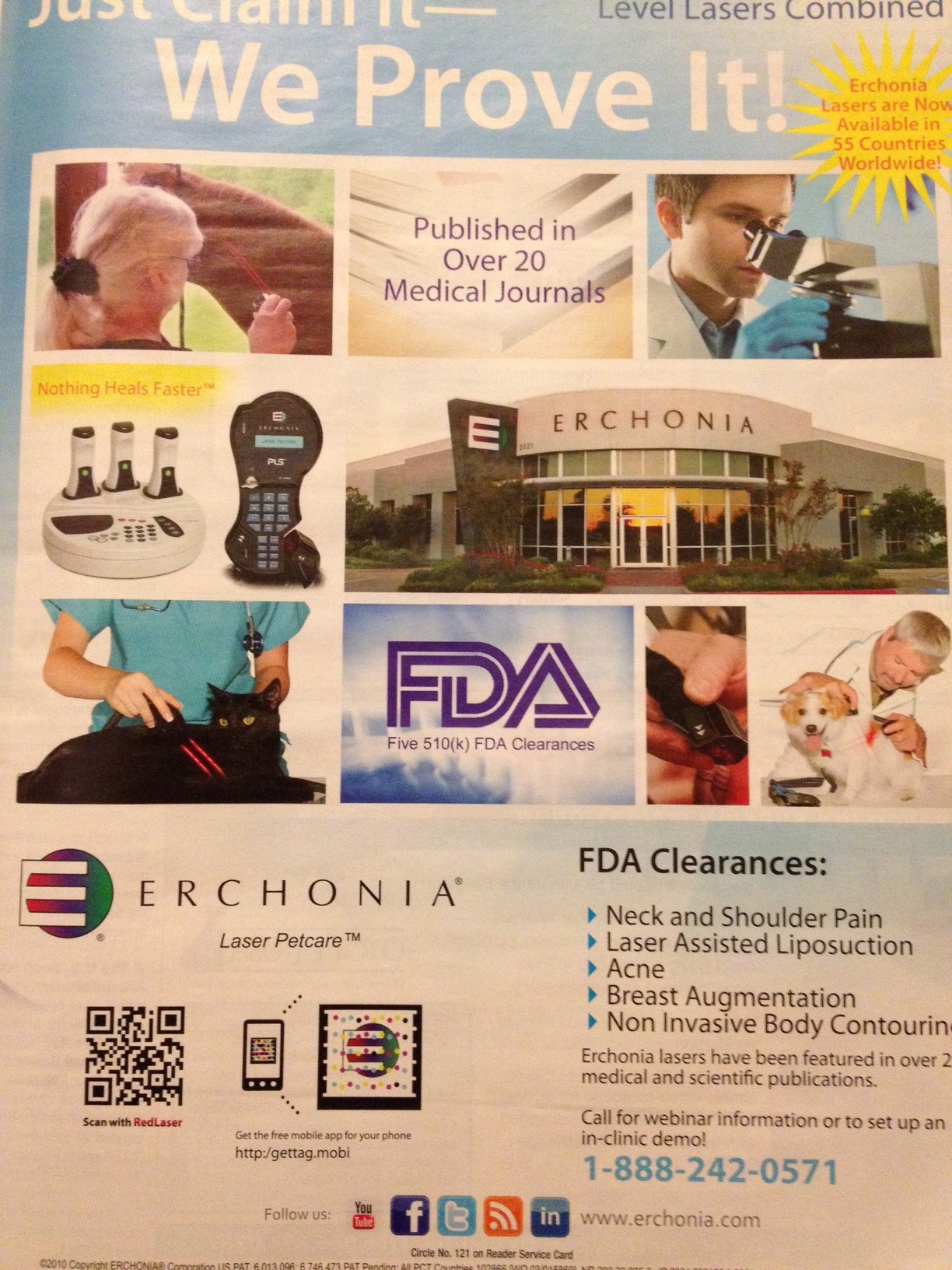
One company, however, did a really nice job however: Erchonica – who make cold lasers for wound therapy. They used both a standard QR Code and the Microsoft Tag which led to an optimized YouTube page with videos of Erchonica’s lasers in action. Very simple idea , and gave the reader something that they could not get with the printed page – video. Interestingly enough, another QR Code I scanned also took me to a YouTube page – however it had not been defined as a mobile page which seemed like significant missed opportunity. So nice job Erchonica – I even watched the video!

The rather nice implimentation of QR codes on the Erchonia ad in this month's Veterinary Practice News.

The bottom line of all this is that QR Codes can be a great little tool but are seriously misused. This hurts wide scale adoption and wastes a lot of time, energy, and money. As for the title of this post? I invite you to watch the great Scott Stratton, who is responsible for my current obsession with QR Codes, on the subject.

As House M.D. ends its eighth and final season I wanted to say thank you to the show for a number of things as they relate to my professional world and give it a (little) bit of a hard time for couple of others. I should make perfectly clear that I am a huge fan and that apart from a couple of minor missteps the show has been amazing television. I apologize for any spoilers!

Parasites and Zoonosis

I freely admit that I do not watch a lot of hospital shows. Apart from the odd episode of ER, House is really the only medical show I have had much time for. But House, as far as I’m aware, has had more than its fair share of parasites. From a veterinary perspective this is amazingly refreshing. As someone who seems to spend their life talking about zooanosis to doctors, staff, and the public, it is great to see some worse case scenarios played out in fiction, with a grounding in scientific fact.

Any one remember the episode with the giant tapeworm? I bet if you’ve seen the episode and your pet(s) have ever had tapeworms you won’t soon forget it. Or there is the episode autistic boy with roundworms, the team members infected with Naegleria fowleri, the homeless woman with Rabies, or the woman who catches Bubonic Plauge from her pet dog. Admittedly these are all extreme cases, but the mere fact that they are on television in some ways is a minor miracle considering that most people do not even want to talk about parasites and zoonosis.

So thank you Dr. House for spreading the word about zoonosis and parasites. Every little helps!

The Diagnostic Process

One of the great gifts that House M.D. gave the veterinary, and probably the wider medical community at large, was giving the public a greater understanding of the diagnostic process. Admittedly, House’s methods are often very unsound, but that fact the he and his team regularly are a loss for what is going on is extremely refreshing. We all in the veterinary profession have heard the complaints:

“Why do you have to do that Parvo test?”
“Why do you need that bloodwork?”
“You did that expensive bloodwork and there is nothing wrong!”

Even a casual viewing of House M.D. shows what is supposed to be one of the world’s foremost diagnosticians performing tests that come out negative and going down blind alleys searching for an elusive diagnosis. By bring the diagnostic process into the living room, House has helped acquaint the public with the idea that a certain level of trial and error are to be expected in any evidence based search for answers.

On more than one occasion I have used the show to help explain to a frustrated client why it took three separate diagnostic tools or lab tests to get diagnosis and why we couldn’t just immediately go to the correct one. So thank you Dr. House for helping to shed light on the diagnostic process!

Superstar Bad Behavior

I went into at some length in a post a couple of months back about what I call “The Steve Jobs Effect.” This is this the phenomena of some doctors, and other professionals, feeling that because they are so good at what they do, it excuses almost any level of behavior. Now House M.D. is very much fiction and levels to which the character of House delves would lead to his dismissal by pretty much any employer – never mind at a medical facility. The sarcasm, plain offensive behavior, and even harrasment, does make for great television, but, although it rarely reaches the epic proportions of House – it does happen in real world.

So not so much thanks, Dr. House, for reenforcing the stereo type that great skill can excuse bad behavior!

The Cuddy Episode

Every now and again on a long running T.V. show the writers shake things up by imagining the world they have created from a different perspective. On the show House M.D. this took the form of a very underrated episode from the perspective of Dr. Lisa Cuddy, the Dean of Medicine (Hospital Administrator to you and I).

The episode (5 – 9), shows the administrator doing very administrator type things – facing off with a vendor, placating the Board, dealing with major H.R. headaches (being short staffed and theft). The episode also deals with the thorny issue of billing and a patient who does not feel they should pay their bill (sound familiar). It is great to see these challenges, admittedly extremely exaggerated for added drama, and that these types of issues as just as much the part of running a medical facility as what the viewers watch Dr. House do every week.

I do have a problem with the episode however. After doing a great job of explaining to a patient why their bill is fair, the episode ends with Dr. Cuddy ripping up the patient’s check. I understand that it is supposed to show how kind-hearted the star of the episode is, but it undermines everything she states earlier in the episode. I also don’t buy that the character would do this.

So thank you Dr. House, sort of, for a great episode showing the role of administrators everywhere.

I, like a lot of people, am going to miss House M.D. But I am grateful that we’ve been able to have eight great seasons of television, and even more grateful that an intelligent show has shown some of the issues that I personally and professionally care about. So long Dr. House, for all your faults, we’ll still really miss you.

Why does being a customer suck?

Does it at your business?

Are you being honest?

How would you know if it did?

What happens when you walk into a restaurant you’ve never been to before? Do you stand there for a moment wondering whether you need to seat yourself or wait to be seated? Do you go up to the counter and order? How open are they going to be to changing one of their dishes to meet your needs?

O.K., enough question marks.

As a restaurant owner, or any business owner for that matter, it is obvious how your business works to you, but your clients almost certainly don’t walk through those doors every day -mores the pity.

Education of the client is often held up as a key component in a lot of service industries to solve these issues (yes veterinarians, I’m looking at you). Our job, as delivers of services however, should be to hold our clients hands through this process and make it as painless as possible. Clients should not need to become experts in how to deal with us, or the industries in which we work.

As I discussed at some length in this post about marketing and branding, what you sell is not necessarily what your clients are buying. The customer experience should reflect this. I had a recent customer service experience that brought this all into sharper light. Because the owner of the business is a friend, I’m not going to go into that particular experience directly, but it did cause me to re-evaluate what I do, how I respond to clients who do have issues, and do some thinking at length about what “customer service” actually is. Instead, let me tell you about my bathroom…

A while back I had a bathroom tiled. I spent a significant amount of time picking out exactly the right shade of tile that I wanted and the size. At the end of day one of the installation however, I come to find out that the tiles are actually two slightly different shades. I talk with the installer and the answer is “Well that is how they come – It is to give the effect of real marble.” Well, I did not want two tone tiles, I wanted them all the same color. Who is right here, and who is wrong? The store, and the installer, are both perfectly right – the tiles are manufactured that way and I’m sure that for most installations it would have made lots of sense, but that was not what I was purchasing! I was purchasing my bathroom tiled in a particular shade!

Interestingly, I was was in a locally owned and operated store a little while later and happened to look at their tiles. Their display was actually setup so that for tiles of the type I was looking at, all the shades of the same batch of tile were shown together as a single piece rather than just an individual tile. This removed the “different shade shock” that I had experienced when I had bought tiles for my bathroom.

Other than showing my bad taste in tiles, what does this experience tell us? It tells us that it is very difficult to forget information or view things as if we don’t know about that information. Chip and Dan Heath, in their book “Switch – How to Change things when change is hard,” have an excellent exercise that you can use with staff – or even just friends – that shows this in action. Give a volunteer a piece of paper with the name of a very common tune written on it and get them to ‘knock’ out the rhythm of the tune on a table and see if the others in the room can guess what tune it is. Try it with a number of different tunes and people. Those knocking the tune out will find it really hard to understand why everyone else in the room can’t guess correctly. The reason for this is that they are hearing the tune in their own heads along with the knocking. They have knowledge which everyone else in the room does not. Not only are they unable to communicate that knowledge, but they don’t understand how or why everyone else in room does not have that knowledge – it is an alien perspective to them.

This is just like my tile sales man and installer who could not understand why I did not know what they knew about tiles. It is also the same phenomenon that has you hesitant and unsure in the lobby of a restaurant you’ve never been to before – the big sign saying “please wait to be seated” can be a huge relief. I’d also argue that this is one of the reasons why chains are so successful. Familiarity is easy!

So what does this all tell us?

Well perhaps we need to start really listening to our clients and thinking about their experience and how it is not our experience. It might sound trite but customer service is about serving the customer. If we have a lot of education deliver to a client, perhaps the problem is that we have not made things simple enough. Of course, if the client wants more information they need to have it, and we need to have the resources to hand to help deliver. But we also know, from numerous studies, that very little information is actually retained when we deliver large amounts of it in person. We also know that lots of choices actually result is less decisions being made.

Clients are not stupid, but they don’t have, and shouldn’t need, a manual to use our businesses or get the services we are trying to deliver to them. One of the reasons why Apple’s iPod, iPhone and iPad are so successful is that anyone can use them from day one with the minimum of instruction. Our businesses and services should be the same way.

Being a customer can suck – but it is our job to ensure that it doesn’t!


A check list for removing suckyness from the customer experience

  • If we have have to explain things over and over how can we stop the need for explaining?

  • Do we get frustrated with our clients lack of knowledge – perhaps they are not the problem?

  • What do our clients complain about?

  • How successful are we with our recommendations?

  • Do we have compliance issues?

  • When issues arise, how could they have been avoided?

If you have any additions to this list, or have any customer service stories to share, please let me know in the comments!

2011 has felt like the year of the Bayer Brakke Study. Most of what has been written in the world of practice management, seminars, and conversations between managers, have ended up talking about the Bayer Brakke study.

This was finally summed up for me when attend a one day workshop held at VSCoT by Butler, Bayer, and Jessica Goodman Lee, CVPM of Brakke consulting, on the study itself and what to do about it’s findings.

I felt it might be interesting for me to give my personal view point on some of what I took away from this presentation, the Bayer Brakke Study in general, and what it means for the veterinary profession, clients and pets, as a whole.

1: The profession needs to change and it needs to take the change seriously.

The 1998 Brakke study made 19 recommendations and the only one that was adopted by almost all veterinary practices was to raise fees. Now that was a good thing – fees need to rise, but the other recommendations we’re also important. Inventory management and reducing expenses, for example, were the recommendations with the next highest adoption rate and they were adopted by less than 50% of practices.

Just raising fees is fine when the economy is doing well, but does not bode well recessionary times and helps explain why visits are down and some practices are have had a significantly hard time over the last couple of years.

What was valid five years ago is not valid now – never mind 10 years ago.

2: Normalcy is not an excuse for inaction.

One of the elements that the study points out is that many practices believe that all they have to do is “weather the storm” and everything will get back to normal. What is currently being misunderstood is that the industry has changed. New competition, with different business models, have arisen partly in response to these challenging times, and who is to say that these will end anytime soon? Only 20% of practices expressed serious concern about the changing market place.

The other major issue is that business itself has changed. As Jim Lecinski points out in his book “Winning the Zero Moment of Truth” buying, consuming and even reviewing habits have changed. As a business you ignore these changes at your peril.

3: We Live, or Perish, by Communication with our Clients.

59% of dog owners and 56% of cat owners would bring their pets in more often if they could prevent problems and extensive treatments later on. The figures are almost identical when owners believe that their pet will live longer by bringing them to their veterinarian more often.

In addition, 56% of clients feel that their veterinarian does give them clear instructions as to when they should bring their pet in.

4: Cats – the Great Opportunity.

As I personally experienced while helping with the pet evacuation due to the Monument Fire in Sierra Vista, cats are woefully undeserved by the veterinary community. The bottom line is that cats do not get brought into the vet enough or sometimes ever. It is difficult for the owner, difficult for the cat, and difficult (from the client’s perspective) for the veterinary practice.

If a veterinary practice sees 25% cats and 75% dogs, and there are 13% more cats that dogs in the U.S. the opportunities are enormous both for the business of the practice and in improving feline health.

5: It is all about money – except when it is not.

Getting inventive about payment options, whatever they might be, are seen by clients as needed services. That does not nessecerally mean that veterinarians have to become banks, but it does mean that we can’t wash our hands of the financial issue. The practices that are able to provide options will find clients flocking to them. It is also important to note that choice is not always a good thing. It can send a a mixed message to clients who are looking for a recommendation. Pet insurance is an obvious area where having a practice provider of choice in terms of recommendations can make a big difference to clients.

Trumping the financial issues, however, is communication as mentioned above. If we do not explain the value of what we do and why we do it (exhibit A: the lack of feline visits) how can we ever expect clients to?

I can sum a lot of what I have written above by one word: Management.

The industry needs to embraise management (this may seem like a self serving argument as a practice manager, and to an extent it is, but it does also does not make it any less true) as a key ingredient for practice health. It is no accident that the Bayer Brakke Study shows that the variables most constistant with increased visits were: seeing the same veterarian every time, wellness exams considered the most important service, marketing and advertising as important to practice success, and the active use of social media. The variables most consistent with decreased visits were: advertising undermines credibility as a veterinarian and lack of referral arrangements with shelters, groomers etc. These are all areas where good management can make a significant difference. Managers have to be allowed to manage, but they also need to manage well.

Proper practice management is not just the responsibility of the managers. Of course, managers must manage, but there has to be a sea-change in understanding that proper practice management actually effects patient health and outcomes.

Just ask all those cats!

These are just my take always, any others or any other ideas? Lets here from you in the comments. Abuse, as always, very welcome.