I left my veterinary practice, and the associated other ventures, after 13 years as Hospital Administrator, three weeks ago as of this writing.
I have left jobs before, I’ve even left vet practices before, but nothing came close to this. Thirteen years is a long time.
When you manage people for a living you hope that you make a difference in people’s jobs and by extension their lives. At the same time, you have your doubts…
“Did I really make any difference at all?”
Sure, there are people who say you’ve made a difference. People who you grow to care for – maybe even think of as friends. At the same time, one can never be unaware of the inequality of those relationships. Managers, by definition, are not on an equal footing with the people they manage.
“Are they saying that nice thing because they mean it or because I’m their manager and they know it’s what I want to hear?”
Leaving changes all that.
Who signs your card and who does not. Who finds the time for a quiet conversation – a mentorship confessional. Those who reach out over social media, knowing your aversion to mixing your personal life and work, is now no longer such an issue. The moving of people from the thought bucket of colleague to the one marked friendship. These are the subtle reminders that you matter. That despite all the challenges, you did good work.
The jaded manager in me, the one who regularly has to be beaten down less he rears his head with his negativity, would always whisper the word “fraud.” That making a difference had failed. That you were not the manager you aspired to be, that indeed you were not the manager you thought you were, that you were the manager you feared being. Many sarcastic thanks to the makers of The Office (either one) for adding to the management second guessing in case we inadvertently and momentarily became David Brent / Michael Scott. Although truthfully there are far worse managers out there, both on Television or Film and in the real world, than David Brent or Michael Scott.
But in leaving one can leave those thoughts behind. These are not the rose-tinted memories of times gone by – although I’m sure those are to come. These are the genuine thing. Reactions from people who care. Who recognize the role you have played. Whether it was a timely job offer, a suggestion of a new role or promotion, advice about how to deal with a colleague, or for faith and belief in another when everyone else has none. This is what work is supposed to be. The collaboration between people in pursuit of a shared goal.
Leaving makes you realize your value. That your value is that things will carry on. That you are not indispensable because you have dedicated your management career to ensuring that others thrive and have the skills they need to grow.
“Any sufficiently advanced technology is indistinguishable from magic” – Arthur C. Clarke.
In a remarkable about face for a technology company, Amazon has confirmed that it is moving away from its “just walk out” technology at its Amazon Fresh stores. The technology boasted that it used a mixture of cameras, sensors, and artificial intelligence (A.I.) to know what consumers had put in their baskets and to accurately bill its customers without all that tedious checking out and interacting with another human being at the grocery store.
Image Copyright Amazon.com used under fair use for criticism, comment, or news reporting.
What was actually happening was that up to 1,000 people in India were watching and tagging videos to ensure that customers were billed correctly. Amazon has apparently laid off almost its entire development team of this “technology” and will start to phase out this service from its existing Amazon Fresh stores. This is all the more surprising after Amazon’s experience with A.I. recruitment. In 2015 Amazon had to abandon an A.I. résumé reading project due to being unable to stop it from discriminating against women. It was seen by many as a humiliating comedown for the tech giant.
Image Copyright Amazon.com used under fair use for criticism, comment, or news reporting.
“Pay no attention to that man behind the curtain!” — The Wonderful Wizard of Oz, L.Frank Baum.
While many will smirk at Amazon’s second major public A.I. failure, and I have to admit to being one of those people, there is a bigger issue here which Amazon should be commended for. It is the lifting the vail on A.I. tools that are not some magic that comes out of the ether. They often require human intervention to be usable- both in front and behind the keyboard. In addition A.I., or more accurately Machine Learning , need examples of human labor in the thousands, if not millions, to be trained. The training of these A.I. “models” has become a contentious subject for those with an interest in A.I. both as supporters and critics.
“Any technology distinguishable from magic is insufficiently advanced” – Barry Gehm’s corollary to Arthur C. Clarke’s original quote.
The main issue with machine learning is that the A.I. industry, almost without exception, sees art, music, writing, film, and pretty much the entire internet as fair game for training A.I. models, which they in turn sell to us in the guise of generative A.I. Those of us on the other side (waves hand in air to indicate exactly where I stand on this subject in case you had not already guessed) say that copyright does not work that way. Derivative works are still derivative.
It is indeed hilarious to watch companies such as Disney try to navigate this brave new world. On the one hand, Disney has tried to argue that generative A.I. is fine for them to use to create new works based on the work of artists they have employed in the past. But Disney has then complained about possible copyright infringement when someone else has tried the same trick with copyrighted works they own.
Image Copyright Walt Disney Company used under fair use for criticism, comment, or news reporting.
The lawyer who used ChatGPT to write a legal brief might want the machines to infringe a bit more. To his cost, literally, the lawyer found out that the pesky machine had just made up all the cases that it sited in its argument which he signed his name to. He was sanctioned and fined after he was found out. I just love that generative A.I. tools hallucinate (the developers term, not mine).
One of my favorite activities these days is to ask A.I. peddlers what they use to train their models. Indeed, I had a most entertaining afternoon doing just that at this year’s Western Veterinary Conference. Amongst the answers I received were “none of your business – who are you” (my favorite), “medical records from a university,” and “the internet.” None of the vendors I spoke to were willing to discuss privacy, copyright, or what happens if they are no longer allowed to train their models that way. One gets the distinct impression of building on borrowed land.
“Thou shall not make a machine in the likeness of a human mind” – Dune, Frank Herbert
There is a temptation to label those who speak out about our current infatuation with A.I. tools and criticize the foundations those tools are built on as luddites. While our current use of the word brings to mind hoards of unemployed mill workers bent on smashing “the spinning jenny,” the truth about the Luddites is actually far more nuanced and carries a message for today. The Luddites did not hate all machines, they in fact were fine with most and just wanted them run by workers who had gone through apprenticeships and were paid decent wages. The Luddites main concern were manufacturers who used machines in “a fraudulent and deceitful manner” notes Kevin Binfield in his book “Writings of the Luddites.” Outsourcing the cashing out of grocery shopping to a developing country, and labeling it as new technology, is a tactic the Luddites would have been all too familiar with and would have been happy to march against.
While I am not advocating for a Butlerian Jihad as Herbert described as the backdrop for Dune, there is merit in the context he provides to the proscription on thinking machines.
“Once men turned their thinking over to machines in the hope that this would set them free. But that only permitted other men with machines to enslave them.” – Dune, Frank Herbert.
As author SJ Sindu wrote on Twitter (I refuse to call it X on general principles); “We don’t need AI to make art. We need AI to write emails and clean the house and deliver the groceries so humans can make more art.”
A.I. art needs human art to model itself on and the pushback from artists and consumers is already significant. When the argument over modeling reaches the courts, the damage may already be done. Only then will we see the parallels between the creative arts and A.I. that we saw in the 2000s with Napster / Pirate Bay and music. Will it be too late to put this tool back in its box?
A healthy skepticism when it comes to A.I., I think is all important. And not just a skepticism for what A.I. can do but for the intentions of those that wield it.
A.I. will need to be “open” and not just open as in the name of a for profit corporation. Its models will need to be transparent and be able to be questioned. As I wrote about in my review of Hilke Schellmann’s book on A.I. in hiring and Human Resources “The Algorithm”; …it is often difficult to impossible for candidates or employees to challenge decisions by managers which they may feel have been affected by bias. How much more difficult is it when it is not a human making the decision or recommendation? A tool of which we cannot ask the most basic of questions: what were you thinking?
Footnotes and links would be a great start. But most generative A.I. companies consider this proprietary information and therefore refuse to provide what would seem a most obvious step when it comes to trust. That, in fact, is exactly why authors use footnotes and links, to allow others to follow their thinking on how they reached their conclusions. I’ve tried to add as many links and footnotes as I can to this article without becoming burdensome.
I am not a Luddite in the modern sense, but I do share a lot of the same concerns of the Luddites of old. We only need to look at our world to see why we should be concerned. It is a world where poor people in the developing world watch us shop so that we can pretend we are living in a magic future where machines do all the work. Where the drudgery of making art has been taken away from us so it can be sold back to us by corporations owned by billionaires.
I’m not sure I want A.I. to write my emails, but I can think of plenty of things that I’d like it to undertake. I already use it in a number of ways. I’ve used A.I. images in my books (although I probably will not do so in the future). I currently feel that A.I. has to earn its place in my world by proving its benefits not just to me, but the world as a whole. Will the undertakings of A.I. be for the benefit of people? Currently, that seems to be the last thing on the developers’ minds.
“The tune had been haunting London for weeks past. It was one of countless similar songs published for the benefit of the proles by a sub-section of the Music Department. The words of these songs were composed without any human intervention whatever on an instrument known as a versificator. But the woman sang so tunefully as to turn the dreadful rubbish into an almost pleasant sound.” – 1984, George Orwell
It seems that everywhere one turns today artificial intelligence (AI) is being added to every aspect of daily life. Whether it be the arts, education, entertainment, search, or the workplace – AI is everywhere.
Often, those of us who are distinctly dubious about the claims that are being made about the current generation of AI, more appropriately labeled machine learning, can often feel like Cassandra of myth – fated never to be believed. At worst we are labeled as luddites, rather than as people who believe that technologies should earn their places in our lives and societies rather than being instantly adopted after being told by people hoping to get rich that they work great and everything will be fine.
Ms. Schellmann’s exhaustive exploration of AI in the workplace is pretty damning.
It catalogs how Human Resource (HR) departments have been adopting technologies that are often little understood by their users and are often working under misapprehensions as to the scientific backing of the ideas behind these tools. The fundamental problem is often one of garbage in – garbage out; a phrase that has been with us from the dawn of the computer age. For more on this I recommend the excellent “Weapons of Math Deception” by Cathy O’Neil which I reviewed here. The majority of AI tools are black boxes that we can’t look inside to see how they work. The manufacturers consider the algorithm’s inside these black boxes proprietary intellectual property. Without being able to look inside the magic black box, it is often impossible to know whether an algorithm is biased inherently, whether it is being trained on biased data, or just plain wrong.
One of the things that comes up again and again in “The Algorithm” is AI’s, or the people that program it, inability to know the difference between correlation and causation. Just because a company’s best managers all played baseball, does not mean that baseball should be a prerequisite for being a manager – particularly if it means that an AI would overlook someone who played softball – which is essentially the same sport. When one considers the fact that men tend to play baseball, and woman tend to play softball, it is easy to see just how problematic these correlations can be.
The problems with correlation and causation are of course magnified when junk science are involved. Tones of voice, language usage, and facial expressions, are being used in virtual one-way interviews for hiring and have little to no science behind them. In one highly memorable section of the book, Ms. Schellmann speaks German to an AI tool, reading from a Wikipedia entry, which is assessing her customer service skills and quality of English. The tool rates her highly in customer service and English even though she is speaking a different language and does not even try to answer the questions being asked.
Where the book falls down a little, but probably says more about the sad state of business thinking, is on personality testing. The author seems to accept as scientifically valid that employees can be categorized as one of a few simple types. You can read my review of “The Personality Brokers” by Merve Emre here for more on this nonsense and dangerous business tool. As Ms. Schellmann rightly states in her take down of how AI handles personality testing, but could actually just apply to all personality testing; “we’d be better off categorizing by star sign.”
It is disturbing just how much AI has already invaded the hiring space in the HR offices at large companies and gives one pause as these tools become more mainstream. While it is true that it is often not the AI software itself that is the problem, but how the humans that wield such technologies choose to use them. There is also the problem of how hard it is for a human employee to challenge a decision that is made by an algorithm – which by its very nature is a secret. The developers will often say that these tools should not be the final word in hiring or firing; but the knowing wink and smile behind these statements tells us everything we need to know.
Ms. Schellmann’s work is laser focused on human resources, an area where bias has been and often is a significant problem. The idea of a tool that can be used to eliminate bias, and that companies want to use tools like this, is not inherently a bad idea – in fact it is admirable. The problem is that bias in hiring is often unconscious bias and tools that are wielded by those who are not aware of their own biases are most likely fated to continue to have these biases and therefore affect the process. In addition, it is often difficult to impossible for candidates or employees to challenge decisions by managers which they may feel have been affected by bias. How much more difficult is it when it is not a human making the decision or recommendation? A tool of which we cannot ask the most basic of questions: what were you thinking?
This is an important work for our time – hopefully one not fated to be a Cassandra.
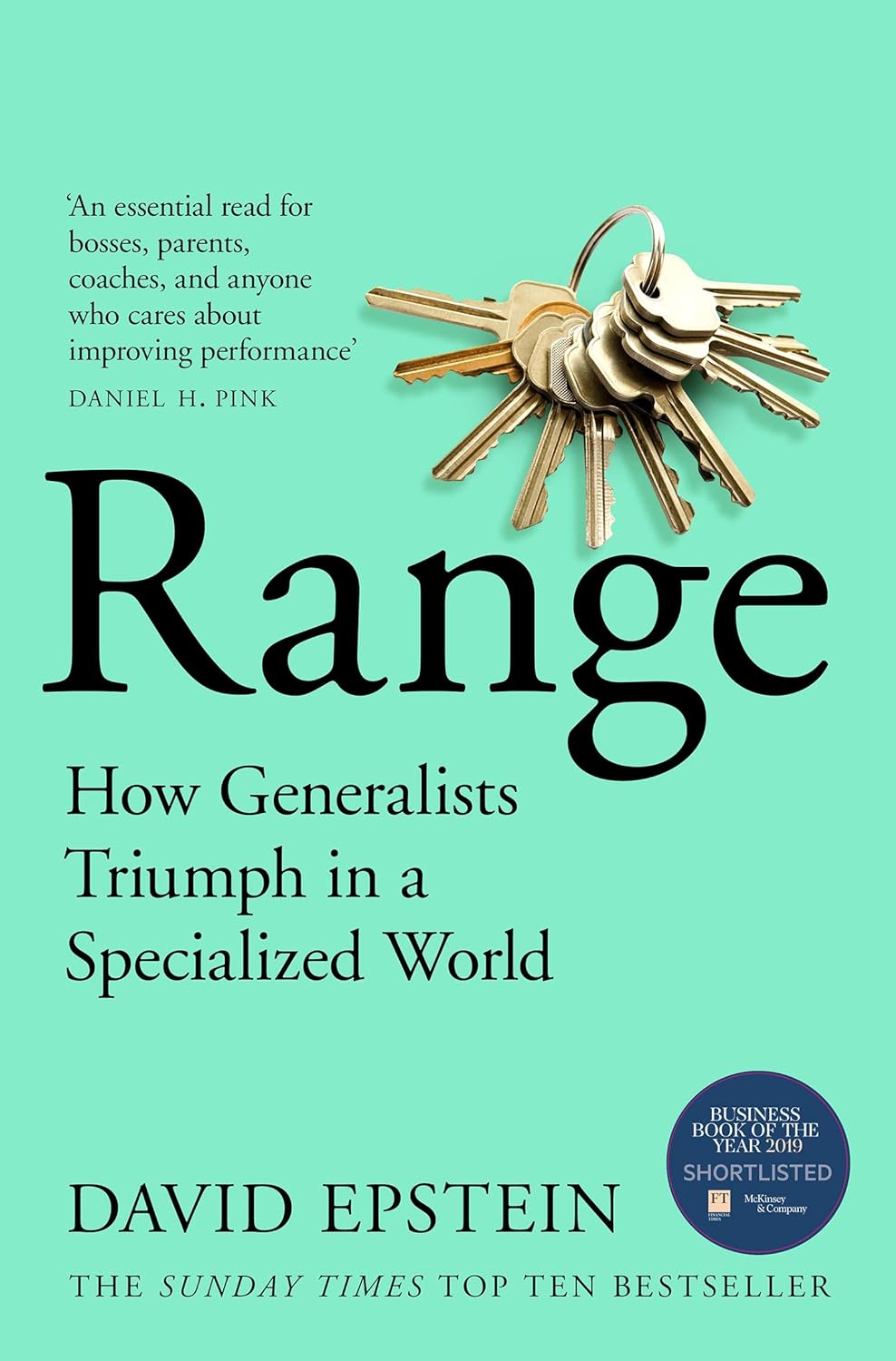
As a society we tell ourselves stories that, while convenient, are not always, or even ever, true. In what is probably Malcom Gladwell’s best book “Outliers” (which I can’t believe I have not reviewed) the author tells of the often decade long stories, and tales of extraordinary advantage, of seemingly overnight successes. David Epstein, in “Range: Why Generalists Triumph in a Specialized World”, is also debunking one of the stories we tell ourselves – that to be really good at something, or to have great success at something, we have to have focused on that thing for a long time – if not forever.
Before I go any further a word to my veterinary and human medicine readers. In this post, and indeed in Mr. Epstein’s book, when we talk about “specialization” we are using it in the general sense as opposed to the legal (small “s” rather than capital “S”). Although, I do believe that there are lessons for students from Mr. Epstein’s excellent book. Don’t be in too much of a hurry to map out your career. It’s a good thing to try out different interests and to change your mind – you’ll be better in the long run for it.
The pressure to focus on one thing, whether it be in sports, music, or entrepreneurship is all pervasive and often has business interests behind the marketing of “hyper specialization.”
It is a good story.
The Tiger Woods story is one that the author highlights. It is a story of the very young Tiger playing golf before he could talk and spending all day at the golf course. It is a story of winning tournament after tournament and having an unflinching goal of winning more titles than anyone else. Mr. Epstein juxtaposes the “Tiger story” with the far less well-known story of Roger Federer. Federer’s mother was a tennis coach but she refused to coach him and actively tried to dissuade him from playing tennis. A young Federer also seemed far more interested in soccer, basketball, skateboarding, handball and skiing. It was not until his teens that Federer started to gravitate towards tennis and then his goals were not lofty, but the rather quaint “meet Borris Becker” and “play at Wimbledon.”
This wide range of experience and lack of focus is the author’s main argument – that, more often than not, it is range that leads to success rather than specialization. That depth of experience of different fields matters more than depth of experience in just one. Interestingly, the evidence that Mr. Epstein quotes, rather persuasively, is that while early hyper specialization can lead to children getting a head start in that chosen area, they tend to fall into line with their peers rather than stay ahead as time goes on.
Where the book misses, for me, is that it seems to continue to fall back to specialization being a worthy goal via a route of different experiences, rather than the range of experiences being a worthy goal in itself. However, this minor quibble aside. The book makes a very strong case for experience in general and for following one’s interests. A great example is the idea to not ask kids what they want to be when they grow up, but rather to ask them what they are interested in. Our education, and in our careers, we often ask others where they are headed and penalize them for not knowing. This may be a mistake.
When I look at my career, I’ve had very specific goals at different times and while I have met some of them, I have taken some spectacular left turns that has led me to areas I would never have even considered just a few years earlier. No one is more surprised than me that I live in Las Vegas, watch a lot of hockey, and write poetry.
This is an important book for those who mentor, or lead, others. How we choose to guide – matters. We are often a deciding factor in whether to specialize in an area or to follow seemingly unconnected interests. There is value in a range of interests and experiences that benefit both the person and the employer.
A more enlightened view of the goals of mentoring will benefit everyone.
Let me tell you a secret about most business books – they are not about business. Oh yes, they claim to be about business, how to work with people, and affect change, but in reality a lot of them are not. They are often about the hard things – finance, cost control, selling, and product development, or the soft things – people management, team dynamics, and marketing. Rarely is a book about how all these things fit together, and how to grow while at the same time dealing with the realities of business day to day.
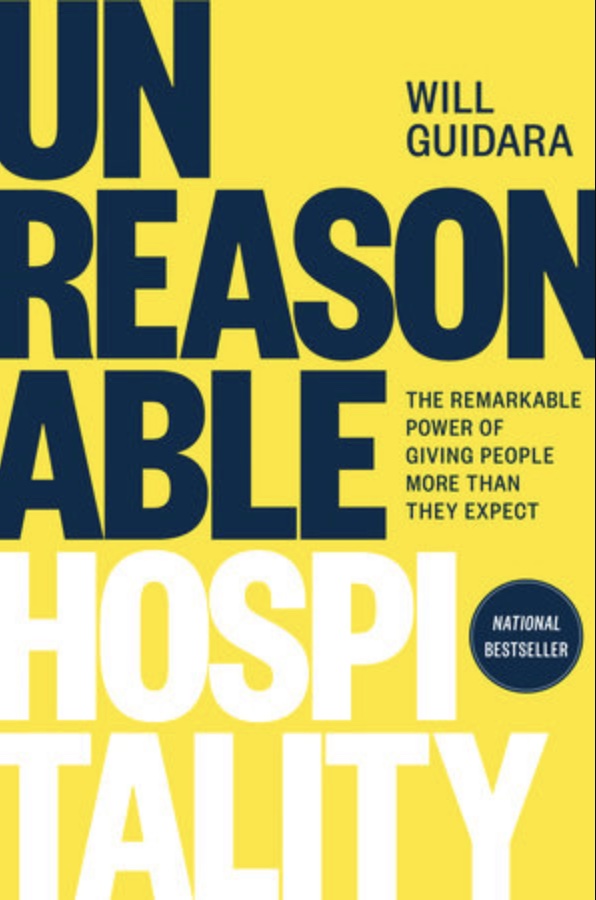
Which is why Will Guidara’s book “Unreasonable Hospitality: The Remarkable Power of Giving People More than They Expect” is so refreshing. This is part memoir of a restauranter and part business manual on blending soft and hard skills that all businesses try to do – with varied levels of success. Mr. Guidara was the general manager of a number of fantastic restaurants, including Eleven Madison Park which became the number one restaurant in the world.
For a book that talks a length about people, values, growth, and mission it is so unusual to hear the real world politick of “I’m also clear about what my job is, which is to do what’s best for the restaurant, not to do what’s best for any of you (the staff). More often than not, what’s best for the restaurant will include doing what’s best for you. But the only way I can take care of all of you as individuals is by always putting the restaurant first.” Just wow!
And that quote really sums up the problems with a lot of books on management and leadership – they are two different things people and not mutually exclusive (I can shout that louder for the hacks with the crappy memes) – we are often being asked to hold ourselves to an impossible standard. People are sometimes not the right fit, sometimes we just have to get through the shift, sometimes we are not going to be perfect. An illuminating passage deals with the idea that while it is often trotted out that employees have a language of appreciation, they may also have a language of criticism – people may need feedback in different ways depending on their personality and work history.
I love the advise to “not let things slide – those small things become personal slights.” This is often ignored because every manager today fears being labeled a micro manager. Just like I also appreciate Mr. Guidara’s works to be maniacal on cost control for 95% of your costs and then to spurge for the last 5% to make a difference to the guest experience.
There are times when this book feels like it is written by the staff from the movie “The Menu,” yet at the same time one has to appreciate what Mr. Guidara was trying to do with his business and why he was doing it. The book says, there is nothing wrong with striving for perfection, as long as perfection is not the standard – little things are always going to go wrong. That does not mean one should not try, but it means managers and leaders have to accept realities.
It may seem extreme and over the top, and it is, but that is the whole point of being “unreasonable.” To give people more than they ever expected in a controlled manner so it can be systemized and scalable. I’ve been banging on about scalability for years, and so to read it in this book was like having to tell the author to get out of my head.
This book should be required reading for managers and leaders of any business who want to deliver a better experience for everyone – including the owner of the business. This is appreciation that businesses are businesses. They must make money and they have to be able to work when you are not there. There has to be systems in place, protocols and procedures, so that everyone knows what to do and new people can be easily trained on what to do.
Unreasonable Hospitality is what business books should be. Simon Sinek, who wrote the introduction and I have been on record for forever as having no time for, could learn a lot from this book for example.
This is where the rubber meets the road. For those who want to add to their passion, or just rekindle it, it is hard to find a better way to do so than to read this wonderful book.
Why on earth am I reviewing a field manual on sabotage by the OSS (the predecessor to the CIA) from World War two?
Well, there are a couple of reasons other than the most obvious one that someone suggested it.
This very short reprinting, which would usually only be of interest to historians or those with underground bunkers and very full larders, is glimpse into the mind of a someone who wants to disrupt or destroy an organization both physically and psychologically.
There is not much that the average person could not have thought of themselves when it comes to physical sabotage, but it is interesting to note how just not doing simple things in the workplace can create serious problems and should therefore be taken seriously by managers. Most disgruntled employees are not quite so literal in showing their displeasure, but one does become aware, through the numerous examples, of just how vulnerable most workplaces and organizations are.
There is an illuminating passage early in the book.
“It should be pointed out to the saboteur where the circumstances are suitable, that he is acting in self-defense against the enemy, or retaliating against the enemy for acts of destruction.”
I, and most modern managers, do not think of employees, even problem employees, as the enemy. However, it is not a far stretch to think that there have been times when an individual employee on a disciplinary path may feel that they are in a battle of wills. This might not lead to outright sabotage, one hopes, but “quiet quitting”? Quiet quitting is the phenomenon of an employee doing just enough not to get fired – but no more. As the book says a couple of sentences on…
“The saboteur may have to reverse his thinking… Where he formerly though of keeping his tools sharp, he should now let them grow dull…”
Where the book really becomes of interest for managers, however, is in the final seven pages where it discusses what steps managers and supervisors can take to disrupt an organization’s psychology. If you recognize your organization within these pages – it is time for change. It is also a great reminder of seemingly well-intentioned actions by leadership teams. Insisting on perfect work where it does not matter, for example. Or “see that three people have to approve everything when one will do.”
There is even guidance for meetings and committees to be found in this later section. Warnings to try and increase the size of meetings or committees to the point where they become unwieldy is reminiscent of the often-told Jeff Bezos, the CEO of Amazon, anecdote that he will not attend meetings that cannot be fed by a single pizza.
A thoughtful reading of this short book by managers should act as a warning and a reminder both to themselves and about others. I think is also a good training tool for new managers to show what not to do and to be aware of the traps of self-sabotage that managers can often fall into. It is also a good reminder of where the line exists between performance problems and being a disruptive influence in the workplace.
Eighty years old it may be, but this short book still has some things to teach us.
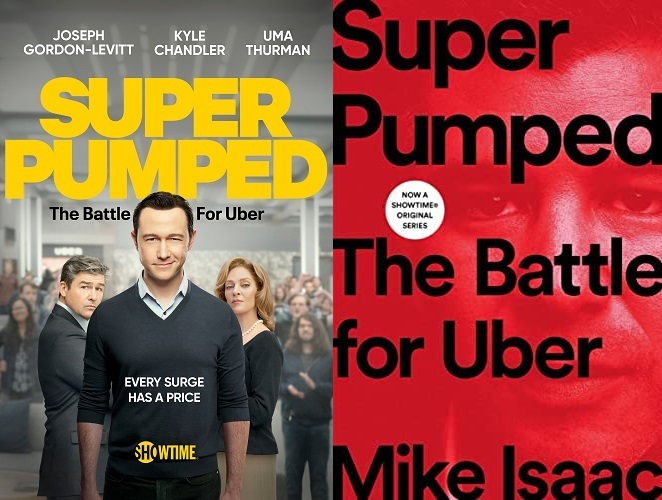
Super Pumped, the book, is an in depth look at the rise and fall of Uber CEO Travis Kalanick. Impeccably researched, and detailed, it goes into the twists and turns of the Uber story. A story of hubris, a complete lack of ethics, a toxic working environment, and a deep dive into the cult of personality that often surrounds tech founders and CEOs. The book also has a few gonzo moments as the author finds themselves part of the story they are covering for both for good and bad.
Super Pumped: The Battle for Uber, the TV Show, is the first season in an ongoing anthology series. The second series will be based on a forthcoming book, also by Mike Isaac, on Facebook. The TV show does an excellent job of capturing all the major beats and intrigues of the book, while also adding a distinctly more human face to its subjects. Kalanick is much more fleshed out in his relationships with girlfriends and family. There is also much more focus on how much the key figures start out liking each other rather than just being marriages of convenience. However, how much of this is “added drama” is unclear. But given the attention to detail of most of the rest of the story, I am inclined to believe the implication if not the actual events themselves.
Where the TV show really shines is in its portrayal of the side characters and their experiences with Kalanick and his “Bro” culture. Episode five is an extraordinary study in sexual harassment and a dysfunctional Human Resources department as experienced by regular employees. Another scene that stands out is when (spoiler) Kalanick’s girlfriend is breaking up with him, an event that clearly affects him, but yet he stops the argument so that he can answer an email on his phone. The book certainly focuses on the sexual harassment aspects of Uber’s culture, however, the visceral nature of the TV dramatization makes for uncomfortable viewing without straying into exploitative / voyeuristic territory. A thoughtful selection of scenes from this episode would make an excellent starting ground for understanding sexist work cultures and how to avoid them and the sexual harassment that ultimately results for managers – both new and old.
The story of Uber and Travis Kalanick is an extraordinary one and is worth your time as a cautionary tale and as a reflection on our cultural blind spot when it comes to convenience. What kind of world do we live in where convenience trumps ethics and the celebration of behavior this is, not to put too fine a point on it, despicable? Does success excuse bad behavior or does success breed a lack of respect for the rules? Does startup culture, which embraces out of the box solutions, also include the idea that as long as you are successful all will be forgiven?
While Travis Kalanick is undoubtedly an extraordinary individual, the TV show rarely makes the viewer feel anything other than deep unease if not downright dislike. The book, while less personal and emotional, is able to illicit sympathy for Kalanick during a meeting with the author and, when out of spite, one of the Uber board members leaks details of Kalanick’s departure from Uber – humiliating him, when the agreement was for a face-saving departure.
By the nature of a TV show, even a series, it can’t go into the detail that a book can. It is interesting that Super Pumped the TV Show starts when Uber is already a reality and uses conversations between protagonists to comment on its past founding and early days. Whereas the book starts from Kalanick’s previous start up and Uber’s humble beginnings as an idea of Garrett Camp when he could not get a cab. Likewise, the TV show ends with Kalanick’s ouster as CEO whereas the book continues into the intrigues of finding a successor and the settling of various lawsuits.
While Super Pumped the book is very much worth your time; Super Pumped: The Battle of Uber, the TV show, is the more extraordinary piece of media. Incredibly watchable, and a useful tool for managers when it comes to toxic internal cultures, the TV show is worth staying up till 2:00AM, as I did, to watch the entire thing in one hit.
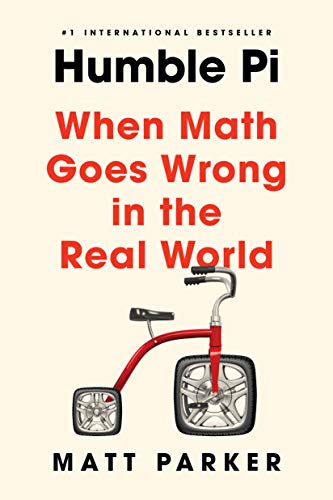
There are few people who would argue with the statement that math is at the heart for most of our modern world. What is less well understood is what happens when that math goes wrong. And it does. All the time!
Mr. Parker’s highly amusing and thought-provoking book is about math and computers, but what becomes clearer as the book goes on is that this is also a book about systems and how and why systems can fail. There are lots of examples of people adding up numbers incorrectly or trying to take shortcuts to make the math simpler, which in turn leads to devastating and sometimes lethal consequences. However, it the subtler applications of mathematics where “Humble Pi” really scores.
For example, looking at 30- or 40-year-old kitchen appliance, still in use, is often accompanied by a phrase such as “they don’t make things today like they used to.” While this might seem obvious at first glance given that we are talking about an appliance working well beyond its expected lifespan, this is actually an example of “Survivor Bias.” If we looked at how many of the appliances had been manufactured, and then looked at how many were still in daily use, the chances are that we would recognize that this surviving appliance is an outlier and that the vast majority of the appliances have actually long been replaced or broken down. It is only the existence of this surviving outlier that prompts the idea even though we would likely not comment on its existence were more of the appliances in existence. The appliance’s rarity generates a false narrative that can only be understood by understanding the underlying math of the number of appliances produced.
For managers there is much to take away from Humble Pi. Mr. Parker encourages us to look at systems like layers of sliced Swiss cheese. All systems should be made of multiple layers – the checks and balances of any good system. But it is important to understand that there are possibilities for mistakes in every layer of a system – the holes in the cheese. The challenge as designers of systems is to ensure that the holes in each layer do not align. The author uses the example of two different nurses in a hospital performing a complicated drug calculation the same way and both making the same math mistake leading to a medical error.
Related to this idea of errors being a natural part of a system is the impact of a lack of tolerance for errors on new employee training. If managers terminate employees for making mistakes, the people who are left to train new employees are those who are must less likely to make mistakes. These are probably the worst people to train new employees who are obviously more prone to making mistakes. If instead, we teach employees to work a system that can detect mistakes and provide feedback, a system where the holes do not line up, then we will overall have far less mistakes – even when people are new. As the books says, humans can be very resourceful in finding ways to make mistakes.
This is not just a book about rounding errors, and why you should turn your computer off regularly. It is a book about what it means to be human in a world that relies and is built on mathematics, which humans are inherently not very good at. It is a fun and interesting read that will stay with you long after you put it down.
I’ve never been a particular fan of Myers-Briggs personality testing, and their ilk, that still permeate business and management culture to this day.
And if a takedown of Myers-Briggs by exposing the complete lack of any scientific basis for personality testing in general is what you are looking for there are perhaps better books. Although, it has to be said, the author does a pretty good job of debunking Myer-Briggs while telling its history anyway.
The Personality Brokers is an examination of how Myers-Briggs became the cultural phenomena that it is today. Its highly humble origins in child rearing of highly dubious quality and obsession with Carl Jung – both his work and the man himself. Through what should have been its repudiation; training spies in World War II and personality typing Nazis – badly. All the way to it being a possible solution searching for a problem and the attempt to automate the hiring process.
The Personality Brokers is a cautionary tale of how wanting something to be true because it would be so useful if it was, does not excuse ignoring the evidence. The fact the it is still a tool used by both business and government today is astounding given the history of the Myers-Briggs and, when pointed out, the obvious reasons why it cannot work as a tool in the workplace.
That it is tool that has cost people their jobs, and possibly their lives, over decades should be a scandal of the highest order. Myer-Briggs offers organizations a way of sorting the workforce without the sticky and inconvenient truth that people defy categorization. What Ms. Emre does in this illuminating volume is show that Myer-Briggs personality testing has always been a dangerous myth that people wanted to believe and therefore overlooked its flaws. That it is something that Jung would have found abhorrent, and perversion of his work.
One cannot help asking “why?” all the way through this book. Why did this idea go so far? Why has not been stopped? And why are business people so gullible when offered a solution that really is too good to be true. While there have undoubtedly been people who have found Myers-Briggs useful, both as managers and professionals, it holds little value over traditional goal setting or positive thinking.
This is a great book for arguing with your boss about.
One of my most popular blog posts is “The Cost of Servant Leadership” which I published in 2012. Due to some renewed interested, I thought it would make a nice first choice as the core content for my first experiment into animation. I hope you enjoy!








 Mike Falconer