Archives for posts with tag: book-review

And the winner for most on the nose book title of the year goes to…

Sarah Wynn-Williams’ recounting of her time at Facebook (now Meta) is at times funny, horrific, and plain sad. From true Facebook believer, who pitched her dream role, international governmental policy, to at first disappointed employee trying to change things from inside, to full blown dissenter, and (spoiler) ultimately fired whistleblower.

There are few familiar names that come of well in Ms. Wynn-Williams’ telling. Mark Zuckerberg and Sheryl Sandberg come off particularly badly with their clueless and tone-deaf behavior being only the start. It is also telling that there are currently no slander or defamation suits against the author for the memoir, only an order enforcing her NDA (Non-Disclosure Agreement) signed as part of her separation agreement.

Ignoring for a moment the wider societal issues with Facebook that are the main thrust of the book, what the author shows off is the often-dark side of the Silicon Valley myth. That while the pay and benefits may be great, the workload is deliberately punishing as an instrument of control. That anything outside of work is seen as an almost disloyal distraction. What is often portrayed as quirky, is often just mean behavior and nepotism with a significant dose of classism and well – carelessness. That it is far better to ask for forgiveness than to ask for permission, regardless of the potential consequences.

Where this volume really scores is in exposing just how deliberately powerful and impactful Facebook can be when it comes to manipulation. That Meta just does not care about the consequences of this or the impact around the world. It cares about getting new users to generate more business and that’s it. Whether it be vulnerable teenagers, peoples struggling to wrestle democracy from authoritarian regimes, or actively embedding staff with political campaigns to spread false information at home, Facebook seems to play the worst role possible. It is illuminating how the lessons learned from real world events are the worst lessons possible and that these are the last people we should be letting have oversized roles in our society.

The public face and social engagement of the leaders of Meta is all front. Sheryl Sandberg’s “Lean In” book and subsequent foundation are shown to be shams by people who not only do not practice what they preach, but also would be horrified by the mere temerity of the idea of being called out on this.

This is a book that exposes titans of Silicon Valley as not only shallow and immoral, but without any ethical framework or even basic decency. The very worst of the “let them eat cake mentality.”

While the book has a little of the “this was awful, but I did not say anything” that is often found in whistleblower accounts, this is kept to a bare minimum and while Ms. Wynn-Williams comes out of the account pretty well, she freely admits to her own naivety, and her wide eyed idealism.

This is a book that will make you think long and hard about your own Facebook usage but it really is about just how out of touch tech leaders can be, even with basic HR norms, and just how much the people who unleash technological forces just do not care about anything other than their own interests.

Careless in other words.

Want to read a takedown of the leaders of the tech world, that calls them out for their hypocrisy and recklessness?

Of course you do.

Burn Book is, for the most part, that book. A book that at its most fundamental says “you promised us a brave new world – and what you delivered us was a more rapacious form of capitalism.”

The author, Kara Swisher, is a long-time journalist and analyst of the “tech sector” – particularly in Silicon Valley. She is also the co-founder of the Recode conference and the co-host of the Pivot podcast.

Burn Book, through the narrative of an autobiography, is her journey into the San Fransisco technology sector and her gonzo view of the events that, for better or worse, have shaped the world we currently live in – particularly its technology.

Where Burn Book really scores is in its view of characters such as Elon Musk, Bill Gates, Mark Zuckerburg, Steve Jobs, and Sergey Brin. From their early days, the beginnings of their success, through to their either refusal to accept the damage of their legacy, or the issues with how that legacy was formed, but also for some of them; their efforts to make amends. One is left with a sense of these figures riding waves that they barely understand or control. That often these figures are deeply flawed individuals who’s flaws have help lead to their success, but that long term they themselves are unrecognizable from the people they once were. Changed by wealth and power and all its trappings.

As Swisher mentions in the introduction; “move fast and break things” is in retrospect indicative of the tech scene entrepreneurs and their willingness to not think through the consequences of their actions. (Move fast and break things was an early internal Facebook slogan that was widely adopted by the tech sector).

Where the book becomes annoying is the author’s habit of “I told you so.” While this may well be true, and the whole purpose of the book is essentially to name drop, and let’s be honest that’s why we are reading it, it can become a little frustrating and seemingly self-aggrandizing. Swisher has earned the right to trumpet her vision and does have a record of putting billionaires on the spot, however, she does seem to fail to see the larger picture of the issues with this kind of innovation model.

Swisher is a self-proclaimed “believer in tech,” and this leads to the impression that she feels if only developers and tech titans were nicer then the world would be a much better place. This is quite possibly true, but one has to wonder about an industry who are happy to undermine industries and even societies, while failing to follow the basic rules that everyone else follows.

To Swisher’s credit she recognizes how close she has become to the tech sector and how that potentially impacts the objectivity of the analysis she gives. Of late she has made efforts to put distance between herself and her subjects. It would be easy to see this book as one of those efforts.

Burn Book is for the most part an enjoyable read with lots of moments to savor for those who want to see the self-proclaimed “Masters of the Universe” taken down a peg and be held to account. It does also do a pretty good job of exploring the duality of some of the complex individuals who run or formed some of the largest companies on the planet with little to no oversight. The author lauds Steve Jobs, for example, but does point out some of the flaws and cruelty that mars his legacy. It is not an in-depth analysis of all that is wrong with tools such as Facebook and the tech sector as a whole, but then it does not set out to be.

This is an autobiography and a story about being in love with an industry. The all too predictable break up, with the realization that who you were in love with is not quite the person you thought they were, is just another part of that love story.

As that, Burn Book succeeds admirably.

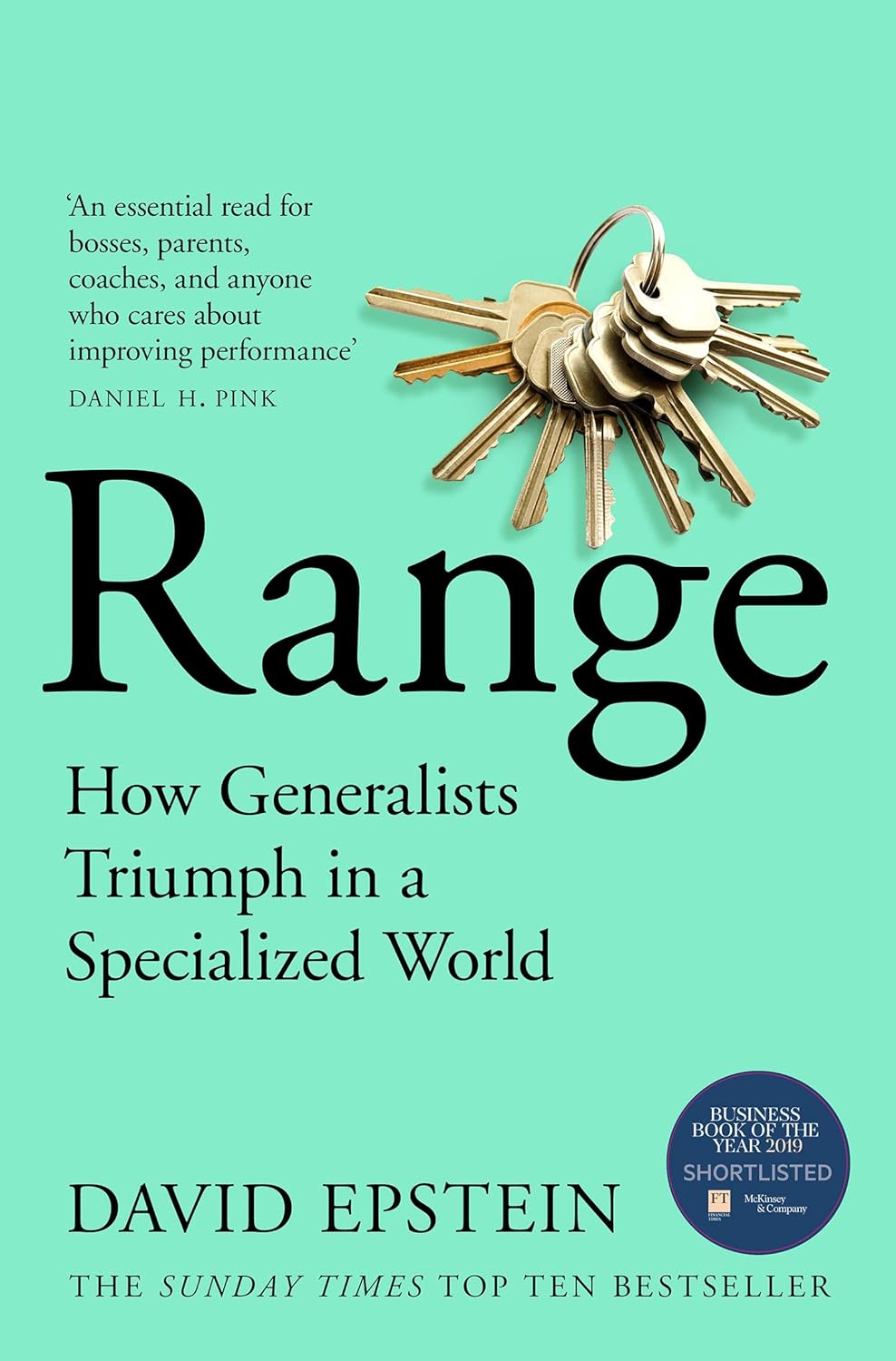
As a society we tell ourselves stories that, while convenient, are not always, or even ever, true. In what is probably Malcom Gladwell’s best book “Outliers” (which I can’t believe I have not reviewed) the author tells of the often decade long stories, and tales of extraordinary advantage, of seemingly overnight successes. David Epstein, in “Range: Why Generalists Triumph in a Specialized World”, is also debunking one of the stories we tell ourselves – that to be really good at something, or to have great success at something, we have to have focused on that thing for a long time – if not forever.

Before I go any further a word to my veterinary and human medicine readers. In this post, and indeed in Mr. Epstein’s book, when we talk about “specialization” we are using it in the general sense as opposed to the legal (small “s” rather than capital “S”). Although, I do believe that there are lessons for students from Mr. Epstein’s excellent book. Don’t be in too much of a hurry to map out your career. It’s a good thing to try out different interests and to change your mind – you’ll be better in the long run for it.

The pressure to focus on one thing, whether it be in sports, music, or entrepreneurship is all pervasive and often has business interests behind the marketing of “hyper specialization.”

 It is a good story.

The Tiger Woods story is one that the author highlights. It is a story of the very young Tiger playing golf before he could talk and spending all day at the golf course. It is a story of winning tournament after tournament and having an unflinching goal of winning more titles than anyone else. Mr. Epstein juxtaposes the “Tiger story” with the far less well-known story of Roger Federer. Federer’s mother was a tennis coach but she refused to coach him and actively tried to dissuade him from playing tennis. A young Federer also seemed far more interested in soccer, basketball, skateboarding, handball and skiing. It was not until his teens that Federer started to gravitate towards tennis and then his goals were not lofty, but the rather quaint “meet Borris Becker” and “play at Wimbledon.”

This wide range of experience and lack of focus is the author’s main argument – that, more often than not, it is range that leads to success rather than specialization. That depth of experience of different fields matters more than depth of experience in just one. Interestingly, the evidence that Mr. Epstein quotes, rather persuasively, is that while early hyper specialization can lead to children getting a head start in that chosen area, they tend to fall into line with their peers rather than stay ahead as time goes on.

Where the book misses, for me, is that it seems to continue to fall back to specialization being a worthy goal via a route of different experiences, rather than the range of experiences being a worthy goal in itself. However, this minor quibble aside. The book makes a very strong case for experience in general and for following one’s interests. A great example is the idea to not ask kids what they want to be when they grow up, but rather to ask them what they are interested in. Our education, and in our careers, we often ask others where they are headed and penalize them for not knowing. This may be a mistake.

When I look at my career, I’ve had very specific goals at different times and while I have met some of them, I have taken some spectacular left turns that has led me to areas I would never have even considered just a few years earlier. No one is more surprised than me that I live in Las Vegas, watch a lot of hockey, and write poetry.

This is an important book for those who mentor, or lead, others. How we choose to guide – matters. We are often a deciding factor in whether to specialize in an area or to follow seemingly unconnected interests. There is value in a range of interests and experiences that benefit both the person and the employer.

A more enlightened view of the goals of mentoring will benefit everyone.