Veterinary Medicine is about communication. Our patients don’t speak. They can’t advocate for themselves so pet owners, doctors, and team members must communicate with each other on their behalf and as clearly as possible.
However, there is a relationship within the practice which is even more important. It is that of practice owner (PO), usually a DVM although the same applies to corporate practices with a medical director, and the hospital administrator / practice Manager / office Manager (OM).
If these two people cannot agree, or agree to disagree, all the other great things that can happen within the practice are subject to failure on a monumental level.
Everything flows from this relationship.
Protocols and standards of care can’t exist if the two people responsible for implementing them can’t agree on what they are and how they should be applied. How can equitable and fair human resource decisions be made if one of these two people plays favorites and overrides the other when it suits them? They must be able to have difficult conversations, where they both will have strong feelings about the results, and must be able to come out of that conversation without hard or hurt feelings that get in the way of their continued relationship.
Vision, Mission, and Core Values statements can go a long way to resolving these issues – but only if they are the living breathing guidelines of the practice. More fundamental is that there is mutual respect between PO and OM for both their respective roles and their responsibilities. They also need to present a united front on matters of change.
Unfortunately, this relationship is often unequal. Practice Owners, by definition call the shots and have the last word. Ideally, they empower their OM as their representative to make decisions and implement policy. However, if there is no trust, no respect, there is no way that is going to happen and no way for the OM to do their job. Likewise, if the OM is constantly aligning themselves as an employee rather than as a member of senior management / ownership they are unlikely to receive the trust from a PO that they would want and rightly so.
There is a balance to be reached and that’s why I advocate that the relationship between PO and OM has to work for anything else in the practice to work. This is also the reason why I am always against PO and OM being married or related in other ways – other parts of their relationship creep into the PO and OM dynamic. PO and OM should not be best friends – there are times they are going to disagree and that’s fine – that’s how it is supposed to be. They represent different interests of the business.
So what if that relationship is not there or there has been a breakdown?
Communication.
Communication.
Communication.
Fundamentally if PO and OM can’t communicate then the relationship is dead. Unfortunately, that probably means the OM needs to leave either by resigning or being let go. It does no good to anyone for there to be infighting between the leaders of the practice. It certainly does not help the practice.
What sucks for the OM in this situation is that jobs of that type in the veterinary industry are usually one per practice. That means if there are ten practices in your town then there are only nine possible jobs for the OM and there are no guarantees that any of them are looking. There are, of course, opportunities in other industries; good leaders and managers are always in demand; however, that means learning another industry.
If the relationship between PO and OM is broken something must change because this is the relationship that can’t be broken for the practice to function. Take care of your own mental health and that of your team.
Be honest about this relationship and either fix it or move on.
Feature image courtesy of Zahid H Javali & Dmitry Abramov from Pixabay
Often, managers are not owners of a business, but they are required to act as if they were. That can mean that they become the person that both team members and ownership feel is there to solve their problems. To be on call all the time. To be the fountain of knowledge whatever the time and whatever the day.
And often they are.
But that does not mean they are not entitled to time off and a personal life.
Setting boundaries with your owners and your team does not mean not being there for them when they really need you, but it should mean that your time is respected and valued by those that depend on you.
Schedule Boundaries
As a manager, it is easy to feel that it is your duty to be there for your team, or whomever you report to, at all hours of the day and every day.
And to a certain extent this is a sign of a good manager. Your team needs to be able to count on you being there when they need you to be.
But….
And this is a big but…
There is a huge difference between being available for an emergency and being available at all times for all things. You have a life to live and just because you hold the title of manager and all that it entails, does not mean that your job gets to monopolize all your time.
Have a schedule and make all efforts to stick to it. The work for most managers will be there the next day. That means you can leave on time. While staying late will reduce that work pile a little, it will not be as beneficial to the business and certainly not as beneficial to you if you just leave when you are supposed to. There will be times when you absolutely will not be able to leave on time. Make those the exceptions rather than the rule.
Take your vacation time and take the holidays you are owed. Never feel guilty about taking the days off you are due. Your mental and physical health will thank you. As one of my favorite phrases goes; “Make time for your wellness or make time for your sickness.”
If there are times that you don’t want to be interrupted – turn your phone off. You turn your phone off when at the movies or at the theater (if you do not there is a special place in hell for you) so a couple of hours of being unreachable is not an unreasonable thing even for the most connected of managers. Your partner and family will thank you.
Communication Boundaries
Managers need to have a system for how and when they should be contacted. If there are things that you require your team to contact you about then make sure they know this. I, for example, want to be called as soon as possible if there is a major I.T. issue so I can have time to fix it – even if that means a phone call at 2AM. If there are things that you don’t need to be informed about, make sure you let your team know that as well (be nice – just redirect: “please email me about this and I will deal with it when I’m next in the office.”
Email is for when you are at work. Do not check your email outside of working hours unless you are explicitly told that there is something you need to read immediately. An example of this would be a phone call or text message that says “check your email. If you have a workplace communication platform, such as Slack, turn off the notifications when you leave the office for the day.
Text messages should be for urgent things that need your attention when you have a second but can’t wait till you are next in the office. Again, if they could be an email – politely redirect and have them send an email. Stay away from work related text message groups and Whatsapp groups. Group messaging in general is not respectful of your time so if they are part of your team’s communication system – find a way of being able to dip out when you are out of the office.
In fact, while you are at it…
Turn off all the notifications on your phone. Notifications should be for things that are true emergencies. You can thank me later.
Answer phone calls. It might sound counterintuitive in an article about setting boundaries, but I believe that when teams need to get hold of their manager, they really need to get hold of them. If they abuse this privilege just redirect and move on. There are times when you’ll wish your team called you. The excuse “we did not want to bother you” is usually a reaction to mishandled boundary setting in the past.
Longer Absences
There are times when you need to not be working.
Vacation, maternity leave, and leaves of absence are perfect examples of this. An email to your team, or whatever communication method you use, that lays out explicitly your level of availability will work wonders. You just have to stick to it. It is not anyone’s business whether you are floating at home in your pool or hiking at the North Pole and it should not change your level of availability outside of what you laid out to your team before leaving.
The Boss
But what happens when it is the business owner, or whomever you report to, who is not respecting your boundaries?
Ideally, an owner / director should understand that your time is your time. Yes, there will be occasions when they may need to talk to you or have you do something, or even come into the office outside of your normal hours, but as mentioned before this should be the exception. If it is not, be sure to keep track of these occasions and bring them up when negotiating salary and other parts of your compensation package.
Like with your team members, don’t be afraid to redirect politely when a communication method is inappropriate. Likewise, if you are being asked to do something and you have other commitments, don’t be afraid to say that you have other commitments; however, if you can give an alternative solution that often is a preferable option – such as calling someone else. Depending on the circumstance, it might be more appropriate for you to take temporary ownership of the issue and then to delegate the response to someone else if that is possible and you are unavailable.
Personal Boundaries
A manager’s life is much simpler if they are not friends, and do not socialize with, the people they manage. It’s harsh, particularly for managers who may have worked alongside team members they are now being asked to manage, but it invariably leads to issues and it is just simpler for it to never happen.
Likewise, never confide in a subordinate. Being a manager can be lonely – particularly if you are the sole member of management. But find a mentor, or a peer to confide in and vent to. A subordinate you like and feel you can trust is still a subordinate and you don’t know when conversations you felt were in confidence might come back to bite you when you have to manage or discipline that employee.
It should also go without saying that relationships between managers and subordinates are a terrible idea for both parties. Even if the relationship is not inappropriate and fully consensual the damage it does to the team can be significant. In some companies, having a relationship with a subordinate would be grounds for termination. If you find yourself in a relationship with a subordinate, disclose the relationship to whomever you report to and make sure that you and the other party sign a relationship agreement.
Appropriate Outlets
As mentioned earlier, management can be lonely. Finding outlets to discuss issues and the challenges you face are extremely important. There are often local manager groups you can take part in. If there is not one – start one!
Internet groups can be an extremely useful in connecting you with likeminded managers, but also extremely rewarding when you are able to help others who may be struggling with issues you have already resolved.
Find a mentor, go for coffee or lunch, and use them as an outlet. Mentors can be found in the most unlikely of people and places; however, it is tough to beat LinkedIn. Connect and make your connections more than just people for whom you like their posts.
You can have boundaries and still be there for your team. However, you must also demonstrate respect for your team’s boundaries. Do you really need to reach out to one of your team on their day off for a piece of information or can you just email them and wait for the answer when they are next in? Yes, it is inconvenient, but you can’t ask for boundaries yourself and then not respect boundaries for others.
Boundaries are selfcare for managers. Boundaries will be different from one manager to the next.
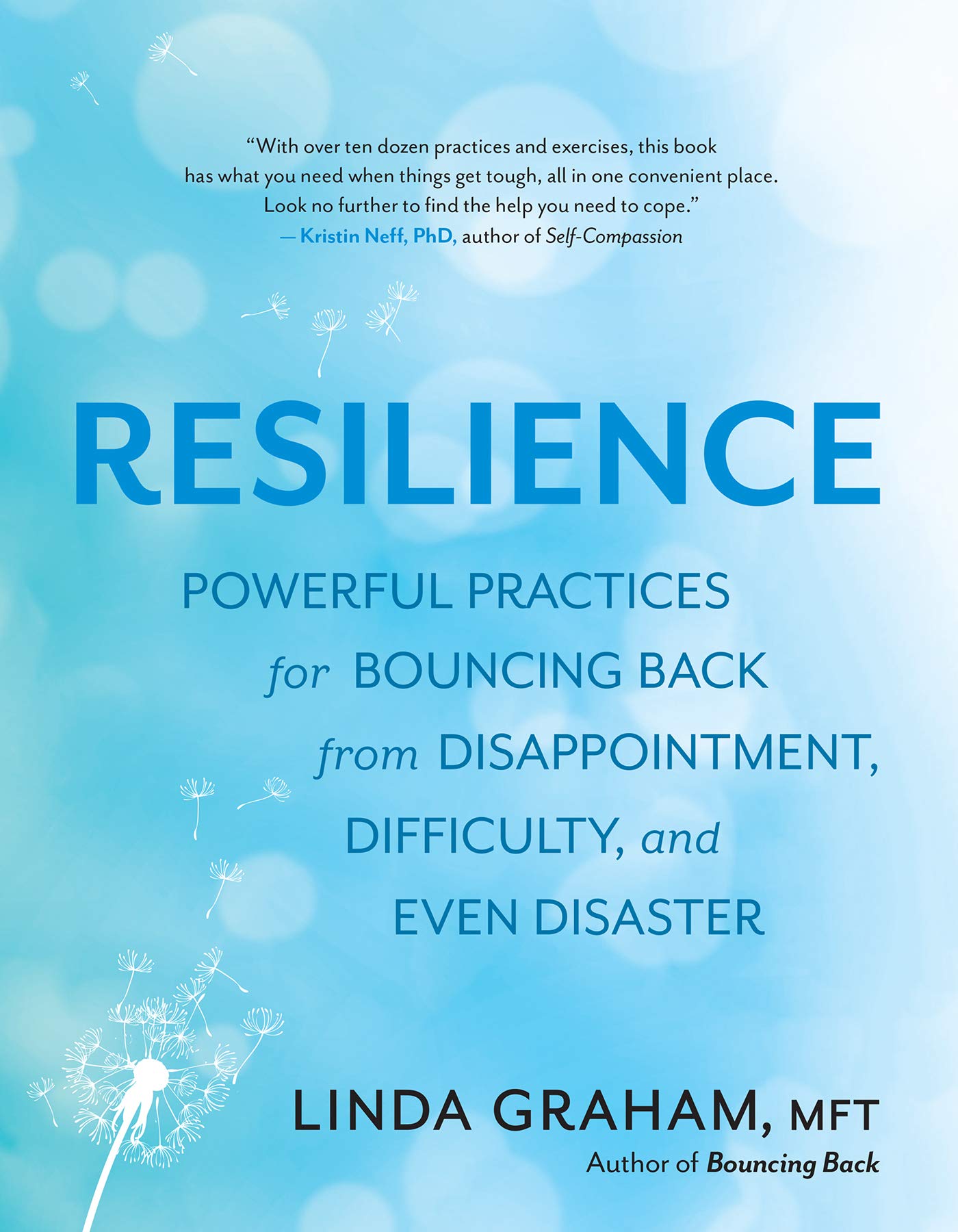
Self-Help books, of which Resilience: Powerful Practices for Bouncing Back from Disappointment, Difficulty, and Even Disaster, undoubtedly is; seem to fall into the two categories. The overly new age, “everything will be alright as long as you are positive” and the so grounded in psychology and psychiatry that you need a degree in medicine to even begin. Resilience is neither of these; yet bridges both worlds and in such a way as to take value in both approaches.
It is telling the Ms. Graham is a marriage and family therapist. Her ability to speak in plan language but also to explain the scientific underpinnings to what can sound, and I am sure does, sound like hogwash to a lot of people, if it were not for these explanations. This is a book for rational people, willing to embrace change – even of they are a little reluctant. It is worth noting that this book was given to me to read by a colleague who recognized how useful it could be for the workplace – particularly in a profession dogged by mental health issues and suicide; but was unwilling to embrace even the small leap of faith that the book asks.
Resilience is a book of exercises – 133 in all. Some will not be right for you, and undoubtedly, some will. Each chapter deals with a different type of intelligence and general resilience. Each chapter is broken down into different mode of how the brain processes; conditioning, new conditioning, reconditioning, and deconditioning. These modes are then in turn broken down into three levels of need; “barely a wobble,” “glitches and heartaches, sorrows and struggles,” and “too much.”
This is a book to refer to and reference as the reader grows and their needs change. One of the most exciting chapters for managers is on “Practices of Relational Intelligence with Others.” The tools and exercises which are explained in detail, have significant uses in getting third parties to communicate with each other, and for improving with interpersonal communication. I am often someone who talks to others about whatever I am currently reading. Resilience, however, has had me proselytizing to co-workers significantly more than normal.
Its use as a tool to help train our brains, something we often pay scant attention to, cannot be disputed. It is a little long and dense, but as mentioned earlier this is a book to refer back to – not to ingest over a few days like I did. That the book strays into areas more normally associated with meditation and yoga is not says a lot more about the positive nature of those practices, than it does as a criticism of the book. This is a book for cynics, and self-help believers alike. We all struggle from time to time and as this book’s title suggests, Resilience is about making us better and more adaptable. Being able to adjust and influence our thinking and emotions, rather than allowing them to influence and dominate our lives.
This should be required reading for the veterinary profession, and for anyone who wants to improve how the inside of their head works. I can’t recommend it enough, and it is not hyperbole to suggest that it could save your life.
I am keeping this copy of Resilience; it is on my nightstand.




 Mike Falconer