Click on the image to take you to the AAHA Press page for this book.
When talking about books that cover regulations and safety, the best authors in the world are going to be challenged to make them “entertaining,” and anything other than a chore to wade through. Therefore, the thing that is probably most important when considering a book on OSHA is probably that it is brief, delivers the information that is required, and is easy to refer to in the future.
This publication from the American Animal Hospital Association (AAHA ) fits all of the above criteria. At 48 pages (this includes the introduction and index), it is certainly brief. The author, Philip J. Seibert, who many will recognize from VIN and VSPN, and is probably the foremost expert on OSHA and how it relates to the veterinary practice. Having been a Fan of Philip’s for quite some time now there is not actually a lot here that can not be found in other places. However having it all in one volume, with the specific concerns of the practice manager directly addressed, is really very useful.
The book offer very practical advise about setting up and OSHA and safety program from scratch and also gets into some of the nitty-gritty of such issues as chemotherapy which can cause long sleepless nights without a resource of this type. Even if you do already have a safety and OSHA program in place , this volume can bring a lot of reassurance and the odd additional tip.
I do have an issue, however.
At $69.95, and that is the AAHA member price – for non members it is an additional $10.00, it is hard to look at this volume as anything other than a license to print money.
For those for whom math is not their strong suit, we are talking about almost $2.00 per page here. Now I truly do understand the economics of a low volume print run such as this. And that what we are purchasing here is not actually the text, but the research that goes into it behind the scenes. But this is an eye-watering price considering that is is coming from a veterinary association and that it is one in a series of books. I also understand that, unlike most text books, it is unlikely that this volume could have any market other than at best one copy per veterinary practice.
To put this in perspective, however, the excellent “Veterinary Fee Reference,” is 470 pages, has almost 700 tables covering 450 services, and is a monument to data collection in the veterinary industry. It is also very unlikely that the market for this volume is anything other than one copy per veterinary practice.
It is $139.95!
I don’t have any good answers as to why there is this discrepancy. If piece of mind is worth a few extra dollars then by all means get this volume. If you already have an OSHA program and you are pretty confident of your program – save up for the Veterinary Fee Reference!
Nobody is perfect, and we all makes mistakes – I’ve made some doozers. But there is a real difference between making mistakes, admitting those mistakes and then trying to fix the problem, as opposed to declaring war on your customers and ultimately your own business.
Lets take this little Twitter gem for starters courtesy of the Daily Mail. A customer in your restaurant overhears a waiter being rude about another restaurant owner who the customer happens to know personally. Your customer is not to thrilled with the service already, and finds this behavior to be rather off, so they Tweet about it. What you do not do, as a restaurant owner, is call up from home, ask to speak to the customer in question, curse at them down the phone, and then demand they leave. That, however, is exactly what happened. In the ensuing Twitter onslaught, the restaurant came off far worse and created a massive (the restaurant is in Texas, the Daily Mail is a UK newspaper as an example) amount of negative publicity over a customer service issue. An apology, and a courtesy meal or bottle of wine, could have turned this incident into a minor win instead of this major fail.
Next up, the auto-body shop that after using a photographer’s work on their Facebook page without permission, proceeded to threaten and abuse the photographer on their own Facebook page for all to see. Needless to say, the page went viral over Twitter and Facebook. With the almost universally courteous, and intelligent, posts from supporters of the photographer, and gangsta inspired vitriol from the body shop it could only be seen as a massive marketing failure right in front of the businesses own 500+ fans. I believe the page is now been taken down as I can no longer find it, but if anyone knows if it is still up please drop me a line so I can share the link.
The Airbnb saga, has been done to death but is instructive because even very smart people can do really dumb things. The basic outline is that Airbnb is a service that allows homeowners to rent out a room on a short term basis like a hotel. Unfortunately, when an owner returned to find their apartment trashed, and their identity stolen, Airbnb basically stuck their heads in the sand and appeared to try and discredit the victim to stop her blogging about her experience. After a major backlash, Airbnb added safeguards, an insurance policy, and tried to do the right thing by the victim. But it could be too little too late considering their model is very easy to copy and already has a number of competitors. Most people had never even heard of Airbnb until this story exploded.
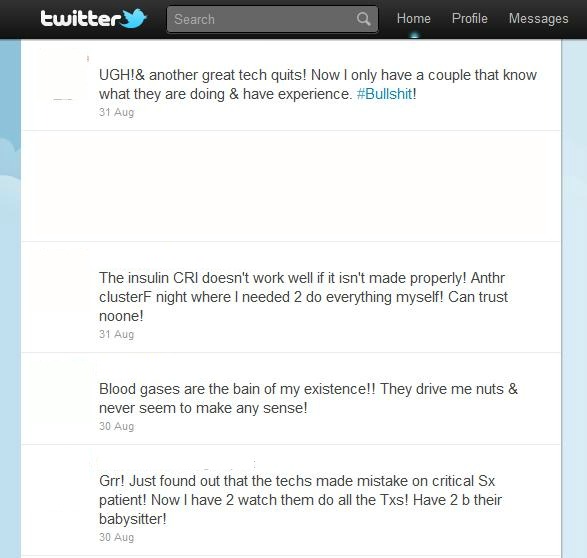
Finally, something a bit closer to home, how would you, or your staff, feel about having this tweeted from your hospital by a doctor, or about your pet?
Not only is this amazingly unprofessional, but all it will take is a single person to make the connection between hospital and Twitter account (the account does not identify the hospital, or the doctor, but I have still blanked out what is there in the interests of fairness) and this will become a huge problem. I’m sure it violates the hospital’s social media policy and I’m sure you could make an argument for it also being damaging to the profession to boot!
The bottom line is that your reputation and your brand are fragile. It is very easy for it to be damaged by just forgetting the basics of customer service. Never do anything, or say anything online, that you wouldn’t want on the front page of the paper or on a billboard. This is an age where it is easier to get your message out than ever before, but it is also just as easy for everyone else. And nothing travels, or goes viral, quite as well as scandal or bad news.
Does anyone have disastrous stories they would like to share or other examples they have seen online? Share with the rest of us in the comments!
Everyone wants good PR (public relations) or good press to put it simply. But how to get it?
The answer is actually really rather simple, and follows a lot of the same rules as social media and content marking: give your audience what it wants!
Your audience in this case is that odd mixture of reporter, editor, and reader. For the most part, in this blog post, I’m discussing newspapers and magazines. But the same rules generally apply to radio, television and web-based news sites.
Your Target
I often hear the complaint from businesses that it is impossible to get the major media interested in small business. It is not impossible, just hard. It is also making sure that you are targeting the right reporters, and right media outlets in the first place. Small local papers are much more likely to be interested in things that will affect the local community. Magazines, and in some cases television, are much more likely to be interested in “human interest” stories. Business journals, including industry specific magazines, are probably most interested in ideas or services that other business can use or learn from.
If you are a small business in a distinct community – as opposed to the big city – focus on your local newspaper or area paper. That might be a free weekly paper, or a daily traditional newspaper. If you are a major business for your community, it is quite possible that your reach will be greater and you can aim higher.
The Press Release
A press release is exactly what sounds like – a release of information to the press. They tend to be short, written in the third person (as if a reporter had written them) and should include quotes from key people involved as well and any and all information that might be considered pertinent to the reader. Remember this is about what a reporter, or editor, will think their readers will be interested in – not what you think is interesting. Long scientific diatribes filled with difficult to spell words are probably not going to work for the local free paper. A press release needs to be newsworthy, or it needs to comment on something that is newsworthy. If you can provide some background to a major story that is already being covered, you have an excellent excuse for a press release!
It is not the goal of a press release to have it reprinted in full – although that would be nice – but rather to give a reporter a jumping off point for their own article or to give additional information for something that they are already working on.
These days emailed press releases are the way to go – preferably with pictures. But don’t send gigantic photos through email. Attach medium sized images and link to high resolution ones.
The Pitch
Journalists are always looking for story ideas. If you have a good one, even if it is a little self serving, you can always call, email, or even write in miniature a “pitch” for how you imagine the story working. I’ve found that pitches work best when you can talk with the writer concerned and then email over some quotes for them to use. Pitches also work best if you can target a particular reporter. Read / watch / listen to your target media outlets and find out which reporters like writing about subjects that align with your interests. Perhaps there is a business reporter who writes about interesting business models. Perhaps another reporter likes writing about pets and animals – if you are a veterinarian that is probably someone you want to get acquainted with.
Information When They Need It
Over the years, the single biggest thing that has allowed me to get great press is the simple act of returning phone calls and responding when I’m asked. A reporter calls up on a busy day and wants to interview someone about the dangers pets face during the holiday season – that reporters request is now my number one priority. I might give that interview myself, email some quotes over or drag a veterinarian out of what they are doing for five minutes, but I will get that reporter what they are asking for. The simple truth is that reporters work to deadlines and simply don’t have the time to mess around and wait for a couple of days for you to get back to them. Most newspaper articles are written that day for the following days paper or maybe the following day of you are lucky. If you respond, the chances are they will call back the next time they need something because they know you’ll work with them and not let them down.
I’ve actually had letters to the editor, in a local paper, complaining that my hospital was always in the paper and what was the connection between the two businesses. I was in the paper, because I would issue press releases when I had news, and I was always respond when asked. Reporters know that the exposure from a newspaper article is important, so they are not going to beg for your input.
Bad Press
If you talk to the press there is a chance of bad publicity. And if you don’t talk to the press there is a chance of bad publicity. There is some merit in the idea that by making yourself more visible, you become more of a target and it is easier for reporters to inquire about something that you would just as rather they forget. However, any reporter worth their salt is going to chase a story down that involves issues or problems, because that is what sells papers and other media.
I’ve found that, on the whole, local media are pretty good about sorting out the normal disputes that occur with all businesses from time-to-time with the real stories that might have “legs.” Having good relations with your local media will not insulate you from bad press, and reporters will bristle at even if inference that it might, but decent relationships will make it easier to get your point across.
Never, under any circumstances, use the words “no-comment.” It sounds awful, and just makes reporters much more interested, because if you are saying no comment that means you don’t want to talk about something that is probably very interesting. Simple, straight forward, and above all short answers to questions are your best defense when being asked about something you’d rather they didn’t. If you genuinely don’t know, say; “I don’t know at the moment, but I’ll be more than happy to find that out for you.” or “Let me put you in touch with someone who can answer that better than I can.” Of course, make sure that you get back to them, because if you don’t now you’ve just made them mad.
And I hope it goes without saying that nothing is ever off the record, even when it is.
Crisis
Crisis management is really beyond the scope of this blog post, but I wanted to briefly touch on it as it really an extension of bad press. When a crisis, that involves the press, happens it is important to get out in front of it – just like with any bad press. No waffling – either in terms of your response or your statements. Don’t hide – it is very easy to feel like the world is collapsing around you, but the media are going to report something and it should be that you are dealing with the situation – not that you are holed up and not speaking. It is far better to give to much away too soon, to try and defuse a crisis, than to give away too little and have to increase it later after the press have had a field day with your reputation.
Toyota’s handling of their recall is often help up as a prime example of doing too little at first. In the end, Toyota were able to recover but only by doing what they should have done in the first place and untold damage to their brand in the process.
The media will always find you should problems occur in your business that they deem to be newsworthy. Building bridges to the media, however, will allow you to open a dialog for both good and bad news. The media can definitely be your friend, and for the most part, they are not looking to be your enemy – so why not create those relationships to help build your business?
Have had good or bad experiences with the press? Have you had crises that you have been able to handle well? Let me know in the comments section I’d love to hear from you!
Over the past few weeks we’ve looked at creating a marketing strategy, branding, social marketing and the various ways of creating an online presence, whether it be websites, social media and some of the other online tools that allow you to market your business. Traditional advertising, however, should still have a place in most marketing strategies.
Where traditional campaigns fail is when they are not part of a much larger effort which includes online social media efforts and the client’s experience in your business. Think about how you, or even better, your clients, find businesses and products. They will probably see a traditional ad, and then do some research online. But if there is not an ad for them to see then this initial driving force never happens.
A well designed ad, whether it be online, in a newspaper, on the radio of television will solve a problem that your potential client has. Your entire branding strategy, in fact, should be geared around this not enough to tell customers that you exist – you have to tell them why and why that matters to them!
Newspapers
Yes, there are people who still read newspapers, and even some who buy them.
In smaller towns, newspapers are still the main source of local news which can be difficult to find from the major media outlets. Newspapers in smaller towns, also recognize that the game is changing and have pretty comprehensive websites with pay walls. If you are in a major metropolitan area you may not have experienced this, however, even in bigger cities, newspapers still have their place.
Ads in newspapers can have a spotty reputation, but a lot of this has traditionally been due to badly designed campaigns and a lack of metrics to track results. Lucky, the internet and new technology is there to help you. A specially tailored URL (website address) for your campaign, or a QR code (bar codes that can be read by a smart phone), in a traditional printed ad that leads the reader to a specially designed landing page on your website makes for easy tracking. A good example of this is on my desk in front of me. It is a piece of junk mail trying to get me to subscribe to the Arizona Republic and offering me a special price for Sunday delivery. If I want the offer, I am told that I should visit “J7.AZCENTRAL.COM,” scan the QR code or call a special number. If I go to that address I am taken to a special landing page with an electronic version of the prepaid card I might have filled out in the past.
Where you appear in the newspaper is incredibly important. I personally stay away from any special section like TV listings or “weekend” sections, unless they are targeted at your audience – pet adoptions sponsored by a veterinarian or pet shop are a good example of what can work. The main part of the paper is where you want to be – that is why people are buying the paper! That is the bit they, in general, read the most. It does tend to cost a little more – that alone should tell you something – but it is worth it.
Radio
Radio, although facing some serious competition, can be a relatively inexpensive way to reach a large part of your client basis. Your radio station will look after production of your ad and can make some really helpful suggestions. Small radio stations may also be willing to work with you on infomercials, which can dramatically increase your exposure for little increase in costs. The trick with infomercials is to have a great idea. I’ve used a weekly vet tips section, which combined with lost and found pets from the local shelter gave dramatic exposure at an excellent price and also gave the radio station some great content that their listeners were interested in.
The great advantage that radio has is that listeners tend to like the station, not the individual programs. That means your ad / program has a far greater chance of being heard because it will not get glanced over (newspapers), or fast forwarded through (Television).
Metrics and tracking with radio can be tricky, but again a URL that is geared to your campaign can work wonders.
Television
With the advent of cable and the fragmentation of the television market it is now possible to have a TV spot running on a popular network for less than you used to pay for a yellow pages ad. This, of course, varies greatly on the market, the cable company and the channels and show you want to be associated with. If you do get an ad – make sure that the cable company will let you use it on YouTube – thereby you can embed it on your website and get the maximum value for your television budget.
A word of warning about YouTube, Facebook, and combining them with traditional campaigns. Don’t make your potential clients go to Facebook or YouTube to get “exclusive content” or to view your new ad. Because once they are there, the chances are that that website will entice them onto something else and they’ll forget about your website that you were hoping you would go back to. Embedding is your friend, and it helps keep the customer where you want them – looking at your content or advertising.
Yellow Pages
As my friend Dave Nicol puts it so sucictly in the title of his excellent book: “The Yellow Pages are Dead” (you can read my review by clicking on the title but not until you’ve finished this article please!)
With all the respect in the world to Dave, I think it is probably nearer the truth to say they are dying. When was the last time you picked up a yellow pages? And if you did, did you then go look at them online to see what you could find out about them? Being in the main yellow pages directory for your area is important, however, the days of the full page ad are over. A listing – maybe a small box ad, depending on your target customer, will be more than enough. Of course, ask your customers, or look up your existing measurements of how people find you and then make your own decision. In areas where there are multiple books pick the best one, or if you can find out, the one your customers use.
Do not buy enhanced online packages from the yellow-pages companies. They are not very good at it, on the whole, and you can find much lower cost solutions. If your marketing budget is an issue the yellow pages are a great area to cut. Don’t be swayed by the “your competition is in our book” argument. Let your competition waste their advertising dollars – be smart about where you place yours.
Directories, Maps, Etc.
These really are a waste of money and probably always were. My favorite I saw recently was a printed directory which had an enhanced picture of smart phone on the cover show what was inside the guide. And no they did not have an app. This cover, all sense of irony removed, was just trying to be hip, and was actually showing off why the publication was irrelevant.
Finally, the Internet
The internet is an incredibly powerful tool, and it is possible to have a marketing strategy and a marketing campaign only using just it. A traditional marketing campaign, however, must have an internet and social media component and all the elements show be designed and work cohesively.
It is also important to remember that ads, even if not very successful in their own right, can help with your general brand awareness – your internet and social media components should be able to tell you if this is the case.
I believe that a good marketing strategy combines lots of elements and disciplines – including the running of your business. If your potential clients know the name of your competitor, but not yours they are not going to be looking for anything other than your competitors name online, …or even in the phone book.
As big as the pile of paperwork on your desk might be, getting out of the building is an important part of any marketing strategy. Marketing is, after all, a discussion with your clients and potential clients about your business. It is not always possible to do that from behind your desk.
What do I mean by getting out of the building? Where will you go? Well that very much depends on your community, your business, and your marketing strategy in general. The idea is to engage with your clients on their own turf – so were is that? If you are a veterinary practice, you might find that there are pet oriented events in your community on a regular basis. Can you go along to them? Can you have a little information booth? Can you sponsor the event?
Once you start looking for events you’ll see them all over your community, and as long as you can come up with a connection to the event, the organizers will always be happy to have another booth. In retail and service industries, the businesses are often recognized just by their brick and mortar exteriors. Getting out into the wider community allows you to meet with your clients, and potential clients, on ‘neutral’ ground and for them to see the people who are in that building. It also proves your commitment to being more than just a business, but to actually being part of the wider community.
In addition to events, become a good corporate citizen. Join the local Chamber of Commerce, or other similar organizations, and actually go to some of the networking events and meetings. Yes, it can sometimes seem like an ‘old boys club’ at organizations like the Chamber of Commerce, but go anyway. You’ll be surprised at the wide cross-section of your community who attend, you’ll find out a lot about what is going on in your town, and how that might affect your business. You’ll also make connections with local officials, the media, and other business that may become useful. If you are in a larger metropolitan area, there may even be industry specific groups, or groups that relate to your daily tasks (like marketing) you can join.
It is easy to say “I’m too busy to go to that!” Make going to events just another part of your job – like doing payroll. You can’t say “I’m too busy to do payroll” – or at least I hope you don’t say that.
Before embarking out in the big wide world do have, for want of a better expression, and elevator speech ready. An elevator speech is basically a distilled version of your marketing strategy, and branding efforts, that only takes up a couple of minutes to recite. Why should someone come to your business in other words. The the good ones don’t sound like that is what you are saying, but at the same time they hit all the salient points. If you are going out and doing events you probably need a little more than that – a reason, beyond just self-promotion, to be out in the wider community. Of course, if someone asks about your business, that is when your elevator speech comes into play. In the veterinary field, zooanosis awareness (the transmission of disease from pets to humans) or the importance of vaccination are great examples of public information subjects. Fire departments, often do outside events with excellent themes such as the importance of emergency plans or checking the batteries in smoke detectors.
A booth for a vetererinary practice that includes a dog to pet, information about zooanosis and the promotion of a pet ambulance.
Whatever you choose, don’t try to do too much. Have a theme and stick with it. It is also important that this theme resonate with your strategy in your business as a whole. There is not point, for example, in having staff promoting the importance of zooanosis awareness out in the field if you also do not promote that in the veterinary clinic itself.
Social marketing and networking, which is effectively what this entire blog post has been about, is an excellent way connect with the community and promote your business without promoting your business. It can pay huge dividends in the long term, is inexpensive as long as you are sensible, but it is a long term strategy – don’t expect immediate returns. That way you’ll be pleasantly surprised when you get them!
Marketing your business is all very well, but what are you marketing?
As we looked at here, developing your marketing strategy should have given you some ideas as to what your clients are wanting to buy. By marketing to what your clients are wanting to buy, as we looked into here , you are already defining certain things about your business. But what about your competitors? How are they marketing, branding,and running their business? You need some business intelligence – don’t just assume you know what is going on actually take the time to find out for sure!
Step one: Online Research. The great thing about the Internet is that you can now research a business to your heart’s content, for the most part, online. Look your competitors branding, how do they sell themselves? Are their hours better than yours? Do they promote how low their prices are? Do they have much of an online presence at all? Is their style very informal, or very corporate?
Step two: Physical Research. There is nothing wrong with sticking your head in, say hello to one of your local competitors, as long as there is not huge animosity between the businesses. You can learn a lot by just waiting in the lobby. There is nothing sneaky about this, this is the store front – essentially a public space. If you are in the veterinary business you can tell a lot if the building smells nice- you can bet the clients can too! Do the staff greet you as soon as you walk in the door? Is the waiting area comfortable? Is the waiting area well laid out? Does the office seem like a model of efficiency, or is everyone running around like chickens with their heads cut off? Take the time to phone your competitors – not from your business, use someone else’s cell phone. How is the phone answered? How do their prices actually compare? They might say they are low cost but in reality…
Step three: Opinion of clients. Hopefully, when planing your strategy, you already figured a lot of this out already, but there is nothing wrong with talking discreetly some if your clients about why they like your business over your competitors. You might be surprised by the responses! What can this tell you about your business and your competitors?
Step four: Look at yourself and your plans. How does your business compare? How can you differentiate yourself? Maybe you need to be the low cost option in town? Maybe you need to be the premium option in town? How do your clients currently think of you? Are there simple things you can change about your business, now that you know all about your competitors, that will make a difference in the minds of your clients? These don’t have to be huge changes, but the more you can neutralize and respond to what your competitors are doing, the more you will begin to control the marketplace and define what it means to be in that market.
A couple of short examples:
Do you close for lunch? Do your competitors? Would your clients like to be able to come in during lunch? A staggered schedule could mean that you become the known as the business that is open and available at lunch time – that could be huge in the veterinary world, where if a pet is sick, and your client has to work, their lunch hour may be all the time they have! It is not a lot, but it is those little things that can start to differentiate your business.
Do you encourage communication? Do you make it easy for clients to come and talk to you? Do all the principles in your business have email addresses? Will they use them? Sounds strange, but the mere concept that businesses want to communicate with their clients – on the clients terms – can be seen as quite a radical concept.
If you have ideas along these lines feel free to add them in the comments section.
Branding can seem like a dirty word – particularly to industries which seem to believe they should be above such things. But branding is simply a way of identifying your business to your clients, and more importantly, for clients to identify your business in their own minds.
Branding itself is neutral. Crass and badly implemented examples can certainly lead to customer confusion or downright rejection. However, the world if full of examples of businesses that embrace branding, find it a useful tool in their marketing strategy, and clients responding in an overwhelmingly positive manor. How else do we explain clients paying money to advertise brands on the clothes they wear rather than the other way round? The brand becomes such a powerful image that clients, and would-be clients, will pay to be associated with it because of what the client perceives that will say to other people about themselves.
As a business, excellence in branding is a key element in any marketing strategy; however, the marketing strategy itself is a critical part of that brand. The brand is method of communicating the goals and ideas contained in the marketing strategy to clients. The brand can’t do it all, but it is an important step and should re-enforce in the mind of the client these goals and ideals until they become synonymous (see last week’s post on creating a marketing strategy here for more information.)
Branding your business is about consistency and simplicity. Walk down the high street and look at the major brands you see there. It is highly unusual to see complex logos or extreme color palettes. By and large most chains use a logo that consists of their name, which ideally is short, and easily identifiable. Chilli’s, Subway, and Wal Mart are all good examples. Even target, which does use a separate logo, uses such a simple logo that is does not detract from their name.
Moving on from the name / logo of a business, other elements of the brand become even more apparent. In Target’s case it is the color red, which is reflected in color if the stores themselves both inside and out, the uniforms that associates wear, the carts, baskets, the carrier bags, the list goes on. Every item where a decision about color has to be made, or can be made, it is made with reference to the brand. But there are other more subtle color choices going on at target as well. There are two other colors that are being used – white and kaki. White is used as a secondary color wherever red is used. When it is not practical to use white, such as the color of trousers that associates wear, it is kaki a neutral white equivalent. Even the Target dog is white.
I find it useful when creating a brand to create a brand bible, or style guide if you prefer, which defines these types of decisions so that everyone can be on the same page when it comes to branding the business. Primary fonts, secondary fonts and general text fonts are all defined, primary and secondary colors are defined and most importantly the business name and / or logo is created in color and black and white and any additional ways if using the logo are defined in detail. Please also remember that when you are defining a brand: work with what you have. If you don’t work with existing elements the process needlessly expensive – unless a complete identity change is what is required in which case make sure that your budget is up to the task. For example, I once defined a brand’s color scheme, in part, because the business’s building happened to be painted those colors.
The web’s restricted color palette and choice of fonts, although becoming less of an issue as the web becomes more and more sophisticated, should still inform your branding decisions. To ignore them would be needlessly short-sighted and potentially very expensive.
Having photographs to hand which help define your business that are online with your brand are incredibly important. When you need a picture of your building, it does not necessarily have to always be the same picture, but it should have a consistent style so that potential clients know they are looking at the same building if they see two different pictures.
Your business’s mission statement may also be able to inform your branding choices. If not then I would argue it is time for a new mission statement! To use Target again the “Expect More, Pay Less,” tag line effectively distills their mission statement into four words, defines what they are about as a company, and even takes a pot shot at their competitors. Not bad for four words.
Finally, be intolerant of off message paperwork, business cards and even staff interactions. In terms of an
Animal hospital is your name ” X animal hospital” or is it “The X animal hospital?” Clients who are familiar with your brand should be able to spot your website, paperwork and even your building even if they forgot your name – because it will feel inconsistent with the identity you have created.
Clients ultimately control your brand’s identity because of how they perceive your business and the interactions they have with you and others about that brand. However, you can set the agenda and shape the discussion by having a consistent and identifiable brand that clients can latch on to and be proud to be associated with.
Next week: Marketing your Strengths and Overcoming Weaknesses
Although significant grief is not, thankfully, something that have had to personally experience, I do see it everyday both from a distance, and close up, in my career in veterinary medicine. This book does hope to help readers through the grieving process by exploring the stages of grief and the relationship of the author with his own pets and their deaths.
The first part of the book deals with the stages of grief and as you would expect with a writer who is also a Father it leans significantly on the spiritual. This gets quite tiresome if you are not that kind of person (I’m not) and almost put paid to the book for me.
However, the second part of the book, which deals with the authors own relationships with his cats – their lives and their deaths – is much better. The author does manage to convey the deep connection that is possible to achieve between owner and pet and how it is impossible to relate to that connection unless you have experienced it. Although, the Father’s own recollections are with cats, which exhibit their own peculiar habits familiar to cat owners world-wide, the deeper message of acceptance, and validation, of the human animal bond are universal.
This is a very short book, much shorter than than even it’s slim spine predicts. One quarter of the book is taken up with resources and memorials to lost pets and considering how I found one half purgatory to read it’s $14.95 price tag more than a little steep. (Full disclosure: I was actually send the book free to review, I assume so I would consider selling them or recommending them through my hospital – I’m not.)
It is possible that in the mids of significant grief over the loss of a pet that this book could provide support and reassurance I suppose, but I hope there are better examples out there than this. If you are looking for an essay on the human-animal bond, this provides a good one – if a little on the pricey side.
Marketing for a veterinary practice, any small business for that matter, starts with deciding what you should sell, or more appropriately what your customers are buying.
For example: Starbucks don’t sell coffee, they sell a daily luxury and a comfortable friendly environment to enjoy it in. They make coffee.
BMW don’t sell cars, they sell a status symbol that is tempered by a performance driving experience. They make cars.
You’re buying what?
Customers (or clients if you prefer) of veterinary practice are, in general, not buying veterinary services, they are buying the wellness and health of a family member. If you are looking to sell to your clients you need to understand what your clients are wanting to buy, or will want to buy, and then taylor both your marketing strategy and, ultimately your business to that need.
Business or Marketing?
Marketing can act as an adjunct to your other business operations, however, I believe that things work best when marketing is integral to every part of your business. Marketing is about the dialog you have with your clients. That dialog could them visiting your website, calling your office, dropping by, or receiving services. Who you are as a business, will define how those interactions are handled – why wouldn’t you want them to be informed by a consistent, and well though out, marketing message that is self reenforcing.
Having a clear understanding of what you are trying to achieve in business, and how you want your clients to perceive that achievement, will define everything else about your marketing program.
A final work of caution…
Keep in mind that you may not always be able to control how clients perceive and pigeon hole you. This is not necessarily a bad thing as your clients are claiming ownership of their relationship with your business. Google would be a classic example of one of the most successful brands on the planet, that can fail totally with product launches because their clients do not feel the new products fit in with how they perceive the company. The trick is to maintain, cultivate, and nurture the relationship with your clients without stifling it.
The wildfires that have been threatening Sierra Vista, Arizona created a epic pet emergency in addition to the human drama.
Dr. Pam Drake and Hospital Administrator Kathryn Honda from New Frontier Animal Medical Center, threw open their doors as soon as the evacuations were announced. By the 17th, New Frontier was looking after 300 pets spread across three locations.
Having run a practice in, and lived in, Sierra Vista and consider Kathryn and Dr. Drake friends, I felt that I needed to help if I could.
The view of the Monument Fire from the New Frontier parking lot.
When I arrived at New Frontier on the morning of 18th the scene that greeted me was on of controlled and cheerful chaos. A loose dog, in the parking lot which I helped to retrieve from underneath a parked pickup truck, seemed to underline the whole morning. After touching base with Kathryn, and finding out how I could help, I headed for the main dog shelter – annex 2. New Frontier’s main building was acting as a triage center and treatment center for any pets that required significant medications. Annex 1, the main cat shelter was an empty office space in a strip mall. Annex 2, the main dog shelter, was behind the main Fedx depot in Sierra Vista. Both annexes had been generously donated by a local property management company.
Annex Two – the carriers and cages had been donated by members of the public.
Although the staff of New Frontier had done a great job of documenting the influx of pets, the sheer volume, inexperienced volunteers and multiple locations had led to multiple lists of pets. My job, for the day it would turn out, was to inventory and create an single list in Excel that the staff could refer to and find pets for the owners and contact owners about their pets. With a population of that size just knowing how many we had and where they were seemed a minor problem until you tried to manage them as a pollution rather than as just an evacuation.
After a 14 hour day, I headed home as the fire seemed to have quieted down and things were very much under control at New Frontier and the two annexes.
Annex Two held 80 dogs and 45 cats
How wrong could I have been.
Due to a previous engagement I spent the 19th in Tucson. In the afternoon, my phone started to go crazy. The wind had dramatically picked up, the fire had jumped the highway and was baring down on both the major boarding facilities that were also acting as shelters – one was evacuated that that day. New Frontier was on pre-evacuation and had taken the decision to evacuate all their evacuees to a third annex. Coronado Veterinary Hospital was evacuated for the second time. My Tucson colleagues who are part of the Southern Arizona Veterinary Managers Group (SAVMG) were already raising the alarm and getting staff and supplies on their way to Sierra Vista, along with my boss who reached out to vendors and other veterinary practices. So off I headed back to Sierra Vista.
The cat room in Annex three
When I arrived, Annex three was already setup, annex one was completely full and annex two had become the central triage center. As night fell the mountains could be seen burning and smoke still covered Sierra Vista. I updated my spreadsheet, spoke to the media on behalf of New Frontier, and worked on a plan of action with Kathryn for the following day(s). I spent the night at Annex three as all the hotels for miles were full of evacuees.
The biggest issue on Monday the 20th was management. Lots of new volunteers, who needed to be trained to handle both unfamiliar dogs and cats as well as how we needed to document. It was also unfortunate that we had a number of volunteers who were comfortable with dogs of whom we had 100, but we had a shortage of cat friendly volunteers and we had 200 cats. Luckily for us, Laurie Miller from AAHA as well as a number of technicians and doctors from Tucson were on hand throughout the morning. They worked tirelessly, and very much got into the spirit of having to make things up as we went along. It was definitely a balancing act between the standards we like to uphold as veterinary professionals – particularly when it came to documentation and at the same time making things easy and friendly enough for the volunteers who were going to be the day in and day out help that would keep the operation running.
Sunday the 19th saw the creation of Annex Three
A scare in the morning of the 20th, brought up the specter of of parvovirus. Although the test was negative, a rush request was put into our SAVMG colleagues in Tucson to see if we could get 150 dose of Bordatella intranasal vaccine as kennel cough was potentially a bigger threat to our hastily thrown together population.
The view from Annex Three
As I left Sierra Vista for the second time it was interesting to reflect on the issues and problems that my weekend had brought up. The complete lack of infrastructure made communications extremely difficult, phones were a huge issue – I spent an incredible amount of time just driving between the various annexes. Facebook became a significant communications channel for both the pet rescuing community and the entire Sierra vista community at large. However, having spotty Internet access (iPhones and iPads) made access a chore with so much else going on.
Considering that New Frontier went from 0 to 300 pets in a matter of a day or two they did a remarkable job, made even more extraordinary that Kathryn and several other staff were evacuated themselves. The entire community pulled together in a quite extraordinary way and the support from our Tucson veterinary community and distributors / manufactures made everything possible.
As I write this much longer blog post than planned, the fires are seemingly under control (60% contained) and the Annexes are beginning to empty. Almost 60 homes have been destroyed and many more buildings damaged and one hopes that this is a once in a life time disaster.