Archives for posts with tag: lyft
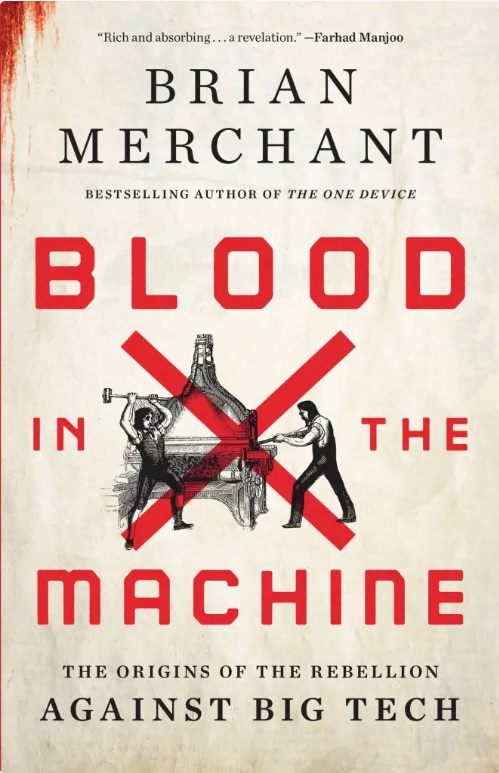
Blood in the Machine cover

What comes to mind when you think of the term “Luddite?”

For the more historically minded of you it might be that they were a British 19th-century grass roots movement that were opposed to, and smashed, technology due to losing their jobs at the start of the industrial revolution.

More usually, “Luddite” is used as an epithet to describe someone who refuses to embrace change, usually technological, or insists on doing things the hard way when a simple technological solution exists. Reactionary idiots who were doomed and dumb. Malcontent losers.

These are both corruptions that were deliberately foisted on the public by those who had the most to gain by discrediting the movement: the State and the “big tech” entrepreneurs of their day.

In “Blood in the Machine: The Origins of the Rebellion Against Big Tech” Brian Merchant does a most remarkable thing for a book on a historical subject. He places events from the beginning of the 1800s in context with the events of today and the same challenges we currently face when it comes to technology and work.

The first half of the book is a history of the Luddite rebellion. Its early beginnings with workers refusing to cooperate with inventors on the design of machinery that was clearly created to put them out of work, to civil disobedience and protest, and then ultimately to the very brink of civil war. While the first half of the book does occasionally highlight just how close some the challenges that 19th century weavers were facing are to modern day concerns, it is the second half of the book which focuses on the “gig economy,” A.I., and other forms of modern automation.

What becomes clear throughout the book is that the Luddites were not sheep afraid of change. This was a nuanced, decentralized movement that had clear goals and wanted to embrace technology and change, but wanted their needs and livelihoods taken into consideration. Weavers were artisans who worked for themselves, setting their own hours, and involving the whole family in their work – but on their own terms. The industrialized mills that replaced them employed mostly woman and children working long hours for low pay and producing a lower quality product that was “good enough.”

A theme that crops up both in the 19th century section and the 21st century section is the concept of the replacement of skilled workers with cheaper lower skilled workers. Mr. Merchant also spotlights the outsized role that venture capitalists play in this dynamic – financing a cheaper alternative to one industry to the point of bankruptcy and then either raising prices or lowering wages of those now forced to work for the bright and shiny new thing: Uber and Lyft I’m looking at you.

The Luddites were met with brutal resistance. Factories became fortresses and soldiers were based in every northern town. This was a time when Britain was in a deeply unpopular War with France and was losing its American colonies. Dozens of Luddites were hanged, mostly for the breaking of machinery, and those who took the Luddite oath were often transported to Australia – a life sentence at the time. All for opposing profit over people.

While not only warning of the impact that disruptive change, both in the past and the present day, the author also adds the note of caution about how people are already pushing back against the same type of change as the Luddites fought against over two centuries previously. The strikes, organizing, and protests by Uber and Lyft drivers to be considered employees rather than contract workers. The organizing at Amazon during COVID-19 over safety concerns. The Hollywood writers strike over using A.I. technology.

These are not isolated incidents.

They form a pattern of how technology is often imposed on people without thought as to its impact. That the technology that is supposed to alleviate work often just degrades it. Just the lexicon of Silicon Valley points to this: “disruption,” “move fast and break things,” “Revolutionize.” To ignore these warning signs could quite possibly doom us to repeat the mistakes of the past.

There is often, from both Hollywood and the media, a hysteria that “the robots are coming for your job.” As Brian Merchant points out; the robots are not coming for anything. It is the people who run companies and implement technologies that decide the impact they will have on peoples’ jobs, and ultimately their lives. This needs to be a discussion, separate from the also highly needed discussion on how machine learning is trained, and how venture capital distorts the business landscape. All these discussions are related, but we have real choices ahead that we will all need to make.

It is interesting to reflect on what might have been if the Luddites had won. There would still have been an industrial revolution, but perhaps the assumed antagonistic relationship stances between management and employees, whether real or perceived, might have had a very different starting point. We can’t change what happened to the Luddites, but we have all the indicators that we have an opportunity ahead of us now.

This is a book for our times and a warning about one possible future.
After I reviewed both the TV show and book, Five Days at Memorial, I swore I was not going to make a habit of this.

And yet here we are.

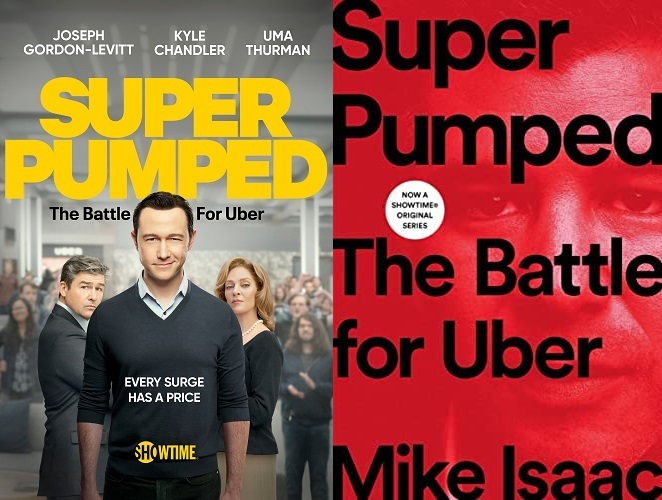
Super Pumped, the book, is an in depth look at the rise and fall of Uber CEO Travis Kalanick. Impeccably researched, and detailed, it goes into the twists and turns of the Uber story. A story of hubris, a complete lack of ethics, a toxic working environment, and a deep dive into the cult of personality that often surrounds tech founders and CEOs. The book also has a few gonzo moments as the author finds themselves part of the story they are covering for both for good and bad.

Super Pumped: The Battle for Uber, the TV Show, is the first season in an ongoing anthology series. The second series will be based on a forthcoming book, also by Mike Isaac, on Facebook. The TV show does an excellent job of capturing all the major beats and intrigues of the book, while also adding a distinctly more human face to its subjects. Kalanick is much more fleshed out in his relationships with girlfriends and family. There is also much more focus on how much the key figures start out liking each other rather than just being marriages of convenience. However, how much of this is “added drama” is unclear. But given the attention to detail of most of the rest of the story, I am inclined to believe the implication if not the actual events themselves.

Where the TV show really shines is in its portrayal of the side characters and their experiences with Kalanick and his “Bro” culture. Episode five is an extraordinary study in sexual harassment and a dysfunctional Human Resources department as experienced by regular employees. Another scene that stands out is when (spoiler) Kalanick’s girlfriend is breaking up with him, an event that clearly affects him, but yet he stops the argument so that he can answer an email on his phone. The book certainly focuses on the sexual harassment aspects of Uber’s culture, however, the visceral nature of the TV dramatization makes for uncomfortable viewing without straying into exploitative / voyeuristic territory. A thoughtful selection of scenes from this episode would make an excellent starting ground for understanding sexist work cultures and how to avoid them and the sexual harassment that ultimately results for managers – both new and old.

The story of Uber and Travis Kalanick is an extraordinary one and is worth your time as a cautionary tale and as a reflection on our cultural blind spot when it comes to convenience. What kind of world do we live in where convenience trumps ethics and the celebration of behavior this is, not to put too fine a point on it, despicable? Does success excuse bad behavior or does success breed a lack of respect for the rules? Does startup culture, which embraces out of the box solutions, also include the idea that as long as you are successful all will be forgiven?

While Travis Kalanick is undoubtedly an extraordinary individual, the TV show rarely makes the viewer feel anything other than deep unease if not downright dislike. The book, while less personal and emotional, is able to illicit sympathy for Kalanick during a meeting with the author and, when out of spite, one of the Uber board members leaks details of Kalanick’s departure from Uber – humiliating him, when the agreement was for a face-saving departure.

By the nature of a TV show, even a series, it can’t go into the detail that a book can. It is interesting that Super Pumped the TV Show starts when Uber is already a reality and uses conversations between protagonists to comment on its past founding and early days. Whereas the book starts from Kalanick’s previous start up and Uber’s humble beginnings as an idea of Garrett Camp when he could not get a cab. Likewise, the TV show ends with Kalanick’s ouster as CEO whereas the book continues into the intrigues of finding a successor and the settling of various lawsuits.

While Super Pumped the book is very much worth your time; Super Pumped: The Battle of Uber, the TV show, is the more extraordinary piece of media. Incredibly watchable, and a useful tool for managers when it comes to toxic internal cultures, the TV show is worth staying up till 2:00AM, as I did, to watch the entire thing in one hit.

Both will also make you download the Lyft app.

pexels-photo-434163

To the casual observer, the world of online reviews has never been healthier.

We are constantly asked to leave reviews, or check-in, and the worst excesses of Yelp and the businesses that try to control posts, seem to have been brought under control.
However, all is not well in the world of online reviews, if it ever was.

The story of the gentleman who created a fake restaurant and got it to become the Top-Rated restaurant on TripAdvisor really should have us never trusting a review site ever again. The story is extraordinary in many ways. That the gentleman concerned made a living writing fake reviews for restaurants, and then was able to manipulate the system to such an extent that a non-existent restaurant, that nobody could find (and they tried), are just two. That the whole thing went on to become such a phenomenon that he effectively had no choice but to create the restaurant to service the demand, is just the icing on the cake.

Yelp, that boogie man to most small businesses, are increasingly cracking down on those who request reviews. Always against Yelp’s terms of service, the practice of asking for reviews is considered best practice by most marketing professionals with the occasional caveat for Yelp. One look at the unregulated, and widely gamed world of Google Local reviews, where a significant proportion of reviews seem to be highly suspicious, and that lack even the admittedly flawed tools that Yelp uses to protect their review ecosystem, should give one pause. The wild west of Google’s review space is so out of control that businesses that do not game the system are at a distinct disadvantage.

It is actually to Yelp’s credit that they do care about their review ecosystem. It is easier to report a Yelp review that a business has issues with, than with any other platform. Yelp also takes seriously the practice of Yelp Bombing and the Weaponizing of Reviews;

particularly when it comes to a business in the news. However, far too many customers use Yelp as a threat, or even as downright extortion, on a daily basis. Even with Yelp’s reporting tools, the rules are still so arcane and at times they can seem downright arbitrary.

To add to the bad news in the reviews world we have to add the knots that both Glassdoor and Indeed are tying themselves up in by trying to have their cake and eat it. Glassdoor, which created a space for employees to share salary, benefits, and culture reviews about their former, and current employers reads more like a platform for griping from former employees unless your company is of sufficient size to generate more than just a handful of reviews. In order to monetize their site, Glassdoor are now encouraging employers to advertise on their platform with limited success. Why would an employer help pay for a site that essentially tries to undermine the narrative that an employer tries to portray to new hires?

Indeed, the highly successful job board that bases its pricing model on an adwords like format, now want to try and imbed employee reviews about the companies posting jobs. Effectively Glassdoor is trying to become Indeed, and Indeed is trying to become more like Glassdoor. What both companies are only now coming to realize that businesses are generally not fans of an unregulated review space, which all too quickly devolves into a method for revenge for former employees who feel wronged. Which in turn means employers can feel they have no option but to try and game these sites themselves. Plenty of new employee orientation sessions now include a “write a review” segment.

So, the review world is a mess. How to fix it?

In a twist worthy of one of its own plot lines, the dystopian science fiction anthology show “Black Mirror,” currently on Netflix, potentially shows a way out of the quagmire of everyone trying to manipulate the review space to their own ends. Titled “Nosedive,” the Black Mirror episode is set in the near future where everyone is concerned about their social media profile, which affects everything from their job to where they can live, and follows a young lady trying to leverage a wedding invitation to increase her social standing. However, things do not go as planned.

What is interesting about the episode is the idea of a single social profile that has, for want of a better word, a points system based on karma. Be nice to gas station attendant and your karma goes up. Be a jerk and it goes down. Of course, things work both ways, but it does highlight the problem with the review space as it currently stands. With the possible exception of Facebook, the vast majority review sites do not require, and sometimes do not even allow, real names. None of the review platforms allow for business to review customers, and while on Yelp and Google, one can see what their history of reviewing is like, there are no consequences for constantly leaving bad reviews, or trying to blackmail a business.

Lyft and Uber do have a review platform that works both ways, between customer and driver, however this is less of an open system than just a general ranking. It is a step in the right direction though and one that the more traditional review sites could learn from.

Facebook is probably in the best place to implement a customer ranking, or even a review ranking system. Facebook is become ubiquitous in so many areas. For those who have read Ernest Cline’s superb “Ready Player One” will recognize that Facebook is essentially placing itself as an equivalent of “The Oasis:” a portal on an online virtual reality environment where people work, learn, and play.

There was a time when if a customer had a problem they would complain to what was essentially an independent body, who would help to try and come up with a compromise to customer service issues and arbiter disputes. The Better Business Bureau (BBB) did not fair well in the internet age and is now pretty irrelevant with most customers now turning to Yelp or Google.

Businesses are mostly at fault for not doing a better job of embracing the BBB, however, with the swing firmly going in the other direction now, and the space being corrupted out of all reason and sense by both businesses and customers, things have to change if reviews are to be of any relevance or even any use.

The days of the BBB do seem rather quaint, but maybe their model was right after all. I look forward to a level playing field with or with out a referee.

And remember to leave me a review!