Archives for posts with tag: relationship

Veterinary Medicine is about communication. Our patients don’t speak. They can’t advocate for themselves so pet owners, doctors, and team members must communicate with each other on their behalf and as clearly as possible.

However, there is a relationship within the practice which is even more important. It is that of practice owner (PO), usually a DVM although the same applies to corporate practices with a medical director, and the hospital administrator / practice Manager / office Manager (OM).

If these two people cannot agree, or agree to disagree, all the other great things that can happen within the practice are subject to failure on a monumental level.

Everything flows from this relationship.

Protocols and standards of care can’t exist if the two people responsible for implementing them can’t agree on what they are and how they should be applied. How can equitable and fair human resource decisions be made if one of these two people plays favorites and overrides the other when it suits them? They must be able to have difficult conversations, where they both will have strong feelings about the results, and must be able to come out of that conversation without hard or hurt feelings that get in the way of their continued relationship.

Vision, Mission, and Core Values statements can go a long way to resolving these issues – but only if they are the living breathing guidelines of the practice. More fundamental is that there is mutual respect between PO and OM for both their respective roles and their responsibilities. They also need to present a united front on matters of change.

Unfortunately, this relationship is often unequal. Practice Owners, by definition call the shots and have the last word. Ideally, they empower their OM as their representative to make decisions and implement policy. However, if there is no trust, no respect, there is no way that is going to happen and no way for the OM to do their job. Likewise, if the OM is constantly aligning themselves as an employee rather than as a member of senior management / ownership they are unlikely to receive the trust from a PO that they would want and rightly so.

There is a balance to be reached and that’s why I advocate that the relationship between PO and OM has to work for anything else in the practice to work. This is also the reason why I am always against PO and OM being married or related in other ways – other parts of their relationship creep into the PO and OM dynamic. PO and OM should not be best friends – there are times they are going to disagree and that’s fine – that’s how it is supposed to be. They represent different interests of the business.  

So what if that relationship is not there or there has been a breakdown?

Communication.

Communication.

Communication.

Fundamentally if PO and OM can’t communicate then the relationship is dead. Unfortunately, that probably means the OM needs to leave either by resigning or being let go. It does no good to anyone for there to be infighting between the leaders of the practice. It certainly does not help the practice.

What sucks for the OM in this situation is that jobs of that type in the veterinary industry are usually one per practice. That means if there are ten practices in your town then there are only nine possible jobs for the OM and there are no guarantees that any of them are looking. There are, of course, opportunities in other industries; good leaders and managers are always in demand; however, that means learning another industry.  

If the relationship between PO and OM is broken something must change because this is the relationship that can’t be broken for the practice to function. Take care of your own mental health and that of your team.

Be honest about this relationship and either fix it or move on.

Feature image courtesy of Zahid H Javali & Dmitry Abramov from Pixabay
age of infuence
I’ve been following Neal, as a voice on marketing and social media, for easily 10 years.

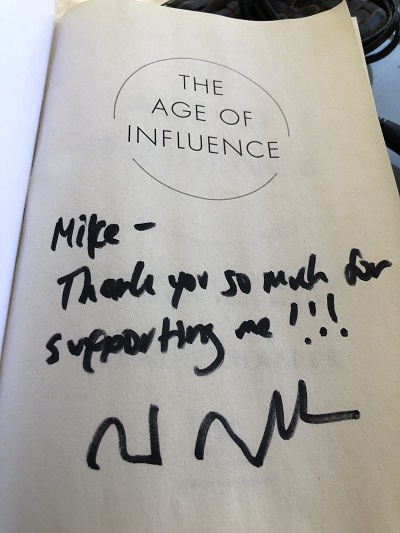
When he announced the opportunity to buy his new book in advance, receive a signed copy, and be mentioned in the acknowledgments for to helping to support the book’s creation; I took him up on his offer – LinkedIn paying off once again.

You can find me mentioned, and neatly bisected, between page ix and x.

Fame at last.

I delve into this minutia because Neal’s book deals with, and makes the case for, influence and influencers. In how to both leverage and engage influencers in a successful business relationship, but also on how to be a successful influencer in the first place.

Influencer Marketing has received rather a bad wrap outside of the marketing world – particularly by the business community. This is mainly due to news stories of millennials traveling the world, and expecting hundreds of dollars in free goods and services in return for a good word on social media of dubious value. It is also not helped by stories of influencers using their networks to “take revenge” on businesses they feel slighted by; or who have spurned their advances.

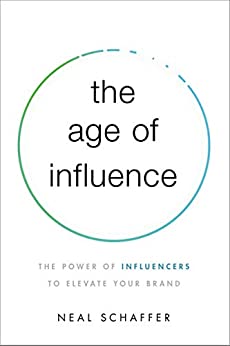
“The Age of Influence” makes the case for influencer marketing to actually be an extension of normal social media engagement, taken to its next logical level. Those of us that have our own brands, and brands that we work for, on social know that our own personal posts are treated much more favorably by algorithm gods than brand business posts. It’s a “pay to play” world.

Influencer marketing leverages the personal voice for business purposes. Where “The Age of Influence” really succeeds is in showing the reader that influencer marketing should really be about the relationship between the brand, the influencer, and their larger social following. That the pinnacle of influencer marketing is not a paid Instagram post by someone famous. The pinnacle is rather the partnership, on a long-term basis, between a fan of a product or service, who also has their own fans who trusts the message because of the messenger. Trust is based on authenticity.

There is, of course, a tendency for brands to want to control their message, voice, and overall look. This is normal. As marketing professionals, we spend a lot of money, time, and energy into creating a look and personality for a brand that we are happy with. However, to do this with influencers is to stifle their natural creativity and voice that made them influencers in the first place. Likewise, influencers are not content creation adjuncts to the marketing department. Working with influencers, whose followings come in all shapes and sizes, is a partnership that could be allowing them to interview staff, get a sneak peek at a product or service, or giving discount codes, or products, to followers. The more successful the influencer, the more like working with a traditional media company the relationship becomes. But at its core, when influencer marketing is successful it is about a relationship where both parties are happy and getting what they want out of the collaboration.

There are significant legal issues with paid collaborations between influencers and brands. And while “The Age of Influence” does not deal with this in depth, it does warn of the pitfalls and make it clear that these are issues to address with any campaign that must be taken seriously.

“The Age of Influence” is much more than a “how to” manual of influencer marketing; it is a treatise on how influence is actually about boosting engagement and having a more dynamic relationship between customer and brand. How in its earliest of stages, influencer marketing is indistinguishable for just good social media engagement. As Neal states in the book, don’t get too focused on the tools; but the tools to get started are all in “The Age of Influence.”

If you feel that influencer marketing is not for you; “The Age of Influence” begs to differ, and if your interest is already there then it is the all-important bible.

IMG_4552 small