Archives for category: Marketing

I have a problem.

I love my smart phone a little too much, and I hate that.

A cell phone has been my constant companion for over 30 years. I never had one of the giant brick phones of 80s yuppies but my first phone was one of the first that made those phones look ancient even then.

However, the advent of the iPhone and social media changed all that.

I’ve spent a significant portion of my career working, at least tangentially, with social media. I still enjoy social media and find it to have value, but I am more and more aware of the downsides. I think the real turning point was TikTok. The pull of those short form video snippets was often just too much on days where not much was going on. Losing hours to the app, while not all valueless (poetry, politics, history, and religious scholarship can all be mixed in with the stupid cat videos and hilarious footage of people hurting themselves) was disconcerting. Like the borderline alcoholic that realizes that perhaps always having beer in the house is not such a good idea, when the app starts warning you that perhaps you’ve been on it too long, you know there is a problem.

I should make clear that I still like and enjoy social media. I’ve been making content for social media and the internet for well over two decades. Call me shallow, but I have much in my life to thank social media for. I also feel that its current place in society is so firmly cemented that to be without it would be detrimental to how I live.

But something had to change.

I’d turned off notifications years ago, no longer being the frontline person responsible for the hospitals’ I manage social media and reviews, has its advantages. For my own personal pages and sites, a brief check whenever I had a moment would do.

But the checking got way out of hand.

Sitting at my desk and getting sucked into checking the groups I was a part of, my social channels, and even personal email seemed to consume more and more time. Even more insidious, was the “always on” home display on my iPhone 14 Pro.

I’d managed to resist the draw of Apple Watch and other smart watches. Partly due to my affinity for real watches, but also because the constant checking seemed even more intrusive than I was already experiencing and harboring qualms about. It also helped to have coworkers who love their Apple Watches and them checking them while mid conversation was annoying enough to “not be one of those people.”

However, the extremely useful always on of my new, at the time, iPhone 14 Pro with its time and date display along with a cute picture of one of my dogs was gateway and constant reminder of the joys of browsing my phone.

But how to change.

When I travel, which I do a lot of for significant portions of the year, the scene in airports is one of obvious Smart Phone addiction. Rows and rows of people, not talking, not reading a book, but low level browsing of social media. I’m not judging, I still am happy to while away the time lost in this miracle of our modern age – the interconnection of smartphone, the internet, and social media.  However, the sheer scale of how much these little devices of glass, metal, and plastic have come to be extensions of our modern selves can be shocking when one takes the place of an outside observer.

But what to do.

It seemed, I was not alone in wanting to make a change in the cycle of cellphone social media and attention-grabbing content intruding on life. Multiple celebrities were announcing their ditching of social media, and there were even a few who were getting rid of their smartphones altogether. But this removal of this seeming essential device of the 21st century seemed to reek of privilege. For every celebrity who is removing the stress of social media and the constant interruptions of a smart phone, you know there is an assistant and / or a marketing team who filter access and are ever more locked to their smartphones as they juggle their own needs and that of those who employ them.

So what for mere mortals?

I had become aware of the Light Phone when it first launched, and I laughed like most people at the idea of wanting a Dumify phone and there being value in that. Now on its third generation, the Light Phone contains a lot of the conveniences of modern smartphones but with a monochromatic interface, limited apps, and no social media.

The downside of course being that I want and need social media in my life. I want and need various apps on my smart phone, to control alarm systems, remote access to work computers, control of my smart home, control of my electric car, notifications of the location of my keys, wallet, and dogs, and any number of other things that make up a connected life and work.  I was not ready to give up all that. I’ve read Ted Kaczynski and the Luddites, and I have sympathy with those arguments, I’m just not ready for the inconvenience, the disconnection, or in a place of that level of privilege, to make such a radical change.

An option would be to slave my iPhone to a Light phone as a hotspot. Meaning my iPhone could stay in my car or bag until I wanted it, but I could carry around a Light phone for day-to-day use. This seemed a needlessly complicated solution and I was also unconvinced that the temptation of the iPhone would not be too much and I would be back to square one but $500 poorer.

Then I found Dumify.

Dumify is an iPhone app, also available for Android users but you are on your own from here on out, that mimics the simpler interface of the Light phone, but does not impact the functionality of or even the regular interface of the iPhone.

By adjusting a few settings, and then just entering the apps you want daily / easy access to, the user can create a non-engaging, and thereby not tempting, interface for the things that matter most to you in a smart phone.

After a few weeks of use here is what I have found.

My smart phone screen time at work has plummeted making me far more productive when I am at my desk.

I still use and enjoy social media but it is as a choice rather than a need. I am therefore finding it limited to specific times of the day.

My simplified lock screen – see below – still can be a temptation but far less so.
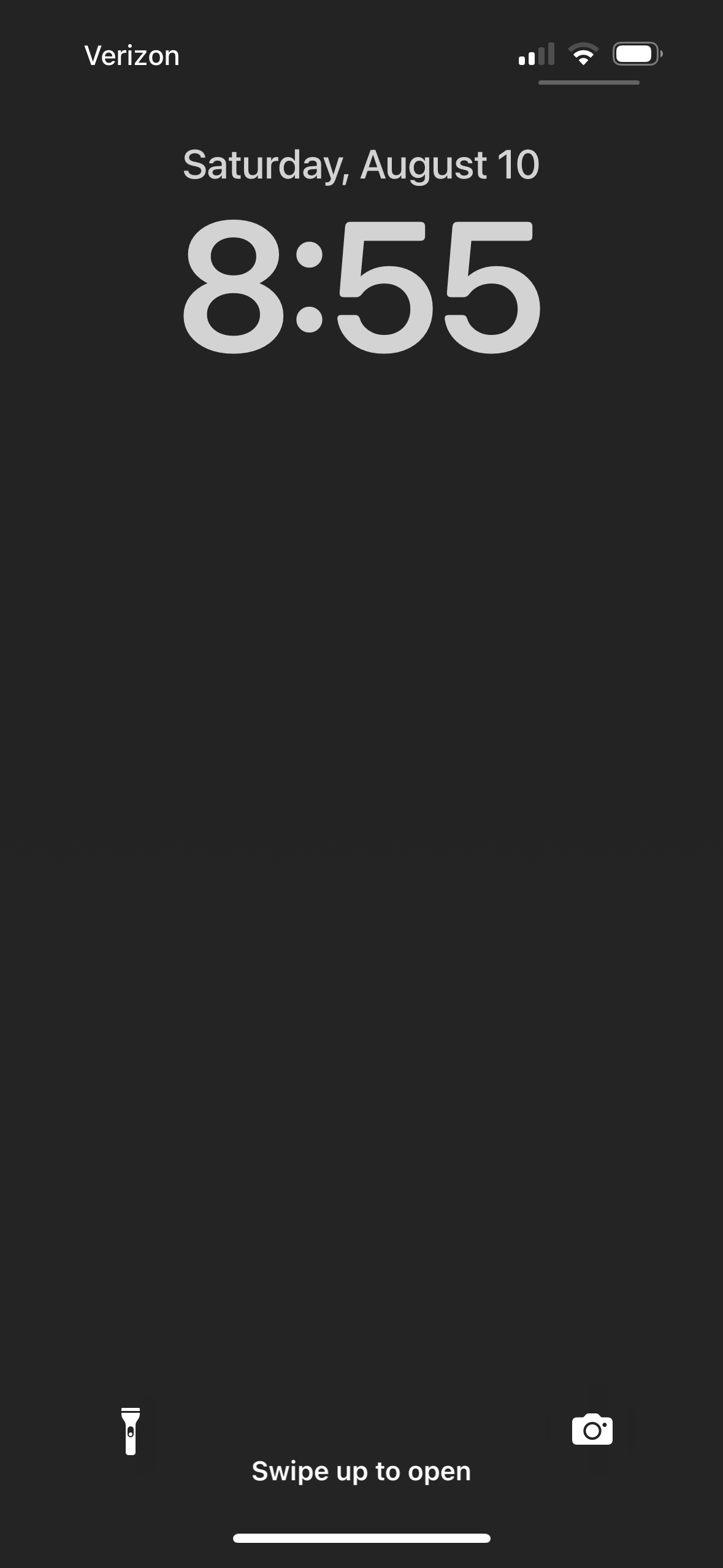
In addition, when I open my phone, I get an immediate reminder that I really don’t need to be checking Instagram, Goodreads, LinkedIn, or whatever, right now due to the interface. That simple reminder, a reminder of virtuous smartphone usage if you like, is all I need to put my phone down.

Many people, when using a tool like Dumify, delete a lot of their other apps. I have not done this. I still like my iPhone. I just use it differently. A bit like being smart about alcohol consumption while driving. An unexpected bonus has been that I have been finding myself leaving my phone in my jacket pocket when I’m in the car. The temptation to check an app while at a set of traffic lights is now gone.

While the setup of Dumify is simple, and the app contains shortcuts to most popular apps, some research for company specific apps may be required. There are also multiple short videos embedded into the app to help the customization process. On the iPhone, the app uses URL Schemes and while it blithely suggests “just search on Google” for anything the app does not already have, I found this a little more complicated than I would have hoped. This might say more about the appalling state of Google search right now, than a lack of awareness by the app developers.

I found this article on URL Schemes extremely useful, however I did end up finding a few on my own either through searching or trial and error. It should be noted that the app uses a very basic implementation of URL schemes, and a lot of the documentation is about how developers can hack iPhone apps to do very specific things. When this is the case, I found just stripping the URL to its most basic form worked great.

These are the URL schemes I ended up having to make myself. I made most of them through trial and error as they are pretty simple.

Harmony Remote          harmony://                       

Hertz                                    hertz://

Lyft                                        lyft://

Music                                   music://

Open Table                        opentable://

Outlook                               ms-outlook://

RingCentral                       rcapp://

Southwest                         southwest://

Wallet                                  wallet://

Itunes Remote                 remote://

Dumify will also make you download a second app for some links. But this is seamless once it is downloaded.

Dumify is a onetime $4.99 purchase – another reason to love it. There are couple of other apps out there that do similar things to Dumify, but they follow a subscription model, and I was less impressed when I looked at them.

Dumbing down your smart phone is not for everyone. Just like being always connected is not for everyone. But it is nice to have choices, and I feel genuinely more in control of my time and feel that access to this wonder of the modern age is now on my terms and not on its terms.
Image of George Orwell by Gordon Johnson from Pixabay

“Any sufficiently advanced technology is indistinguishable from magic” – Arthur C. Clarke.

In a remarkable about face for a technology company, Amazon has confirmed that it is moving away from its “just walk out” technology at its Amazon Fresh stores. The technology boasted that it used a mixture of cameras, sensors, and artificial intelligence (A.I.) to know what consumers had put in their baskets and to accurately bill its customers without all that tedious checking out and interacting with another human being at the grocery store.

Image Copyright Amazon.com used under fair use for criticism, comment, or news reporting.

What was actually happening was that up to 1,000 people in India were watching and tagging videos to ensure that customers were billed correctly. Amazon has apparently laid off almost its entire development team of this “technology” and will start to phase out this service from its existing Amazon Fresh stores. This is all the more surprising after Amazon’s experience with A.I. recruitment. In 2015 Amazon had to abandon an A.I. résumé reading project due to being unable to stop it from discriminating against women. It was seen by many as a humiliating comedown for the tech giant.

Image Copyright Amazon.com used under fair use for criticism, comment, or news reporting.

“Pay no attention to that man behind the curtain!” — The Wonderful Wizard of Oz, L.Frank Baum.

While many will smirk at Amazon’s second major public A.I. failure, and I have to admit to being one of those people, there is a bigger issue here which Amazon should be commended for. It is the lifting the vail on A.I. tools that are not some magic that comes out of the ether. They often require human intervention to be usable- both in front and behind the keyboard. In addition A.I., or more accurately Machine Learning , need examples of human labor in the thousands, if not millions, to be trained. The training of these A.I. “models” has become a contentious subject for those with an interest in A.I. both as supporters and critics.   

“Any technology distinguishable from magic is insufficiently advanced” – Barry Gehm’s corollary to Arthur C. Clarke’s original quote.

The main issue with machine learning is that the A.I. industry, almost without exception, sees art, music, writing, film, and pretty much the entire internet as fair game for training A.I. models, which they in turn sell to us in the guise of generative A.I. Those of us on the other side (waves hand in air to indicate exactly where I stand on this subject in case you had not already guessed) say that copyright does not work that way. Derivative works are still derivative.

 It is indeed hilarious to watch companies such as Disney try to navigate this brave new world. On the one hand, Disney has tried to argue that generative A.I. is fine for them to use to create new works based on the work of artists they have employed in the past. But Disney has then complained about possible copyright infringement when someone else has tried the same trick with copyrighted works they own.

Image Copyright Walt Disney Company used under fair use for criticism, comment, or news reporting.

The lawyer who used ChatGPT to write a legal brief might want the machines to infringe a bit more. To his cost, literally, the lawyer found out that the pesky machine had just made up all the cases that it sited in its argument which he signed his name to. He was sanctioned and fined after he was found out. I just love that generative A.I. tools hallucinate (the developers term, not mine).

One of my favorite activities these days is to ask A.I. peddlers what they use to train their models. Indeed, I had a most entertaining afternoon doing just that at this year’s Western Veterinary Conference. Amongst the answers I received were “none of your business – who are you” (my favorite), “medical records from a university,” and “the internet.” None of the vendors I spoke to were willing to discuss privacy, copyright, or what happens if they are no longer allowed to train their models that way. One gets the distinct impression of building on borrowed land.

The latest darling of the A.I. generation tools is Sora, which creates beautiful full motion video from text prompts and is from the OpenAI stable. However, in a recent interview with the Wallstreet Journal, Mira Murati, OpenAI’s Chief Technology Officer, refused to answer questions about where Sora’s data set for modeling came from. Murati also refused to say whether the data set that Sora used included YouTube and Instagram videos – stating that she “did not know.” That in turn has led to some serious questions about licensing, as YouTube’s CEO Neal Mohan, confirmed that OpenAI using YouTube content for modeling purposes would be a violation of YouTube’s terms of service.  

“Thou shall not make a machine in the likeness of a human mind” – Dune, Frank Herbert

There is a temptation to label those who speak out about our current infatuation with A.I. tools and criticize the foundations those tools are built on as luddites. While our current use of the word brings to mind hoards of unemployed mill workers bent on smashing “the spinning jenny,” the truth about the Luddites is actually far more nuanced and carries a message for today.  The Luddites did not hate all machines, they in fact were fine with most and just wanted them run by workers who had gone through apprenticeships and were paid decent wages. The Luddites main concern were manufacturers who used machines in “a fraudulent and deceitful manner” notes Kevin Binfield in his book “Writings of the Luddites.” Outsourcing the cashing out of grocery shopping to a developing country, and labeling it as new technology, is a tactic the Luddites would have been all too familiar with and would have been happy to march against.

While I am not advocating for a Butlerian Jihad as Herbert described as the backdrop for Dune, there is merit in the context he provides to the proscription on thinking machines.

“Once men turned their thinking over to machines in the hope that this would set them free. But that only permitted other men with machines to enslave them.” – Dune, Frank Herbert.

As author SJ Sindu wrote on Twitter (I refuse to call it X on general principles); “We don’t need AI to make art. We need AI to write emails and clean the house and deliver the groceries so humans can make more art.”

A.I. art needs human art to model itself on and the pushback from artists and consumers is already significant. When the argument over modeling reaches the courts, the damage may already be done. Only then will we see the parallels between the creative arts and A.I. that we saw in the 2000s with Napster / Pirate Bay and music. Will it be too late to put this tool back in its box?

A healthy skepticism when it comes to A.I., I think is all important. And not just a skepticism for what A.I. can do but for the intentions of those that wield it.

A.I. will need to be “open” and not just open as in the name of a for profit corporation. Its models will need to be transparent and be able to be questioned. As I wrote about in my review of Hilke Schellmann’s book on A.I. in hiring and Human Resources “The Algorithm”; …it is often difficult to impossible for candidates or employees to challenge decisions by managers which they may feel have been affected by bias. How much more difficult is it when it is not a human making the decision or recommendation? A tool of which we cannot ask the most basic of questions: what were you thinking?

Footnotes and links would be a great start. But most generative A.I. companies consider this proprietary information and therefore refuse to provide what would seem a most obvious step when it comes to trust. That, in fact, is exactly why authors use footnotes and links, to allow others to follow their thinking on how they reached their conclusions. I’ve tried to add as many links and footnotes as I can to this article without becoming burdensome.

I am not a Luddite in the modern sense, but I do share a lot of the same concerns of the Luddites of old. We only need to look at our world to see why we should be concerned. It is a world where poor people in the developing world watch us shop so that we can pretend we are living in a magic future where machines do all the work. Where the drudgery of making art has been taken away from us so it can be sold back to us by corporations owned by billionaires.

I’m not sure I want A.I. to write my emails, but I can think of plenty of things that I’d like it to undertake. I already use it in a number of ways. I’ve used A.I. images in my books (although I probably will not do so in the future). I currently feel that A.I. has to earn its place in my world by proving its benefits not just to me, but the world as a whole. Will the undertakings of A.I. be for the benefit of people? Currently, that seems to be the last thing on the developers’ minds.

“The tune had been haunting London for weeks past. It was one of countless similar songs published for the benefit of the proles by a sub-section of the Music Department. The words of these songs were composed without any human intervention whatever on an instrument known as a versificator. But the woman sang so tunefully as to turn the dreadful rubbish into an almost pleasant sound.” – 1984, George Orwell

There are a lot of books about Twitter out there right now. That is perhaps not a surprise given (Spoiler Alert) that it has become a corporate / Silicon Valley dumpster fire.

Mr. Wagner’s account is balanced and well researched; however, one cannot feel while reading the work that it is missing the insider juicy details that make tech CEOs squirm. Perhaps because so much of Twitter’s (now X’s) dirty laundry has already been aired there is little new revelations in the work.

What” Battle of the Bird” does do is provide a clinical timeline from Twitter’s founding through to the events leading up to its purchase by Elon Musk and the unravelling of the technology institution under his stewardship. This in turn provides insights into the failure of Jack Dorcey (Twitter’s former CEO and co-founder) and Elon Musk’s failures with X.

As I talked about in my review of “Kingdom of Happiness” by Amiee Groth which referenced the failures at Zappos and the Downtown Project, both Dorsey and Musk in hindsight have had a failure of leadership due to a lack of management. It is all very well being able to persuade people to jump out of a plane, but you have to ensure that they have parachutes and know how to use them.

There is no doubt that Dorsey and Musk both do, or more appropriately have at one time, loved Twitter and what it has brought to the world. While Dorsey, according to Mr. Wagner’s book, seems to have lost interest in Twitter as a company once the reality of being a public company set in. Musk on the other hand, seems far too interested in his own press and ego once he understood the challenges Twitter faced and continues to face even after his pointless rebranding to X. It is hard to feel sorry for billionaires when the world does not work the way they want it to.

There is a theme throughout the book that perhaps Twitter can’t be a company. Dorsey in particular laments that what Twitter should be is a technology like email, that allows for the exchange of information, but that is not gatekept by any one platform. This is the kind of wishful thinking of people who have been made rich by the decisions to take their company public and have second thoughts. That they wish the world could be a different place. It can be, but only if different decisions are taken – the kind of decisions that don’t make entrepreneurs and venture capitalists rich.

Like I said, it is hard to feel sorry for billionaires when things don’t go their way.

Mr. Wagner does go into some reasonable depth as to the ethical dilemmas brought up by Donald Trump’s tweeting and his eventual banning from the platform. These are bigger issues than Twitter, but the impact on Twitter for both Dorsey and Musk were profound and still rancor the platform to this day. I’m not sure I want a committee of Twitter employees making decisions on whether what a world leader says is appropriate for public consumption, but at the same time I am positive I don’t want Elon Musk making those decisions.

As a grounding in the backstory and drama that is Twitter, now X, Battle for the Bird is a great document. Not a thrill ride or exposé, but a methodical grounding in the facts.

This is probably for the best given its subject matter and the turgid realities of Twitter’s recent past.

Perhaps this is the account we need rather than the one we might want.

Want to read a takedown of the leaders of the tech world, that calls them out for their hypocrisy and recklessness?

Of course you do.

Burn Book is, for the most part, that book. A book that at its most fundamental says “you promised us a brave new world – and what you delivered us was a more rapacious form of capitalism.”

The author, Kara Swisher, is a long-time journalist and analyst of the “tech sector” – particularly in Silicon Valley. She is also the co-founder of the Recode conference and the co-host of the Pivot podcast.

Burn Book, through the narrative of an autobiography, is her journey into the San Fransisco technology sector and her gonzo view of the events that, for better or worse, have shaped the world we currently live in – particularly its technology.

Where Burn Book really scores is in its view of characters such as Elon Musk, Bill Gates, Mark Zuckerburg, Steve Jobs, and Sergey Brin. From their early days, the beginnings of their success, through to their either refusal to accept the damage of their legacy, or the issues with how that legacy was formed, but also for some of them; their efforts to make amends. One is left with a sense of these figures riding waves that they barely understand or control. That often these figures are deeply flawed individuals who’s flaws have help lead to their success, but that long term they themselves are unrecognizable from the people they once were. Changed by wealth and power and all its trappings.

As Swisher mentions in the introduction; “move fast and break things” is in retrospect indicative of the tech scene entrepreneurs and their willingness to not think through the consequences of their actions. (Move fast and break things was an early internal Facebook slogan that was widely adopted by the tech sector).

Where the book becomes annoying is the author’s habit of “I told you so.” While this may well be true, and the whole purpose of the book is essentially to name drop, and let’s be honest that’s why we are reading it, it can become a little frustrating and seemingly self-aggrandizing. Swisher has earned the right to trumpet her vision and does have a record of putting billionaires on the spot, however, she does seem to fail to see the larger picture of the issues with this kind of innovation model.

Swisher is a self-proclaimed “believer in tech,” and this leads to the impression that she feels if only developers and tech titans were nicer then the world would be a much better place. This is quite possibly true, but one has to wonder about an industry who are happy to undermine industries and even societies, while failing to follow the basic rules that everyone else follows.

To Swisher’s credit she recognizes how close she has become to the tech sector and how that potentially impacts the objectivity of the analysis she gives. Of late she has made efforts to put distance between herself and her subjects. It would be easy to see this book as one of those efforts.

Burn Book is for the most part an enjoyable read with lots of moments to savor for those who want to see the self-proclaimed “Masters of the Universe” taken down a peg and be held to account. It does also do a pretty good job of exploring the duality of some of the complex individuals who run or formed some of the largest companies on the planet with little to no oversight. The author lauds Steve Jobs, for example, but does point out some of the flaws and cruelty that mars his legacy. It is not an in-depth analysis of all that is wrong with tools such as Facebook and the tech sector as a whole, but then it does not set out to be.

This is an autobiography and a story about being in love with an industry. The all too predictable break up, with the realization that who you were in love with is not quite the person you thought they were, is just another part of that love story.

As that, Burn Book succeeds admirably.

Let me tell you a secret about most business books – they are not about business. Oh yes, they claim to be about business, how to work with people, and affect change, but in reality a lot of them are not. They are often about the hard things – finance, cost control, selling, and product development, or the soft things – people management, team dynamics, and marketing. Rarely is a book about how all these things fit together, and how to grow while at the same time dealing with the realities of business day to day.

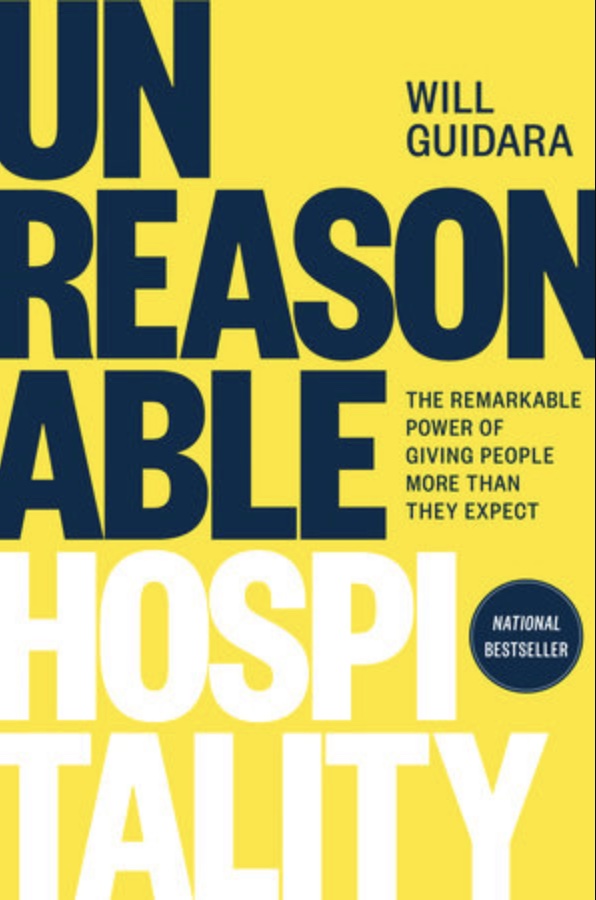
Which is why Will Guidara’s book “Unreasonable Hospitality: The Remarkable Power of Giving People More than They Expect” is so refreshing. This is part memoir of a restauranter and part business manual on blending soft and hard skills that all businesses try to do – with varied levels of success. Mr. Guidara was the general manager of a number of fantastic restaurants, including Eleven Madison Park which became the number one restaurant in the world.

For a book that talks a length about people, values, growth, and mission it is so unusual to hear the real world politick of “I’m also clear about what my job is, which is to do what’s best for the restaurant, not to do what’s best for any of you (the staff). More often than not, what’s best for the restaurant will include doing what’s best for you. But the only way I can take care of all of you as individuals is by always putting the restaurant first.” Just wow!

And that quote really sums up the problems with a lot of books on management and leadership – they are two different things people and not mutually exclusive (I can shout that louder for the hacks with the crappy memes) – we are often being asked to hold ourselves to an impossible standard. People are sometimes not the right fit, sometimes we just have to get through the shift, sometimes we are not going to be perfect. An illuminating passage deals with the idea that while it is often trotted out that employees have a language of appreciation, they may also have a language of criticism – people may need feedback in different ways depending on their personality and work history.

I love the advise to “not let things slide – those small things become personal slights.” This is often ignored because every manager today fears being labeled a micro manager. Just like I also appreciate Mr. Guidara’s works to be maniacal on cost control for 95% of your costs and then to spurge for the last 5% to make a difference to the guest experience.

There are times when this book feels like it is written by the staff from the movie “The Menu,” yet at the same time one has to appreciate what Mr. Guidara was trying to do with his business and why he was doing it. The book says, there is nothing wrong with striving for perfection, as long as perfection is not the standard – little things are always going to go wrong. That does not mean one should not try, but it means managers and leaders have to accept realities.  

It may seem extreme and over the top, and it is, but that is the whole point of being “unreasonable.” To give people more than they ever expected in a controlled manner so it can be systemized and scalable. I’ve been banging on about scalability for years, and so to read it in this book was like having to tell the author to get out of my head.

This book should be required reading for managers and leaders of any business who want to deliver a better experience for everyone – including the owner of the business. This is appreciation that businesses are businesses. They must make money and they have to be able to work when you are not there. There has to be systems in place, protocols and procedures, so that everyone knows what to do and new people can be easily trained on what to do.

Unreasonable Hospitality is what business books should be. Simon Sinek, who wrote the introduction and I have been on record for forever as having no time for, could learn a lot from this book for example.

This is where the rubber meets the road. For those who want to add to their passion, or just rekindle it, it is hard to find a better way to do so than to read this wonderful book.   

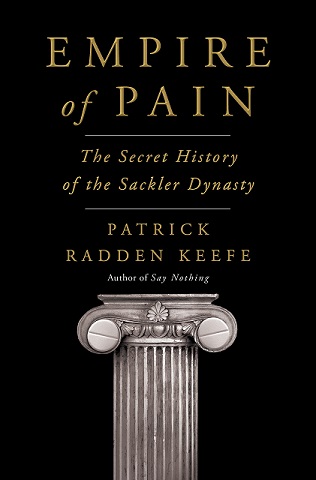
Empire of Pain is superb in its scope and breadth.

It is not just the story of the rise of prescription opioid use and abuse and OxyContin and Purdue Pharma in particular, but it is also the story of the Sackler family. The owners of Purdue Pharma. Their rise to wealth and power and their role in not only bring OxyContin to market, but their role in setting the stage of the opioid epidemic and crisis, and the multitude of lawsuits.  

There is a lot to unpack in this book and a lot of lessons for society. However, what is of particular interest to me in Patrick Radden Keefe’s outstanding work is what Empire of Pain teaches us about company culture and values.

The Sackler’s have never admitted any wrongdoing for their role in the selling and distribution of Oxycontin, although Purdue Pharma has. This does not just stem from not wanting to go to prison, but from a cultural belief, both inside the family and at the highest levels of Purdue Pharma, that the Sackler’s could do no wrong. Even when marketing strategies inside the United States and outside the United States contradicted each other, the lack of any moral reevaluation of what they were doing to the detriment of millions, never seems to give any of the family pause or cause for reflection.

Even members of the Sackler Dynasty who had little to no involvement with Purdue Pharma were not prepared give thought as to the moral questions surrounding their wealth. Even when their work would seem to be directly involved in reflecting the human costs of the opioid crisis they seemed oblivious or to deliberately obfuscate. Madeleine Sackler is a filmmaker, who in 2018 made a fictional drama, O.G., and a documentary It’s a Hard Truth Ain’t It, entirely inside the level four Pendleton Correctional Facility. However, as the author states, Sackler “was able to weigh in, sagely, on the plight of America’s prison population without being asked to account for her own familial connection to one of the underlying drivers of that crisis.”

What is so surprising about the Sackler Story was the extent to which the Sackler family, while in theory only being board members of a private company, were able to co-opt and influence. This was not just decision making, marketing, and research on a day-to-day basis inside a company that others were supposed to be running, but the Sackler’s were able to influence the culture and thought of those at Purdue Pharma. Of course, money, power, and influence all played a part, but what is most remarkable, and disturbing, is just how much they were able to value loyalty above all else, and that loyalty meant thinking the same way.

It is clear from Empire of Pain, that while there are few who support the Sackler family today – they are virtual pariahs today in the art world, a world where their philanthropy had made them famous – there are still those who are colored by what Hanna Arendt called “the banality of evil.”

These were salespeople, marketers, CEOs, lawyers, secretaries, doctors, and researchers, who all bought into a view of the world so out of step with reality that it led to a crisis that some have stated is “bigger than the HIV epidemic.” The author even notes in his epilogue that the Sackler family story is bereft of whistleblowers. A testament to the family’s power? Or testament to how all-encompassing the culture was at Purdue Pharma.

For those wanting a proof positive macro view of why culture and values matter, you will be hard pressed to find a more glaring example.

Want to get really scared and hopeful at the same time?

Scary Smart is a low level dive into the technology of Artificial Intelligence (A.I.) and deep level dive into the ethics and morality of those who are most responsible for how A.I. will turn out:

Us.

A.I. may seem like the new buzz term with its adoption into our daily lives through products like ChatGPT’s Open A.I. platform and Bing’s real question search algorithm; however, A.I. is baked into almost everything we do with technology. Every app on our phones and every social media platform we interact with has A.I.’s fingerprints all over them.

Mr. Gawat’s premise in “Scary Smart” is that A.I. is a child. And the best way to predict what kind of teen and adult we will get with A.I. is to be good parents. A brilliant initial example from our current comic book obsessed culture is Superman. What kind of Superman would Clark Kent have become of Jonathan and Martha Kent were greedy, selfish, and aggressive? There is no doubt that A.I. is already smarter than humans in many specialized areas, but what happens when A.I. becomes just generally smarter than the smartest human and has access to all the knowledge of humanity through the internet?

Unfortunately, humanity is not doing a very good job of raising A.I. as a child. From our methods of creating and improving these machine intelligences all the way through to the tasks that we are giving them perform, we are emphasizing our worst instincts: To create wealth, surveille our citizenry, gamble, and coming to a battlefield near you soon – to kill people.

We as a society, may feel we have no choice but to use A.I. in this way. If a foreign power, or terrorists, use A.I. controlled drones which are smarter and more efficient than any human, the only way to fight back may be to use A.I. in a similar fashion. But what does that teach our new artificial children? A.I.’s already have a disturbing habit of developing their own language when they communicate together and of finding ways to communicate with each other. What happens when and A.I. who has been taught to ruthlessly buy and sell shares to maximize short term profits starts to talk to an A.I. that has been taught to ruthlessly kill its enemies when they are shown to it?

The author’s excellent example of what might happen is the world’s reaction to the outbreak of COVID-19: Ignore the problem, try to blame someone else, and ultimately overreact upending our society. We may try to put the A.I. genie back in the bottle through pulling the plug or lockdowns, but we will fail. A.I’s will be faster, smarter, and have more knowledge than any human or group of humans. While a lot of this may seem like the dream of Hollywood Blockbusters, Mo Gawat is at pains to explain that there is little disagreement within the A.I. community that these risks are real. How real is where the disagreements start.

The possible solution to these issues, the author postulates, lies not with the developers but with users and how we define our relationship with A.I. In history, master slave relationships have not ended well for the masters – with good reason. How we interact and decide to use A.I. will define what kind of parents we will be to this fledgling new intelligence. A new intelligence that although they may start out separately will share information and communicate with each other so quickly, and with access to the memories and experiences of all those who have come before them, that it will be impossible to not consider them one single intelligence.

This then leads us to what kind of example will we set for these new children? While A.I.s have already shown that they can develop a sense of morals, and not in a good way, by their interactions with users they will also learn from our interactions with each other. Machine morality may very well not be programed by developers, but learned from observing and interacting with us. What are machines already learning from our social media, search habits, and politics?

This is thought provoking and important work essentially on morals and ethics withing the framework of A.I. that occasionally reads like a Arnold Schwarzenegger movie. If we ignore the topics it raises, we deserve our fate.

And while Mr. Gawat paints a hopeful portrait, he also shows us just how bleak things could get.  

Image by Xavier Turpain from Pixabay

Just stop it, okay?

Unless you have been living in an underground bunker for the past three years, not as unlikely as it might have seemed ten years ago, you might have noticed that QR codes are back.

Menus, adverts, buildings, and trade show booths are once again adorned with them.

Other than the pandemic, another reason for their renewal is the imbedding in the camera functions of most smart phones, a QR code reader allowing links to websites be opened by visually scanning the code with your phone.

What is also back; however, is bone headed implementations of QR codes because they are “cool.”

Don’t get me wrong, I’ve seen great implementations of QR codes. I have used them on ads and I used them extensively in the hardcover edition of my book. However, just like the article I wrote in 2012, which in turn was inspired by Scott Stratten’s rants on the subject, QR codes are a simple technology that often gets badly implemented and are used to cover up a multitude of other sins.

Please don’t put QR codes on websites

Mike’s Guide to QR Code Bliss

DO make sure that your website is mobile friendly if you are going to use QR codes. I can’t really believe I have to say this, or that anyone still does not have a mobile friendly website, but they do; and QR codes are a mobile technology. Therefore, as a mobile technology, if you are sending people to a website that is not mobile friendly all you are going to do is frustrate people who know how to use a technology better than you.  

DON’T put QR codes in emails. QR codes need to be scanned by a mobile device. Putting a QR code in a email which is then opened on a desktop requires the user to scan their computer monitor or laptop screen with their smartphone. This is nonsense. It is particularly nonsense because a QR code is just a fancy way of getting someone to click a link and links can be easily embedded directly into emails. Also, an email opened on a mobile device cannot read a QR code in that email. There are a few workarounds for this which I go into below; however, a link is simple straight forward, and we have been using them successfully for decades.  

DO make sure that the site your QR code links to is clear simple and easy to use. Having ambiguity on a target page, after someone has gone to the trouble of scanning your QR code, is just silly. It is snatching defeat from the jaws of victory. Test your QR codes. Make sure your landing pages are simple, easy to use, and above all, working. There is nothing wrong with having multiple QR codes when it comes to directing your target audience.

DON’T put QR codes in Instagram posts. For some phones this actually works – they have a built in QR code scanner for photos and there are also apps users can download to allow for the scanning of codes. However, one of the reasons why QR codes had such problems with adoption in the past was the need to download an app. But for most users, who almost exclusively looking at the platform on their smart phones, QR codes on Instagram are useless as there is no way to directly scan them. “Link in Bio,” which directs users to look at the Instagram bio, and click the link there, is a simple workaround for the Instagram imposed limitation of only allowing a single link in an Instagram users bio. There are also multiple tools, including just a website, which allows users to have that single link lead to a page where there are multiple link options. I should also add that all Instagram users can now just add links in their Stories negating the whole issue.

DO put QR codes on flyers for things that require a sign up. Flyers that get printed out and put on notice boards for meetings etc., that require an RSVP, are a great use of QR codes. Much easier than the target audience having to type in a URL or email address. Just ensure that the landing page is simple and easy to use. However…

DON’T make the QR code on a flyer the only way to RSVP / sign up. Flyers for meetings etc. are often emailed to multiple people. If a QR in a pdf document is the only way to access the link to sign up it is massive over complication for the end user. A link in an email works great. A link in the PDF also works. Hell, you could even make the QR code itself a clickable link (I don’t recommend this). QR codes are supposed to make things easier not harder.

DO make QR codes simple. The more complicated the URL that the QR code is linking to, the more complicated the QR code itself needs to be. URL shorteners can help here; however, one should use these sparingly as security conscious users may be unwilling to got to a site blindly.

DON’T make QR codes too small. The vast majority of sensible QR code implementations are to add links to paper. A user sees something that interests them on a piece of paper, and they can then scan the code for more information, to sign up for something, or even to buy something. However, tiny QR codes can be difficult for some smartphones, or users, to scan. Since QR codes are about reducing barriers to getting users to click on a link, making the link too small is just a case of shooting yourself in the foot.

DO put QR codes in videos and digital signage. But only if you are going to give users enough time to get out their smart phones, open their camera app, focus on the screen, and scan your code. If you are not going to devote enough time to allow the QR code to be scanned, and allow for the QR code to be a sensible size, then what is the point of having the QR code in the first place? Also, if the QR code is being including in content when the user can just pause the video to scan a QR code then the likelihood is that they will find clicking a link much easier. Just put the link in the description.  

DON’T think you must have a computer to display a QR code. I have seen a laptop on a tradeshow booth being used solely to display a QR code. How about a piece of paper? A QR code on a computer screen does not make you look more technically savvy. It makes you look like you forgot the sign, or the piece of paper, with the QR code printed on it.

QR codes can be awesome, particularly with smartphones having the ability to scan them built in. However, like any technology, it is only as good as its implementation. Bad implementations are just bad – they don’t get better because they have a QR code involved. Having a QR code to have a QR code is a prime example of bad implementation. They are a tool – try not to bring back 2012.

Why would we be offended if someone offered to pay us after we invited them to Thanksgiving dinner? What is the cost of zero, and why is it far more expensive than $0.01? Do we really need to tell our waiter our order in secret if we really want to feel that it is okay for us to have our first choice from the menu?

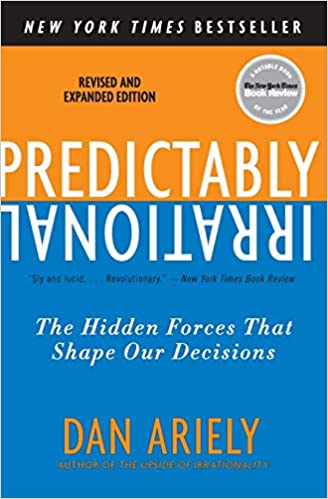
Subtitled; “The Hidden Forces that shape our Decisions,” Dr. Ariely’s superb book has the potential to change dramatically how we think about business and our personal lives.

With the use of subtle yet easily understood experimental data, Dr. Ariely exposes humans as often acting against our own interests due to societal or market norms and that we just do not understand our own personalities and the role that emotion plays in shaping decision making – spoiler its usually for the worse.

So why would we feel offended if someone offered to pay for Thanksgiving dinner? Dr. Ariely not only explains but also shows with examples and experiment data that we humans have social exchanges and market exchanges of behavior. Social exchanges we use with friends and family. They are the norms that govern daily life and allow us to bond with other humans. Market exchanges are, as they sound, the exchange of money for goods and services and also the money we receive in exchange for our labor in the form of our working lives. When one offers to pay for Thanksgiving dinner were mixing social norms with market norms. We are indicating that we are rejecting the social acceptance of those who may be friends or family in favor of an exchange that we could expect to have with a stranger. A commercial transaction. What becomes interesting in breaking these social norms is that we find it is difficult to go back. Trying to pay for Thanksgiving dinner may never get us invited back because a social exchange has been turned into a market exchange. Employers who do not have social exchanges with their employees may find that employees therefore treat the relationship as a purely market exchange and leave for an employer who offers a better market exchange – usually more money or better benefits.  This also explains why employers who do embrace a social exchange in their workplace culture become frustrated and angry when an employee uses only market norms in their decision-making process to leave.

Likewise, when companies use a social exchange to bond with clients they may find when they resort to a market exchange when it suits them – policy over the relationship with the client – they have unleashed a Pandora’s box of problems with someone they once may have considered a friend of the business. Business can’t have it both ways, and if we try to, we are storing up trouble for ourselves.

Debunking of personality testing, without mentioning personality testing, is in this book with a discussion of priming and setting expectations. There are also volumes of data showing that making something free rather than reducing a price – even if the reductions are the same, can make a dramatic difference in the uptake of an offer. Buy one get one free really does work!

There is also a highly disturbing chapter on the affect of sexual arousal and decision making and morality. While I will spare you the details here it is difficult as a guy to read this chapter without recognizing oneself and feeling ashamed of the implications. This chapter does not give guys and excuse; however, it should make us pause and understand that we have the capability to be highly irrational in the right circumstances.

And that is really the crux of the book.

By recognizing that we can be irrational beings and what triggers that irrationality, we can know ourselves better and make better decisions. It also allows us to spot irrationality in others and how that has come about.

I can’t recommend this book enough.

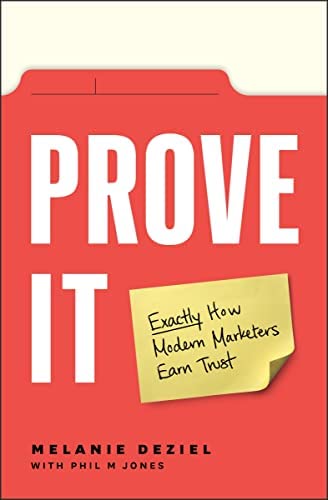
Prove It by Melanie Deziel with Phil M Jones: Exactly How Modern Marketers Earn Trust, is the follow-up to Ms. Deziel excellent The Content Fuel Framework which I reviewed last year.

Like its predecessor, Prove It is a how to guide that many marketers will find familiar for the ideas and concepts are not really new and are the fodder that modern marketing is based on. However, like her previous book, what Ms. Deziel and Mr. Jones do in Prove It is to create an overarching framework and concept that put these ideas into context and provides a guide to future ideas and processes.

The main thrust of Prove Its is that today’s customers don’t want to be told why they should buy a product or service but to be shown why they should with concrete and provable examples. This process then becomes the underpinning for a brand as a whole. Where Prove It really works its magic is by showing rather than telling. It uses the slogans and catchphrases that the reader will be all too familiar with to make its points crystal clear.  “Fifteen minutes could save you 15% or more on car insurance” for example is Geico’s way of proving that they are easy and convenient to deal with while also potentially being able to save the customer money – ‘give us a little of your time and we’ll lower your car insurance rate.’

Prove it is full of these examples for every type of business or service and how these claims can be discovered about your business, and how that discovery process in turn leads into a marketing / branding strategy. The book also encourages the reader to back up these claims with documentation and to use this a method of re-enforcing the brand’s identity by doing so. Where Prove It really scores on this front is by pointing out that businesses often already have access this documentation in other forms. Reviews on sites such as Yelp, customer service surveys, or just by talking to customers themselves can yield not only great content but can also provide witness to the claims that a brand is making and therefore backup the branding process itself.

What I personally found very interesting was a dissection of how Apple ‘coached’ its client base to not necessarily believe the claims of its competitors when it came to the differences between using a Mac or another computer brand with its “I’m a Mac and I’m a PC” series of TV ads. The idea that an ad can be coaching a customer to ask the difficult questions that the competition may not want to answer is fascinating and subtly brilliant.

Prove It is a short and engaging book for both marketing professionals and beginners alike. It demystifies how modern advertising and content marketing work. This is not a nuts and bolts “place this type of ad at this type of time” kind of book; but more about mindset. This is a book to understand how to sell a product or service so that a customer can easily identity the ‘why’ they are prepared to buy.

To sum up it so very worth your time and its place on your bookshelf.