I left my veterinary practice, and the associated other ventures, after 13 years as Hospital Administrator, three weeks ago as of this writing.
I have left jobs before, I’ve even left vet practices before, but nothing came close to this. Thirteen years is a long time.
When you manage people for a living you hope that you make a difference in people’s jobs and by extension their lives. At the same time, you have your doubts…
“Did I really make any difference at all?”
Sure, there are people who say you’ve made a difference. People who you grow to care for – maybe even think of as friends. At the same time, one can never be unaware of the inequality of those relationships. Managers, by definition, are not on an equal footing with the people they manage.
“Are they saying that nice thing because they mean it or because I’m their manager and they know it’s what I want to hear?”
Leaving changes all that.
Who signs your card and who does not. Who finds the time for a quiet conversation – a mentorship confessional. Those who reach out over social media, knowing your aversion to mixing your personal life and work, is now no longer such an issue. The moving of people from the thought bucket of colleague to the one marked friendship. These are the subtle reminders that you matter. That despite all the challenges, you did good work.
The jaded manager in me, the one who regularly has to be beaten down less he rears his head with his negativity, would always whisper the word “fraud.” That making a difference had failed. That you were not the manager you aspired to be, that indeed you were not the manager you thought you were, that you were the manager you feared being. Many sarcastic thanks to the makers of The Office (either one) for adding to the management second guessing in case we inadvertently and momentarily became David Brent / Michael Scott. Although truthfully there are far worse managers out there, both on Television or Film and in the real world, than David Brent or Michael Scott.
But in leaving one can leave those thoughts behind. These are not the rose-tinted memories of times gone by – although I’m sure those are to come. These are the genuine thing. Reactions from people who care. Who recognize the role you have played. Whether it was a timely job offer, a suggestion of a new role or promotion, advice about how to deal with a colleague, or for faith and belief in another when everyone else has none. This is what work is supposed to be. The collaboration between people in pursuit of a shared goal.
Leaving makes you realize your value. That your value is that things will carry on. That you are not indispensable because you have dedicated your management career to ensuring that others thrive and have the skills they need to grow.
Veterinary Medicine is about communication. Our patients don’t speak. They can’t advocate for themselves so pet owners, doctors, and team members must communicate with each other on their behalf and as clearly as possible.
However, there is a relationship within the practice which is even more important. It is that of practice owner (PO), usually a DVM although the same applies to corporate practices with a medical director, and the hospital administrator / practice Manager / office Manager (OM).
If these two people cannot agree, or agree to disagree, all the other great things that can happen within the practice are subject to failure on a monumental level.
Everything flows from this relationship.
Protocols and standards of care can’t exist if the two people responsible for implementing them can’t agree on what they are and how they should be applied. How can equitable and fair human resource decisions be made if one of these two people plays favorites and overrides the other when it suits them? They must be able to have difficult conversations, where they both will have strong feelings about the results, and must be able to come out of that conversation without hard or hurt feelings that get in the way of their continued relationship.
Vision, Mission, and Core Values statements can go a long way to resolving these issues – but only if they are the living breathing guidelines of the practice. More fundamental is that there is mutual respect between PO and OM for both their respective roles and their responsibilities. They also need to present a united front on matters of change.
Unfortunately, this relationship is often unequal. Practice Owners, by definition call the shots and have the last word. Ideally, they empower their OM as their representative to make decisions and implement policy. However, if there is no trust, no respect, there is no way that is going to happen and no way for the OM to do their job. Likewise, if the OM is constantly aligning themselves as an employee rather than as a member of senior management / ownership they are unlikely to receive the trust from a PO that they would want and rightly so.
There is a balance to be reached and that’s why I advocate that the relationship between PO and OM has to work for anything else in the practice to work. This is also the reason why I am always against PO and OM being married or related in other ways – other parts of their relationship creep into the PO and OM dynamic. PO and OM should not be best friends – there are times they are going to disagree and that’s fine – that’s how it is supposed to be. They represent different interests of the business.
So what if that relationship is not there or there has been a breakdown?
Communication.
Communication.
Communication.
Fundamentally if PO and OM can’t communicate then the relationship is dead. Unfortunately, that probably means the OM needs to leave either by resigning or being let go. It does no good to anyone for there to be infighting between the leaders of the practice. It certainly does not help the practice.
What sucks for the OM in this situation is that jobs of that type in the veterinary industry are usually one per practice. That means if there are ten practices in your town then there are only nine possible jobs for the OM and there are no guarantees that any of them are looking. There are, of course, opportunities in other industries; good leaders and managers are always in demand; however, that means learning another industry.
If the relationship between PO and OM is broken something must change because this is the relationship that can’t be broken for the practice to function. Take care of your own mental health and that of your team.
Be honest about this relationship and either fix it or move on.
Feature image courtesy of Zahid H Javali & Dmitry Abramov from Pixabay
I love my smart phone a little too much, and I hate that.
A cell phone has been my constant companion for over 30 years. I never had one of the giant brick phones of 80s yuppies but my first phone was one of the first that made those phones look ancient even then.
However, the advent of the iPhone and social media changed all that.
I’ve spent a significant portion of my career working, at least tangentially, with social media. I still enjoy social media and find it to have value, but I am more and more aware of the downsides. I think the real turning point was TikTok. The pull of those short form video snippets was often just too much on days where not much was going on. Losing hours to the app, while not all valueless (poetry, politics, history, and religious scholarship can all be mixed in with the stupid cat videos and hilarious footage of people hurting themselves) was disconcerting. Like the borderline alcoholic that realizes that perhaps always having beer in the house is not such a good idea, when the app starts warning you that perhaps you’ve been on it too long, you know there is a problem.
I should make clear that I still like and enjoy social media. I’ve been making content for social media and the internet for well over two decades. Call me shallow, but I have much in my life to thank social media for. I also feel that its current place in society is so firmly cemented that to be without it would be detrimental to how I live.
But something had to change.
I’d turned off notifications years ago, no longer being the frontline person responsible for the hospitals’ I manage social media and reviews, has its advantages. For my own personal pages and sites, a brief check whenever I had a moment would do.
But the checking got way out of hand.
Sitting at my desk and getting sucked into checking the groups I was a part of, my social channels, and even personal email seemed to consume more and more time. Even more insidious, was the “always on” home display on my iPhone 14 Pro.
I’d managed to resist the draw of Apple Watch and other smart watches. Partly due to my affinity for real watches, but also because the constant checking seemed even more intrusive than I was already experiencing and harboring qualms about. It also helped to have coworkers who love their Apple Watches and them checking them while mid conversation was annoying enough to “not be one of those people.”
However, the extremely useful always on of my new, at the time, iPhone 14 Pro with its time and date display along with a cute picture of one of my dogs was gateway and constant reminder of the joys of browsing my phone.
But how to change.
When I travel, which I do a lot of for significant portions of the year, the scene in airports is one of obvious Smart Phone addiction. Rows and rows of people, not talking, not reading a book, but low level browsing of social media. I’m not judging, I still am happy to while away the time lost in this miracle of our modern age – the interconnection of smartphone, the internet, and social media. However, the sheer scale of how much these little devices of glass, metal, and plastic have come to be extensions of our modern selves can be shocking when one takes the place of an outside observer.
But what to do.
It seemed, I was not alone in wanting to make a change in the cycle of cellphone social media and attention-grabbing content intruding on life. Multiple celebrities were announcing their ditching of social media, and there were even a few who were getting rid of their smartphones altogether. But this removal of this seeming essential device of the 21st century seemed to reek of privilege. For every celebrity who is removing the stress of social media and the constant interruptions of a smart phone, you know there is an assistant and / or a marketing team who filter access and are ever more locked to their smartphones as they juggle their own needs and that of those who employ them.
So what for mere mortals?
I had become aware of the Light Phone when it first launched, and I laughed like most people at the idea of wanting a Dumify phone and there being value in that. Now on its third generation, the Light Phone contains a lot of the conveniences of modern smartphones but with a monochromatic interface, limited apps, and no social media.
The downside of course being that I want and need social media in my life. I want and need various apps on my smart phone, to control alarm systems, remote access to work computers, control of my smart home, control of my electric car, notifications of the location of my keys, wallet, and dogs, and any number of other things that make up a connected life and work. I was not ready to give up all that. I’ve read Ted Kaczynski and the Luddites, and I have sympathy with those arguments, I’m just not ready for the inconvenience, the disconnection, or in a place of that level of privilege, to make such a radical change.
An option would be to slave my iPhone to a Light phone as a hotspot. Meaning my iPhone could stay in my car or bag until I wanted it, but I could carry around a Light phone for day-to-day use. This seemed a needlessly complicated solution and I was also unconvinced that the temptation of the iPhone would not be too much and I would be back to square one but $500 poorer.
Then I found Dumify.
Dumify is an iPhone app, also available for Android users but you are on your own from here on out, that mimics the simpler interface of the Light phone, but does not impact the functionality of or even the regular interface of the iPhone.
By adjusting a few settings, and then just entering the apps you want daily / easy access to, the user can create a non-engaging, and thereby not tempting, interface for the things that matter most to you in a smart phone.
After a few weeks of use here is what I have found.
My smart phone screen time at work has plummeted making me far more productive when I am at my desk.
I still use and enjoy social media but it is as a choice rather than a need. I am therefore finding it limited to specific times of the day.
My simplified lock screen – see below – still can be a temptation but far less so.
In addition, when I open my phone, I get an immediate reminder that I really don’t need to be checking Instagram, Goodreads, LinkedIn, or whatever, right now due to the interface. That simple reminder, a reminder of virtuous smartphone usage if you like, is all I need to put my phone down.
Many people, when using a tool like Dumify, delete a lot of their other apps. I have not done this. I still like my iPhone. I just use it differently. A bit like being smart about alcohol consumption while driving. An unexpected bonus has been that I have been finding myself leaving my phone in my jacket pocket when I’m in the car. The temptation to check an app while at a set of traffic lights is now gone.
While the setup of Dumify is simple, and the app contains shortcuts to most popular apps, some research for company specific apps may be required. There are also multiple short videos embedded into the app to help the customization process. On the iPhone, the app uses URL Schemes and while it blithely suggests “just search on Google” for anything the app does not already have, I found this a little more complicated than I would have hoped. This might say more about the appalling state of Google search right now, than a lack of awareness by the app developers.
I found this article on URL Schemes extremely useful, however I did end up finding a few on my own either through searching or trial and error. It should be noted that the app uses a very basic implementation of URL schemes, and a lot of the documentation is about how developers can hack iPhone apps to do very specific things. When this is the case, I found just stripping the URL to its most basic form worked great.
These are the URL schemes I ended up having to make myself. I made most of them through trial and error as they are pretty simple.
Harmony Remote harmony://
Hertz hertz://
Lyft lyft://
Music music://
Open Table opentable://
Outlook ms-outlook://
RingCentral rcapp://
Southwest southwest://
Wallet wallet://
Itunes Remote remote://
Dumify will also make you download a second app for some links. But this is seamless once it is downloaded.
Dumify is a onetime $4.99 purchase – another reason to love it. There are couple of other apps out there that do similar things to Dumify, but they follow a subscription model, and I was less impressed when I looked at them.
Dumbing down your smart phone is not for everyone. Just like being always connected is not for everyone. But it is nice to have choices, and I feel genuinely more in control of my time and feel that access to this wonder of the modern age is now on my terms and not on its terms.
Often, managers are not owners of a business, but they are required to act as if they were. That can mean that they become the person that both team members and ownership feel is there to solve their problems. To be on call all the time. To be the fountain of knowledge whatever the time and whatever the day.
And often they are.
But that does not mean they are not entitled to time off and a personal life.
Setting boundaries with your owners and your team does not mean not being there for them when they really need you, but it should mean that your time is respected and valued by those that depend on you.
Schedule Boundaries
As a manager, it is easy to feel that it is your duty to be there for your team, or whomever you report to, at all hours of the day and every day.
And to a certain extent this is a sign of a good manager. Your team needs to be able to count on you being there when they need you to be.
But….
And this is a big but…
There is a huge difference between being available for an emergency and being available at all times for all things. You have a life to live and just because you hold the title of manager and all that it entails, does not mean that your job gets to monopolize all your time.
Have a schedule and make all efforts to stick to it. The work for most managers will be there the next day. That means you can leave on time. While staying late will reduce that work pile a little, it will not be as beneficial to the business and certainly not as beneficial to you if you just leave when you are supposed to. There will be times when you absolutely will not be able to leave on time. Make those the exceptions rather than the rule.
Take your vacation time and take the holidays you are owed. Never feel guilty about taking the days off you are due. Your mental and physical health will thank you. As one of my favorite phrases goes; “Make time for your wellness or make time for your sickness.”
If there are times that you don’t want to be interrupted – turn your phone off. You turn your phone off when at the movies or at the theater (if you do not there is a special place in hell for you) so a couple of hours of being unreachable is not an unreasonable thing even for the most connected of managers. Your partner and family will thank you.
Communication Boundaries
Managers need to have a system for how and when they should be contacted. If there are things that you require your team to contact you about then make sure they know this. I, for example, want to be called as soon as possible if there is a major I.T. issue so I can have time to fix it – even if that means a phone call at 2AM. If there are things that you don’t need to be informed about, make sure you let your team know that as well (be nice – just redirect: “please email me about this and I will deal with it when I’m next in the office.”
Email is for when you are at work. Do not check your email outside of working hours unless you are explicitly told that there is something you need to read immediately. An example of this would be a phone call or text message that says “check your email. If you have a workplace communication platform, such as Slack, turn off the notifications when you leave the office for the day.
Text messages should be for urgent things that need your attention when you have a second but can’t wait till you are next in the office. Again, if they could be an email – politely redirect and have them send an email. Stay away from work related text message groups and Whatsapp groups. Group messaging in general is not respectful of your time so if they are part of your team’s communication system – find a way of being able to dip out when you are out of the office.
In fact, while you are at it…
Turn off all the notifications on your phone. Notifications should be for things that are true emergencies. You can thank me later.
Answer phone calls. It might sound counterintuitive in an article about setting boundaries, but I believe that when teams need to get hold of their manager, they really need to get hold of them. If they abuse this privilege just redirect and move on. There are times when you’ll wish your team called you. The excuse “we did not want to bother you” is usually a reaction to mishandled boundary setting in the past.
Longer Absences
There are times when you need to not be working.
Vacation, maternity leave, and leaves of absence are perfect examples of this. An email to your team, or whatever communication method you use, that lays out explicitly your level of availability will work wonders. You just have to stick to it. It is not anyone’s business whether you are floating at home in your pool or hiking at the North Pole and it should not change your level of availability outside of what you laid out to your team before leaving.
The Boss
But what happens when it is the business owner, or whomever you report to, who is not respecting your boundaries?
Ideally, an owner / director should understand that your time is your time. Yes, there will be occasions when they may need to talk to you or have you do something, or even come into the office outside of your normal hours, but as mentioned before this should be the exception. If it is not, be sure to keep track of these occasions and bring them up when negotiating salary and other parts of your compensation package.
Like with your team members, don’t be afraid to redirect politely when a communication method is inappropriate. Likewise, if you are being asked to do something and you have other commitments, don’t be afraid to say that you have other commitments; however, if you can give an alternative solution that often is a preferable option – such as calling someone else. Depending on the circumstance, it might be more appropriate for you to take temporary ownership of the issue and then to delegate the response to someone else if that is possible and you are unavailable.
Personal Boundaries
A manager’s life is much simpler if they are not friends, and do not socialize with, the people they manage. It’s harsh, particularly for managers who may have worked alongside team members they are now being asked to manage, but it invariably leads to issues and it is just simpler for it to never happen.
Likewise, never confide in a subordinate. Being a manager can be lonely – particularly if you are the sole member of management. But find a mentor, or a peer to confide in and vent to. A subordinate you like and feel you can trust is still a subordinate and you don’t know when conversations you felt were in confidence might come back to bite you when you have to manage or discipline that employee.
It should also go without saying that relationships between managers and subordinates are a terrible idea for both parties. Even if the relationship is not inappropriate and fully consensual the damage it does to the team can be significant. In some companies, having a relationship with a subordinate would be grounds for termination. If you find yourself in a relationship with a subordinate, disclose the relationship to whomever you report to and make sure that you and the other party sign a relationship agreement.
Appropriate Outlets
As mentioned earlier, management can be lonely. Finding outlets to discuss issues and the challenges you face are extremely important. There are often local manager groups you can take part in. If there is not one – start one!
Internet groups can be an extremely useful in connecting you with likeminded managers, but also extremely rewarding when you are able to help others who may be struggling with issues you have already resolved.
Find a mentor, go for coffee or lunch, and use them as an outlet. Mentors can be found in the most unlikely of people and places; however, it is tough to beat LinkedIn. Connect and make your connections more than just people for whom you like their posts.
You can have boundaries and still be there for your team. However, you must also demonstrate respect for your team’s boundaries. Do you really need to reach out to one of your team on their day off for a piece of information or can you just email them and wait for the answer when they are next in? Yes, it is inconvenient, but you can’t ask for boundaries yourself and then not respect boundaries for others.
Boundaries are selfcare for managers. Boundaries will be different from one manager to the next.
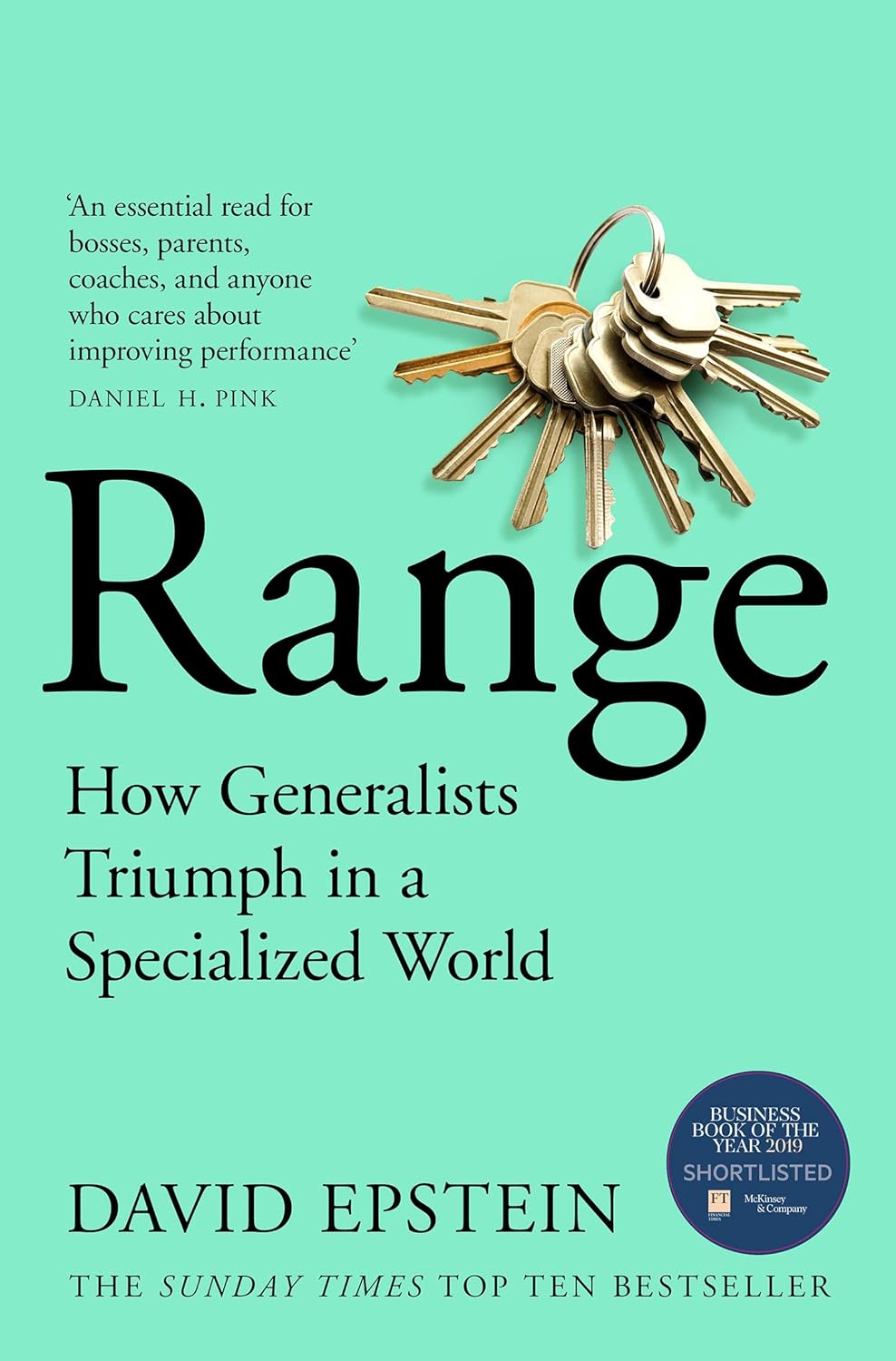
As a society we tell ourselves stories that, while convenient, are not always, or even ever, true. In what is probably Malcom Gladwell’s best book “Outliers” (which I can’t believe I have not reviewed) the author tells of the often decade long stories, and tales of extraordinary advantage, of seemingly overnight successes. David Epstein, in “Range: Why Generalists Triumph in a Specialized World”, is also debunking one of the stories we tell ourselves – that to be really good at something, or to have great success at something, we have to have focused on that thing for a long time – if not forever.
Before I go any further a word to my veterinary and human medicine readers. In this post, and indeed in Mr. Epstein’s book, when we talk about “specialization” we are using it in the general sense as opposed to the legal (small “s” rather than capital “S”). Although, I do believe that there are lessons for students from Mr. Epstein’s excellent book. Don’t be in too much of a hurry to map out your career. It’s a good thing to try out different interests and to change your mind – you’ll be better in the long run for it.
The pressure to focus on one thing, whether it be in sports, music, or entrepreneurship is all pervasive and often has business interests behind the marketing of “hyper specialization.”
It is a good story.
The Tiger Woods story is one that the author highlights. It is a story of the very young Tiger playing golf before he could talk and spending all day at the golf course. It is a story of winning tournament after tournament and having an unflinching goal of winning more titles than anyone else. Mr. Epstein juxtaposes the “Tiger story” with the far less well-known story of Roger Federer. Federer’s mother was a tennis coach but she refused to coach him and actively tried to dissuade him from playing tennis. A young Federer also seemed far more interested in soccer, basketball, skateboarding, handball and skiing. It was not until his teens that Federer started to gravitate towards tennis and then his goals were not lofty, but the rather quaint “meet Borris Becker” and “play at Wimbledon.”
This wide range of experience and lack of focus is the author’s main argument – that, more often than not, it is range that leads to success rather than specialization. That depth of experience of different fields matters more than depth of experience in just one. Interestingly, the evidence that Mr. Epstein quotes, rather persuasively, is that while early hyper specialization can lead to children getting a head start in that chosen area, they tend to fall into line with their peers rather than stay ahead as time goes on.
Where the book misses, for me, is that it seems to continue to fall back to specialization being a worthy goal via a route of different experiences, rather than the range of experiences being a worthy goal in itself. However, this minor quibble aside. The book makes a very strong case for experience in general and for following one’s interests. A great example is the idea to not ask kids what they want to be when they grow up, but rather to ask them what they are interested in. Our education, and in our careers, we often ask others where they are headed and penalize them for not knowing. This may be a mistake.
When I look at my career, I’ve had very specific goals at different times and while I have met some of them, I have taken some spectacular left turns that has led me to areas I would never have even considered just a few years earlier. No one is more surprised than me that I live in Las Vegas, watch a lot of hockey, and write poetry.
This is an important book for those who mentor, or lead, others. How we choose to guide – matters. We are often a deciding factor in whether to specialize in an area or to follow seemingly unconnected interests. There is value in a range of interests and experiences that benefit both the person and the employer.
A more enlightened view of the goals of mentoring will benefit everyone.
Chef 1:- I just… I don’t think it’s fair (talking to Chef 2)
Kiki: Chef!
Kiki: Chef!
Chef 1: Yes, Kiki, what is that?
Kiki: A man on table six wants an eggless omelette. He wants an egg…
Chef 1: Kiki you can’t have an eggless omelette, can you?
Kiki: Why do we not have any?
Chef 1: No, they don’t exist, do they? Because there’s no… Breadsticks, what are they made of?
Kiki: Bread.
Chef 1: Bread, very good. OK, take away the bread, what are you left with?
Kiki: Sticks?
Chef 1: No, Kiki! (Sprinkles a few herbs on an empty plate) There you go, that’s an eggless omelet.
Kiki: Okay (takes plate)
Chef 1: No, don’t take the plate, Kiki, what are you doing? Please!
Chef 2: Kiki, just ask the nice man if he’d like his omelet made with whole eggs or just egg whites. (Kiki smiles and goes to leave)
Chef 2: You can leave the plate.
When I was first shown this scene from the British restaurant-based sitcom “Whites” I found it amusing like I’m sure most of you did. How we can laugh at how silly Kiki is being and how she lacks all common sense. And the scene is funny, but it reflects a real behavior that we see every day, admittedly pushed to extremes.
But this is an attitude that needs to change. Just like to scene where the security guard gets humiliated for not stopping the scruffy young man from entering the fancy building and not recognizing that he in-fact owns the building and is ultimately is the security guard’s employer. The poor guard is just doing his job. Just because you walk around like you own the building does not automatically mean you actually do. We’ve all seen the videos that prove you can get it almost anywhere if you are carrying a ladder. Employees, just like clients, can suffer from being of the loosing end of the curse of knowledge.
The curse of knowledge is where we humans can’t understand that others may not have the same life, education, and training as us and therefore may not know the same things. What is obvious and, in that most awful of phrases, “common sense” may not in fact be widely known or common sense. For more on my hatred of “common sense” you can read this post.
But yet we do this all the time. The client who does not know to vaccinate their new puppy. The coffee drinker who does not know that Starbucks calls its large “Venti” or a regular coffee an “Americano.” There is a whole video just about that too.
With employees a lack of knowledge is a teaching moment. Of course, it can be frustrating and if we find ourselves teaching the same thing over and over again we have a different problem, but we can’t criticize, or worse snap at, for a lack of knowledge – even when we think employees should have this knowledge. In any other environment, we would recognize this behavior for what it is; bullying.
Recognizing that teams need be able to express when they don’t know something helps to create a safe space for learning. Teachable moments should be embraced for what they are – a chance to get better, to improve. Its also just the decent thing do to. There can also be more going on than just not knowing something.
New employees, for example, don’t know the limits of their knowledge yet. So while they may not of heard of something does not mean that it does not exist. We don’t want them to guess – so employees ask. They need to praised for checking and confirming that what we think is obvious is actually not. We all need to be better about this. I for one know that I can be bad at this but, as with most things, recognizing when you have a problem is the first step in fixing it.
Why on earth am I reviewing a field manual on sabotage by the OSS (the predecessor to the CIA) from World War two?
Well, there are a couple of reasons other than the most obvious one that someone suggested it.
This very short reprinting, which would usually only be of interest to historians or those with underground bunkers and very full larders, is glimpse into the mind of a someone who wants to disrupt or destroy an organization both physically and psychologically.
There is not much that the average person could not have thought of themselves when it comes to physical sabotage, but it is interesting to note how just not doing simple things in the workplace can create serious problems and should therefore be taken seriously by managers. Most disgruntled employees are not quite so literal in showing their displeasure, but one does become aware, through the numerous examples, of just how vulnerable most workplaces and organizations are.
There is an illuminating passage early in the book.
“It should be pointed out to the saboteur where the circumstances are suitable, that he is acting in self-defense against the enemy, or retaliating against the enemy for acts of destruction.”
I, and most modern managers, do not think of employees, even problem employees, as the enemy. However, it is not a far stretch to think that there have been times when an individual employee on a disciplinary path may feel that they are in a battle of wills. This might not lead to outright sabotage, one hopes, but “quiet quitting”? Quiet quitting is the phenomenon of an employee doing just enough not to get fired – but no more. As the book says a couple of sentences on…
“The saboteur may have to reverse his thinking… Where he formerly though of keeping his tools sharp, he should now let them grow dull…”
Where the book really becomes of interest for managers, however, is in the final seven pages where it discusses what steps managers and supervisors can take to disrupt an organization’s psychology. If you recognize your organization within these pages – it is time for change. It is also a great reminder of seemingly well-intentioned actions by leadership teams. Insisting on perfect work where it does not matter, for example. Or “see that three people have to approve everything when one will do.”
There is even guidance for meetings and committees to be found in this later section. Warnings to try and increase the size of meetings or committees to the point where they become unwieldy is reminiscent of the often-told Jeff Bezos, the CEO of Amazon, anecdote that he will not attend meetings that cannot be fed by a single pizza.
A thoughtful reading of this short book by managers should act as a warning and a reminder both to themselves and about others. I think is also a good training tool for new managers to show what not to do and to be aware of the traps of self-sabotage that managers can often fall into. It is also a good reminder of where the line exists between performance problems and being a disruptive influence in the workplace.
Eighty years old it may be, but this short book still has some things to teach us.
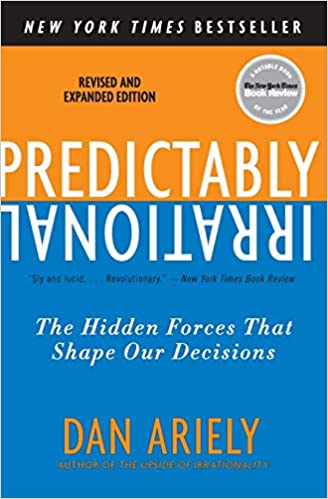
Why would we be offended if someone offered to pay us after we invited them to Thanksgiving dinner? What is the cost of zero, and why is it far more expensive than $0.01? Do we really need to tell our waiter our order in secret if we really want to feel that it is okay for us to have our first choice from the menu?
Subtitled; “The Hidden Forces that shape our Decisions,” Dr. Ariely’s superb book has the potential to change dramatically how we think about business and our personal lives.
With the use of subtle yet easily understood experimental data, Dr. Ariely exposes humans as often acting against our own interests due to societal or market norms and that we just do not understand our own personalities and the role that emotion plays in shaping decision making – spoiler its usually for the worse.
So why would we feel offended if someone offered to pay for Thanksgiving dinner? Dr. Ariely not only explains but also shows with examples and experiment data that we humans have social exchanges and market exchanges of behavior. Social exchanges we use with friends and family. They are the norms that govern daily life and allow us to bond with other humans. Market exchanges are, as they sound, the exchange of money for goods and services and also the money we receive in exchange for our labor in the form of our working lives. When one offers to pay for Thanksgiving dinner were mixing social norms with market norms. We are indicating that we are rejecting the social acceptance of those who may be friends or family in favor of an exchange that we could expect to have with a stranger. A commercial transaction. What becomes interesting in breaking these social norms is that we find it is difficult to go back. Trying to pay for Thanksgiving dinner may never get us invited back because a social exchange has been turned into a market exchange. Employers who do not have social exchanges with their employees may find that employees therefore treat the relationship as a purely market exchange and leave for an employer who offers a better market exchange – usually more money or better benefits. This also explains why employers who do embrace a social exchange in their workplace culture become frustrated and angry when an employee uses only market norms in their decision-making process to leave.
Likewise, when companies use a social exchange to bond with clients they may find when they resort to a market exchange when it suits them – policy over the relationship with the client – they have unleashed a Pandora’s box of problems with someone they once may have considered a friend of the business. Business can’t have it both ways, and if we try to, we are storing up trouble for ourselves.
Debunking of personality testing, without mentioning personality testing, is in this book with a discussion of priming and setting expectations. There are also volumes of data showing that making something free rather than reducing a price – even if the reductions are the same, can make a dramatic difference in the uptake of an offer. Buy one get one free really does work!
There is also a highly disturbing chapter on the affect of sexual arousal and decision making and morality. While I will spare you the details here it is difficult as a guy to read this chapter without recognizing oneself and feeling ashamed of the implications. This chapter does not give guys and excuse; however, it should make us pause and understand that we have the capability to be highly irrational in the right circumstances.
And that is really the crux of the book.
By recognizing that we can be irrational beings and what triggers that irrationality, we can know ourselves better and make better decisions. It also allows us to spot irrationality in others and how that has come about.
“You don’t have to go to every argument you are invited to.”
It is refreshing to read a book about communication that is so direct, and tool driven. Mr. Manney has created such a book and it is excellent.
Filled with examples of how to change conversations and thinking, as well as helpful nuggets such as the one above and “you only ever control 50% of the conversation,” this is a book that is meant to be slowly digested and read a chapter at a time. In fact, what makes this book so interesting and usable is its insistence that arguing is not an insurmountable problem, but that there are limits to what an individual can do and how to move forward with that information.
The book also interjects that arguments are really opportunities to try and find new solutions to existing problems. It is obvious from reading that Mr. Manney is a therapist due to the dispassionate voice that is so often missing from more business orientated communication books. That is not to say that “Why We Argue and How to Stop” is not a book that focuses on business communication – it is and even tackles social media issues – it is more to suggest that this is a perspective we don’t often hear in the business world. And that’s a shame.
Where this book really succeeds is on focusing on the person and their motivations for arguing. This is a book about healthy relationships and what it takes to not only start them but to maintain them. I am particularly enamored with the authors habit of showing what prior bad habits in communication look like and then what making efforts to more health communication look like about the same subject.
This is a book to refer back to – particularly when trying to self-diagnose issues with arguing and communication in general. The author’s advice to read one chapter and then digest it before moving on is sound. But I feel its real value is in using the book as a resource as circumstances arise. Knowledge of one’s own emotions are not often easily came by, but Mr. Manney provides some excellent tools for doing just that – including mnemonics.
The latter chapters of the book stray into more specific areas such as dealing with children and teens, as well as abusive relationships. Which this is, of course, great information to have, it does seem to be rather shoehorned in. This is a very minor quibble, however, for such a useful book, and I am sure that others will be glad that the latter chapters are there.
This is not a long book, but it is surprising dense. Do not let that put you off. Read in small chunks. Breathe in what is being said to you. This is a great book and worthy of a space on your shelf as long as you go back to it when needed, as we can all use its wisdom.
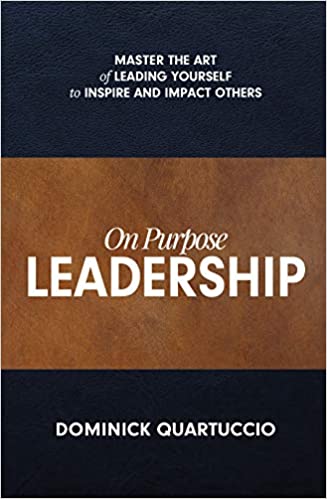
I loved Dominick Quartuccio’s other book, Design your Future which I reviewed here. When I was sent the second edition of On Purpose Leadership I had high hopes, and in general those hopes were met – sort of.
The problem, and I’m prepared to be wrong here, is that while Design Your Future felt like a new and fresh bundle of ideas, On Purpose Leadership feels like a second bite of the same apple. That it was written before Design Your Future is an irony not lost on me. The idea of bringing focus into your leadership world is not by any means unwelcome. As is being those lessons to your team. The issue is that it is not a different enough book for the reader to feel that they actually have read a different book.
The tools in On Purpose Leadership are great in themselves. The “drifting” and dissatisfaction of leaders, even those who have achieved significant success, is a well understood phenomenon. Most of us call this burnout. Anything that helps those in management circles is very welcome. Identifying the problems with burnout or drift is helpful as are identifying the solutions. The idea of putting oneself first, that others want to be led, and creating an environment for success are all excellent principles for addressing the problem.
This is a short and small book, with some interesting case studies, but for me the greater insights are to be gleaned from Mr. Quartuccio’s other book or reading both books in tandem.














 Mike Falconer