Archives for posts with tag: twitter
Image of George Orwell by Gordon Johnson from Pixabay

“Any sufficiently advanced technology is indistinguishable from magic” – Arthur C. Clarke.

In a remarkable about face for a technology company, Amazon has confirmed that it is moving away from its “just walk out” technology at its Amazon Fresh stores. The technology boasted that it used a mixture of cameras, sensors, and artificial intelligence (A.I.) to know what consumers had put in their baskets and to accurately bill its customers without all that tedious checking out and interacting with another human being at the grocery store.

Image Copyright Amazon.com used under fair use for criticism, comment, or news reporting.

What was actually happening was that up to 1,000 people in India were watching and tagging videos to ensure that customers were billed correctly. Amazon has apparently laid off almost its entire development team of this “technology” and will start to phase out this service from its existing Amazon Fresh stores. This is all the more surprising after Amazon’s experience with A.I. recruitment. In 2015 Amazon had to abandon an A.I. résumé reading project due to being unable to stop it from discriminating against women. It was seen by many as a humiliating comedown for the tech giant.

Image Copyright Amazon.com used under fair use for criticism, comment, or news reporting.

“Pay no attention to that man behind the curtain!” — The Wonderful Wizard of Oz, L.Frank Baum.

While many will smirk at Amazon’s second major public A.I. failure, and I have to admit to being one of those people, there is a bigger issue here which Amazon should be commended for. It is the lifting the vail on A.I. tools that are not some magic that comes out of the ether. They often require human intervention to be usable- both in front and behind the keyboard. In addition A.I., or more accurately Machine Learning , need examples of human labor in the thousands, if not millions, to be trained. The training of these A.I. “models” has become a contentious subject for those with an interest in A.I. both as supporters and critics.   

“Any technology distinguishable from magic is insufficiently advanced” – Barry Gehm’s corollary to Arthur C. Clarke’s original quote.

The main issue with machine learning is that the A.I. industry, almost without exception, sees art, music, writing, film, and pretty much the entire internet as fair game for training A.I. models, which they in turn sell to us in the guise of generative A.I. Those of us on the other side (waves hand in air to indicate exactly where I stand on this subject in case you had not already guessed) say that copyright does not work that way. Derivative works are still derivative.

 It is indeed hilarious to watch companies such as Disney try to navigate this brave new world. On the one hand, Disney has tried to argue that generative A.I. is fine for them to use to create new works based on the work of artists they have employed in the past. But Disney has then complained about possible copyright infringement when someone else has tried the same trick with copyrighted works they own.

Image Copyright Walt Disney Company used under fair use for criticism, comment, or news reporting.

The lawyer who used ChatGPT to write a legal brief might want the machines to infringe a bit more. To his cost, literally, the lawyer found out that the pesky machine had just made up all the cases that it sited in its argument which he signed his name to. He was sanctioned and fined after he was found out. I just love that generative A.I. tools hallucinate (the developers term, not mine).

One of my favorite activities these days is to ask A.I. peddlers what they use to train their models. Indeed, I had a most entertaining afternoon doing just that at this year’s Western Veterinary Conference. Amongst the answers I received were “none of your business – who are you” (my favorite), “medical records from a university,” and “the internet.” None of the vendors I spoke to were willing to discuss privacy, copyright, or what happens if they are no longer allowed to train their models that way. One gets the distinct impression of building on borrowed land.

The latest darling of the A.I. generation tools is Sora, which creates beautiful full motion video from text prompts and is from the OpenAI stable. However, in a recent interview with the Wallstreet Journal, Mira Murati, OpenAI’s Chief Technology Officer, refused to answer questions about where Sora’s data set for modeling came from. Murati also refused to say whether the data set that Sora used included YouTube and Instagram videos – stating that she “did not know.” That in turn has led to some serious questions about licensing, as YouTube’s CEO Neal Mohan, confirmed that OpenAI using YouTube content for modeling purposes would be a violation of YouTube’s terms of service.  

“Thou shall not make a machine in the likeness of a human mind” – Dune, Frank Herbert

There is a temptation to label those who speak out about our current infatuation with A.I. tools and criticize the foundations those tools are built on as luddites. While our current use of the word brings to mind hoards of unemployed mill workers bent on smashing “the spinning jenny,” the truth about the Luddites is actually far more nuanced and carries a message for today.  The Luddites did not hate all machines, they in fact were fine with most and just wanted them run by workers who had gone through apprenticeships and were paid decent wages. The Luddites main concern were manufacturers who used machines in “a fraudulent and deceitful manner” notes Kevin Binfield in his book “Writings of the Luddites.” Outsourcing the cashing out of grocery shopping to a developing country, and labeling it as new technology, is a tactic the Luddites would have been all too familiar with and would have been happy to march against.

While I am not advocating for a Butlerian Jihad as Herbert described as the backdrop for Dune, there is merit in the context he provides to the proscription on thinking machines.

“Once men turned their thinking over to machines in the hope that this would set them free. But that only permitted other men with machines to enslave them.” – Dune, Frank Herbert.

As author SJ Sindu wrote on Twitter (I refuse to call it X on general principles); “We don’t need AI to make art. We need AI to write emails and clean the house and deliver the groceries so humans can make more art.”

A.I. art needs human art to model itself on and the pushback from artists and consumers is already significant. When the argument over modeling reaches the courts, the damage may already be done. Only then will we see the parallels between the creative arts and A.I. that we saw in the 2000s with Napster / Pirate Bay and music. Will it be too late to put this tool back in its box?

A healthy skepticism when it comes to A.I., I think is all important. And not just a skepticism for what A.I. can do but for the intentions of those that wield it.

A.I. will need to be “open” and not just open as in the name of a for profit corporation. Its models will need to be transparent and be able to be questioned. As I wrote about in my review of Hilke Schellmann’s book on A.I. in hiring and Human Resources “The Algorithm”; …it is often difficult to impossible for candidates or employees to challenge decisions by managers which they may feel have been affected by bias. How much more difficult is it when it is not a human making the decision or recommendation? A tool of which we cannot ask the most basic of questions: what were you thinking?

Footnotes and links would be a great start. But most generative A.I. companies consider this proprietary information and therefore refuse to provide what would seem a most obvious step when it comes to trust. That, in fact, is exactly why authors use footnotes and links, to allow others to follow their thinking on how they reached their conclusions. I’ve tried to add as many links and footnotes as I can to this article without becoming burdensome.

I am not a Luddite in the modern sense, but I do share a lot of the same concerns of the Luddites of old. We only need to look at our world to see why we should be concerned. It is a world where poor people in the developing world watch us shop so that we can pretend we are living in a magic future where machines do all the work. Where the drudgery of making art has been taken away from us so it can be sold back to us by corporations owned by billionaires.

I’m not sure I want A.I. to write my emails, but I can think of plenty of things that I’d like it to undertake. I already use it in a number of ways. I’ve used A.I. images in my books (although I probably will not do so in the future). I currently feel that A.I. has to earn its place in my world by proving its benefits not just to me, but the world as a whole. Will the undertakings of A.I. be for the benefit of people? Currently, that seems to be the last thing on the developers’ minds.

“The tune had been haunting London for weeks past. It was one of countless similar songs published for the benefit of the proles by a sub-section of the Music Department. The words of these songs were composed without any human intervention whatever on an instrument known as a versificator. But the woman sang so tunefully as to turn the dreadful rubbish into an almost pleasant sound.” – 1984, George Orwell

There are a lot of books about Twitter out there right now. That is perhaps not a surprise given (Spoiler Alert) that it has become a corporate / Silicon Valley dumpster fire.

Mr. Wagner’s account is balanced and well researched; however, one cannot feel while reading the work that it is missing the insider juicy details that make tech CEOs squirm. Perhaps because so much of Twitter’s (now X’s) dirty laundry has already been aired there is little new revelations in the work.

What” Battle of the Bird” does do is provide a clinical timeline from Twitter’s founding through to the events leading up to its purchase by Elon Musk and the unravelling of the technology institution under his stewardship. This in turn provides insights into the failure of Jack Dorcey (Twitter’s former CEO and co-founder) and Elon Musk’s failures with X.

As I talked about in my review of “Kingdom of Happiness” by Amiee Groth which referenced the failures at Zappos and the Downtown Project, both Dorsey and Musk in hindsight have had a failure of leadership due to a lack of management. It is all very well being able to persuade people to jump out of a plane, but you have to ensure that they have parachutes and know how to use them.

There is no doubt that Dorsey and Musk both do, or more appropriately have at one time, loved Twitter and what it has brought to the world. While Dorsey, according to Mr. Wagner’s book, seems to have lost interest in Twitter as a company once the reality of being a public company set in. Musk on the other hand, seems far too interested in his own press and ego once he understood the challenges Twitter faced and continues to face even after his pointless rebranding to X. It is hard to feel sorry for billionaires when the world does not work the way they want it to.

There is a theme throughout the book that perhaps Twitter can’t be a company. Dorsey in particular laments that what Twitter should be is a technology like email, that allows for the exchange of information, but that is not gatekept by any one platform. This is the kind of wishful thinking of people who have been made rich by the decisions to take their company public and have second thoughts. That they wish the world could be a different place. It can be, but only if different decisions are taken – the kind of decisions that don’t make entrepreneurs and venture capitalists rich.

Like I said, it is hard to feel sorry for billionaires when things don’t go their way.

Mr. Wagner does go into some reasonable depth as to the ethical dilemmas brought up by Donald Trump’s tweeting and his eventual banning from the platform. These are bigger issues than Twitter, but the impact on Twitter for both Dorsey and Musk were profound and still rancor the platform to this day. I’m not sure I want a committee of Twitter employees making decisions on whether what a world leader says is appropriate for public consumption, but at the same time I am positive I don’t want Elon Musk making those decisions.

As a grounding in the backstory and drama that is Twitter, now X, Battle for the Bird is a great document. Not a thrill ride or exposé, but a methodical grounding in the facts.

This is probably for the best given its subject matter and the turgid realities of Twitter’s recent past.

Perhaps this is the account we need rather than the one we might want.

Want to read a takedown of the leaders of the tech world, that calls them out for their hypocrisy and recklessness?

Of course you do.

Burn Book is, for the most part, that book. A book that at its most fundamental says “you promised us a brave new world – and what you delivered us was a more rapacious form of capitalism.”

The author, Kara Swisher, is a long-time journalist and analyst of the “tech sector” – particularly in Silicon Valley. She is also the co-founder of the Recode conference and the co-host of the Pivot podcast.

Burn Book, through the narrative of an autobiography, is her journey into the San Fransisco technology sector and her gonzo view of the events that, for better or worse, have shaped the world we currently live in – particularly its technology.

Where Burn Book really scores is in its view of characters such as Elon Musk, Bill Gates, Mark Zuckerburg, Steve Jobs, and Sergey Brin. From their early days, the beginnings of their success, through to their either refusal to accept the damage of their legacy, or the issues with how that legacy was formed, but also for some of them; their efforts to make amends. One is left with a sense of these figures riding waves that they barely understand or control. That often these figures are deeply flawed individuals who’s flaws have help lead to their success, but that long term they themselves are unrecognizable from the people they once were. Changed by wealth and power and all its trappings.

As Swisher mentions in the introduction; “move fast and break things” is in retrospect indicative of the tech scene entrepreneurs and their willingness to not think through the consequences of their actions. (Move fast and break things was an early internal Facebook slogan that was widely adopted by the tech sector).

Where the book becomes annoying is the author’s habit of “I told you so.” While this may well be true, and the whole purpose of the book is essentially to name drop, and let’s be honest that’s why we are reading it, it can become a little frustrating and seemingly self-aggrandizing. Swisher has earned the right to trumpet her vision and does have a record of putting billionaires on the spot, however, she does seem to fail to see the larger picture of the issues with this kind of innovation model.

Swisher is a self-proclaimed “believer in tech,” and this leads to the impression that she feels if only developers and tech titans were nicer then the world would be a much better place. This is quite possibly true, but one has to wonder about an industry who are happy to undermine industries and even societies, while failing to follow the basic rules that everyone else follows.

To Swisher’s credit she recognizes how close she has become to the tech sector and how that potentially impacts the objectivity of the analysis she gives. Of late she has made efforts to put distance between herself and her subjects. It would be easy to see this book as one of those efforts.

Burn Book is for the most part an enjoyable read with lots of moments to savor for those who want to see the self-proclaimed “Masters of the Universe” taken down a peg and be held to account. It does also do a pretty good job of exploring the duality of some of the complex individuals who run or formed some of the largest companies on the planet with little to no oversight. The author lauds Steve Jobs, for example, but does point out some of the flaws and cruelty that mars his legacy. It is not an in-depth analysis of all that is wrong with tools such as Facebook and the tech sector as a whole, but then it does not set out to be.

This is an autobiography and a story about being in love with an industry. The all too predictable break up, with the realization that who you were in love with is not quite the person you thought they were, is just another part of that love story.

As that, Burn Book succeeds admirably.

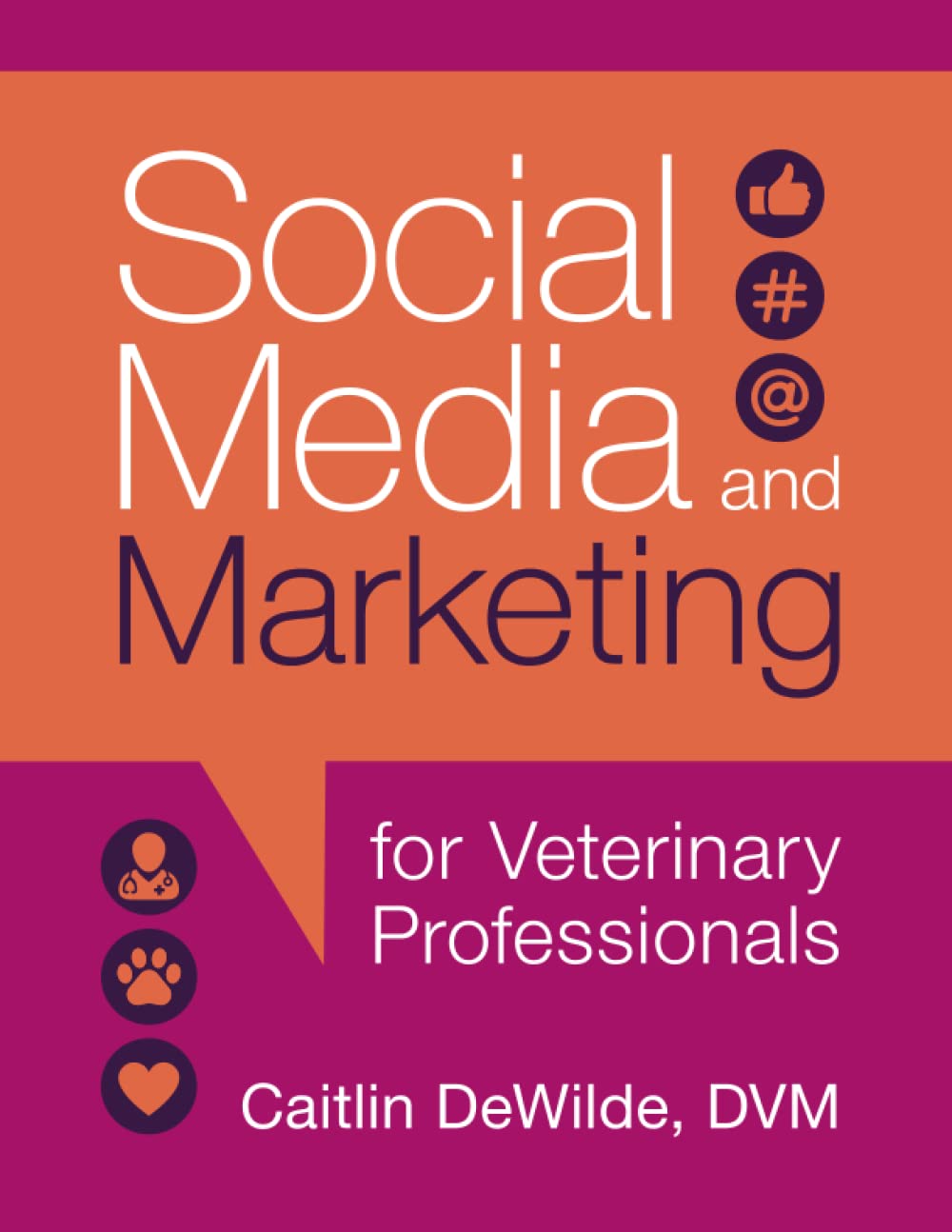
Writing an accessible and thorough book about a complex and everchanging subject, such as social media, is a daunting prospect – particularly when your audience is a niche one such as veterinary medicine. Dr. Caitlin DeWilde; however, has done just that.

With the look and feel of a textbook, but the format a “Dummies” or “Idiots how to” book, Social Media and Marketing for Veterinary Professionals is a how to guide to all the major Social Media platforms and to all the tasks needing to be understood for someone who is not a marketing professional or even someone that interested in social media or reviews.

With chapters dedicated to each of the major platforms making up the first half of the book this can at times feel redundant; however, the thoroughness will be welcomed by those feeling out of their depth in a brand-new field and the dedication to not making assumptions is more than admirable. The second half of the book is a much more interesting read for the existing user, touching on issues such as retargeting (when online ads seem to follow you around the internet), review bombing, return on investment (ROI), and general advertising strategies both online and in print ads.

Filled with footnotes, the book is impeccably researched as would expect from someone with Dr. DeWilde’s reputation as “The Social DVM.” The index is a little thin, but it at least has one and it covers most of the things that one is likely to need to find in a hurry. What is a surprising addition is the over 80 QR Codes that link directly to an online resource for forms and other digital content. It is a little disappointing that the QR codes only take the user to a menu structure that the reader then must navigate through to get the required content. But this is a minor quibble and is a great use of a technology that is often used and abused. The fact that these online resources exist at all, and are included in the price of this volume, more than makes up for any navigation quibbles.

While I waded through all 200 odd and large format pages in three or four sittings, this is actually a book to tackle one chapter at a time, or to dip into as required. Growing your knowledge with your own experimentation and reading. While there is some building on what has come before, the chapters generally stand on their own and therefore can be used as a reference book if so desired.

Whether it be new managers suddenly saddled with a topic they know nothing about, staff members who have only ever used social media for their own personal networks, or those looking to build their own personal brands online there is now a guide for you with no translations from other industries required. To the vast majority of its readers, the subject of this book will always be a side interest to their main passion – whether it be veterinary management or veterinary medicine. We don’t often get resources geared towards niche areas within other niche areas. It is great to see this one.

Dr. DeWilde has literally written the book on using social media as a veterinary professional.

And it’s a good one.

Content or social media curation is a fancy term for sharing things with your followers / audience.

This is something that almost all users of social media do almost every day.
If you create content; write a blog, create memes, take photographs, make videos, sing songs, etc., the chances are that you do not have enough content to keep your audience engaged with you. So you do what I, and most everyone else does; you share the interesting things that you come across that are in roughly the same space as your content is with perhaps your own thoughts on that content to give some perspective as to why you are sharing it.

What you do not do is the following:

Steal

I really can’t believe that I have spell this out but given some events recently by people who really should know better I guess I do.
If you download a photo, or image, and then re-upload it, without attributing it to the person who posted it first, its theft. Plain and simple.
Yes, all content creators should brand things they create, or otherwise assert their rights as the owner of the material, but failing to do so is not a license to steal.

What makes matters worse is when you go to great lengths to brand your own content and assert your own copyright, but still do not see the hypocrisy of stealing other people’s work.
And of course, just rebuilding a meme using your own image and then trying to assert copyright over that phrase or image is just theft of a different type. Just ask Scott Stratten about the fun he had with “You are not the Jack Ass Whisperer.”

For those confused about copyright and trademarks, I wrote about them here.
If you do want to share something that does not have a watermark or any kind of attribution and you are on a social network that makes directly sharing difficult, Instagram comes immediately to mind, then just ask. It’s the nice and friendly thing to do.

Click Bait

Recycling content, and then spreading it across multiple pages to increase page views and therefore sell more advertising is click bait. It is a real problem on Facebook. If you are creating content with this in mind please stop. If you are clicking on these articles please stop. And for the love of god, if you are liking these sites please stop. It is the equivalent of a magazine in the checkout aisle.

Linkjacking

Linkjacking covers a multitude of sins, but is generally cross posting from one social network to another via a 3rd party website to create traffic for the 3rd party site. Ignoring the generally agreed upon “bad form” of sharing from one social network to another to one side, linkjacking is again just stealing traffic off of the back of someone else’s work.

Newsjacking

Also known as: “how to ruin Twitter.” Newsjacking is the habit of companies to insert themselves, usually via #hashtags, into news stories to promote their brand. The most awful examples of this are companies that just randomly pick whatever is trending on Twitter or their chosen social network and insert those hashtags into their post in order to generate more views without even checking to see if those hashtags have any relevance to their brand whatsoever.

If there is something in the news that is relevant for your brand and you have content that may help provide context to a story then, of course, use the hashtag – that is what they are there for. But to leverage the news, and potentially the misery of others to sell things, is just wrong. And should be wrong in anyone’s book.

Content Farming

Generating articles purely with search engine optimization (SEO) in mind just so that your site can rank higher in Google should obviously be seen as a self-limiting strategy. Who is going to trust you if your articles are terrible to read? Generate good content and it will be shared. Sure, pay attention to good SEO practices, but if that becomes the reason you are writing something, you are writing for the wrong reasons and anyone who reads what you have written, or published to your site, will know it.

Being ethical about how you use social media is not hard. Social Media is about being social. It’s easy to steal content. It’s easy to film a speaker at a conference and then turn that into a blog post and not to credit them – it is still theft. For most people who create great content, and I like to think I’m one of them, we want it shared and to be seen by as many people as possible.

Just ask, and give credit where credit is due. It’s not hard.

I am all for Return On Investment (ROI).

However, defining ROI in any small service business, particularly in marketing, can be incredibly difficult to be even remotely useful. Most businesses don’t bother except when it is easy. But for some reason, when it comes to social media, ROI is mission critical.

Why?

You can place an ad for discounted services, with a coupon, running for a month, and a unique web address, and  a unique phone number, and track that (but honestly how many actually do this?) But how can you track the person who becomes aware of your business through that ad, spots your sign one day while driving by, and then six months later needs and uses your services unrelated to the ad?

What is the ROI of your fax machine?

What is the ROI of customer service?

What is the ROI of a strong brand?

How do you place a value on communicating with a significant proportion of your clients every day?

Most businesses consider word of mouth one of the most important forms of promotion. It is essentially free and it is highly effective. With social media, we have the opportunity to insert our businesses into the “word of mouth” of our customers, and thereby their friends, and their friends friends. Why would you not get involved and take advantage of that?

Facebook for my business probably takes up 15 minutes of my day on average. An email, or even a call by the time I’ve documented it, to an upset client can easily take an hour. Should I not deal with an upset client when I don’t have to because the ROI is lousy? Yes, you can place a value on a client and on retaining that client. You can even track that you do get some clients from Facebook, but you may also get clients because you have an email address or a telephone number. When was the last time that anyone figured out the ROI of their email system? Even when buying a new phone system most businesses to not justify it with ROI, but rather than as the cost of doing business.

Small businesses often look up to companies such as Nike and Apple and see their devoted, and almost rabid, fan bases as evidence of marketing in action. I would argue, however, that companies like Apple and Nike create devoted fan bases is by being approachable and interacting with their clients – Apple in particular. I’m not the greatest Steve Jobs fan, but there are lots of examples of Steve taking the time to reply to ordinary consumers and being very interested in what they had to say. HP, Dell, et al. for a number of years, sold dramatically more computers than Apple, but it was Apple who held Mac World every year. Nike became cool because they did not go after deals, they went after people who actually used their shoes – athletes. They engaged their most high profile target market.

Of course, there is a lot of other marketing involved, but remember Apple’s most famous ad only ran once in most markets. Apple, and Nike for that matter, opened their own stores that operate on a quite a different model from other retail outlets. There is some argument that this was to help control the customer experience, but I also feel it was to be able to respond, and engage, with customers. Like all companies, they do not always get it right, but I do think that it is the willingness to attempt true engagement, and a real concern for the customer experience, that breeds fierce loyalty.

Social media is not a strategy – engagement, however, is.

So how to do social media and get some results and some traction?

To me, a major issue for small businesses is when they are on Facebook, Twitter, Google +, YouTube, and are doing all of them badly. Focus on one, and only one, and do it well. Then you can move on to another one.

Create things,or provide a service, using social media that other people will value.

Share other people’s content sparingly.

Self promotion has to have value, or at least not look like self promotion.

Don’t be afraid to ask questions of your fan base or ask them to share.

Drive fans to your website, or blog, from places like Facebook or YouTube not the other way round.

Pick your social media sites carefully. In my opinion, YouTube, for example, is very useful and can expose you to an enormous audiences, but the attention span is fleeting and the sense of community is almost non-existent. Embed videos in your site or page. Facebook works for my business and my previous business. Twitter does not. However, Twitter will almost certainly work for my new business, and it works for me personally. This has a lot to do with the small towns versus large cities and the  nature of my business – it may well be different for yours. Google+ has some personal value, and some SEO benefits, but has little real world value at this point in time in my opinion. But it does look very pretty!

Numbers of likes or followers are pretty irrelevant. It is the level of engagement that counts. I’d much rather have two hundred relevant, and engaged, fans or followers than 6,000 just making up the numbers. As someone much smarter than me once said: “If you believe business is built on relationships, make building them your business.”

And finally, don’t cross post, post from one social network to another, unless you really know what you are doing.

And even then just don’t do it.

Please.

I beg of you.

I see people I respect and who should really know better, cross posting and it is counterproductive. Content for Facebook does not translate well to Twitter because of the character limit. Twitter’s special characters are not understood by most Facebook users.

There are social networks where cross posting seems to work pretty well, but again, it is a black art, and if you are questioning the ROI of any social network, cross posting from a different network is not any kind of an investment.

To sum up this long, and sprawling post, the ROI of social media is the ROI of engagement. If talking to existing and new customers is not for you then I wish you well.

That just means more customers for the rest of us.

Many thanks to my friends and colleagues on the Marking in Veterinary Medicine LinkedIn group for the conversation that this post was cannibalized from. Also many thanks to Ali Burden-Blake (@inkspotsocial) for her excellent blog post: “Stop! Why using social media won’t work for your veterinary practice.” which inspired the conversation in the first place.

Bad feedback, subtle (and not so subtle) digs on Twitter, your mistakes pointed out for all to see, and then you go make it way worse…

In your online life, just like your business life, it can be hard to take criticism. We are not married, after all, to our peers – business is personal. But just like in person, going ballistic certainly does not help the relationship, how you are perceived by other people, or even your own equilibrium.

I seemed to attract a deluge of criticism online and off recently. In addition, I had a management issue that felt like backhanded criticism. Although my first instinct was to react as if these were attacks, by standing back, taking a deep breath, and actually trying to see what the other person was saying, I realized that they all had merit – and in some cases, there were things that needed addressing.

What is so odd, for me, is that, I consider it a key function of my job to address client issues when they come up about my practice. I survey every client who visits us, so thanking clients for positive feedback, and trying to address negative feedback, is part and parcel of what I do.

Learning the lesson that bad, even unjustified, feedback about your business is not a personal attack was an easy lesson to learn. Understanding, that personal business criticism should be handled in a similar vein is harder to learn, but ultimately even more important.

Comments welcome (please be gentle…)

You build a marketing strategy, craft your brand, have a good grasp of your online identity, lots of likes and followers on the various social media platforms, and even have developed great connections to your local media…and then you do something really stupid that could potentially blow it all.

Nobody is perfect, and we all makes mistakes – I’ve made some doozers. But there is a real difference between making mistakes, admitting those mistakes and then trying to fix the problem, as opposed to declaring war on your customers and ultimately your own business.

Lets take this little Twitter gem for starters courtesy of the Daily Mail. A customer in your restaurant overhears a waiter being rude about another restaurant owner who the customer happens to know personally. Your customer is not to thrilled with the service already, and finds this behavior to be rather off, so they Tweet about it. What you do not do, as a restaurant owner, is call up from home, ask to speak to the customer in question, curse at them down the phone, and then demand they leave. That, however, is exactly what happened. In the ensuing Twitter onslaught, the restaurant came off far worse and created a massive (the restaurant is in Texas, the Daily Mail is a UK newspaper as an example) amount of negative publicity over a customer service issue. An apology, and a courtesy meal or bottle of wine, could have turned this incident into a minor win instead of this major fail.

Next up, the auto-body shop that after using a photographer’s work on their Facebook page without permission, proceeded to threaten and abuse the photographer on their own Facebook page for all to see. Needless to say, the page went viral over Twitter and Facebook. With the almost universally courteous, and intelligent, posts from supporters of the photographer, and gangsta inspired vitriol from the body shop it could only be seen as a massive marketing failure right in front of the businesses own 500+ fans. I believe the page is now been taken down as I can no longer find it, but if anyone knows if it is still up please drop me a line so I can share the link.

The Airbnb saga, has been done to death but is instructive because even very smart people can do really dumb things. The basic outline is that Airbnb is a service that allows homeowners to rent out a room on a short term basis like a hotel. Unfortunately, when an owner returned to find their apartment trashed, and their identity stolen, Airbnb basically stuck their heads in the sand and appeared to try and discredit the victim to stop her blogging about her experience. After a major backlash, Airbnb added safeguards, an insurance policy, and tried to do the right thing by the victim. But it could be too little too late considering their model is very easy to copy and already has a number of competitors. Most people had never even heard of Airbnb until this story exploded.

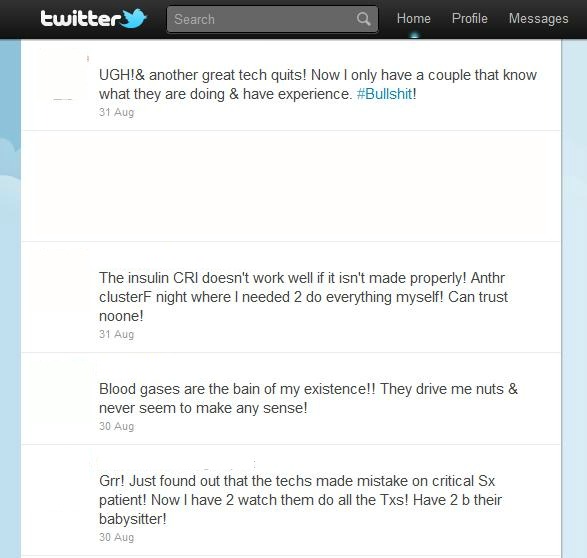
Finally, something a bit closer to home, how would you, or your staff, feel about having this tweeted from your hospital by a doctor, or about your pet?

Twitter vet image blanked out

Not only is this amazingly unprofessional, but all it will take is a single person to make the connection between hospital and Twitter account (the account does not identify the hospital, or the doctor, but I have still blanked out what is there in the interests of fairness) and this will become a huge problem. I’m sure it violates the hospital’s social media policy and I’m sure you could make an argument for it also being damaging to the profession to boot!

The bottom line is that your reputation and your brand are fragile. It is very easy for it to be damaged by just forgetting the basics of customer service. Never do anything, or say anything online, that you wouldn’t want on the front page of the paper or on a billboard. This is an age where it is easier to get your message out than ever before, but it is also just as easy for everyone else. And nothing travels, or goes viral, quite as well as scandal or bad news.

Does anyone have disastrous stories they would like to share or other examples they have seen online? Share with the rest of us in the comments!

(Click on the image above to view the book on Amazon!)
With possibly the longest subtitle ever: “Move your business forward through the convergence of search, social & content marketing,” Accelerate! cannot be accused of false advertising.

Quiet simply, Accelerate is a blueprint for successfully using 21st century tools for small business online marketing. Written by Arnie Kuenn, the president of Vertical Measures in Phoenix, and a co-founder of the Arizona Interactive Marketing Association; Mr. Kuenn certainly knows his stuff. In fact, it is one of the few criticism of the book that I have, is that it gets a little dense at times, particularly early on. The Search Engine Optimization (SEO) section while being very detailed gets to be a little much and will require a couple of readings for all but the most experienced of readers. However, the style does settle down, and it would be a mistake to give up on the book as and what you are left with in the end is, a user friendly handbook for search, social media, and content marketing.

The book covers all the major players as you might expect; Facebook, Twitter, LinkedIn and Google; but is also covers a lot of the less mainstream sites. Accelerate! plucks a number online tools out from the magic geek SEO toolbox to help with almost every aspect of the radical overhaul of your marketing strategy that will undoubtedly unfold once you have finished the book. I myself, am already looking carefully at how I put posts together for my site and have joined a number of social bookmarking sites directly because of this book.

A self published book, also available in a Kindle edition, I was initially concerned about the physical binding on Accelerate! I’ve had problems in the past with the spines of self published books cracking and then loosing pages after a single reading. I’m happy to report that this is not the case with Accelerate! I did take care not to be too absusive to the spine, but i needn’t have worried, the book is in great shape and looks the same as when it arrived.

I mention the self publishing issue, not just because of quality, but also because the text of the book directly references it as well. With a subject such as search and social media marketing, it is easy to get very out of date very quickly – Google+, for example, is not mentioned once. As the text explains, being a self published book, in addition to being an E-book, allows for easier updates than traditional publishing. I, for one, hope we do get new editions on a fairly regular basis, because this a great resource and one I know I will be referring to for quite some time. In fact, I found it quite odd to see URLs in the footnotes and be unable to click on them – should have got the Kindle version!

Mr. Kuenn’s book will not tell you how to brand and create a marketing strategy for your business – hopefully that is why you read my blog! What Accelerate! will do, however, is tell you how to navigate the waters of the increasingly complex world of search, social media, and content marketing. This still might not mean that you still don’t need to hire someone of Mr. Kuenn’s caliber, or the man himself, to work with you on these magic things. But if you do you’ll at least know what they are talking about and why.

If you want to get serious about search, social media and content marketing, you need to buy this book – it does what is says on the cover!

(Clicking on the cover above will take you to the book’s Amazon page and contribute to my book buying habit / problem.)

So Facebook and Twitter, which we looked at last week, are now part of your lexicon, what now?

There are other social media tools out there which can be of significant benefit. For Business to Client (B2C) businesses such as veterinarians, Facebook and Twitter are the ones to be using. However, having a strategy for some of the other sites can set you apart from your competitors and provide some interesting opportunities.

Foursquare

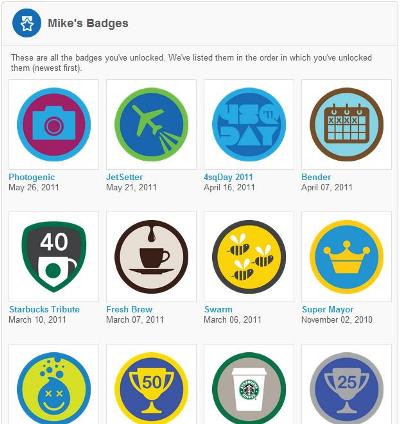
A personal favorite of mine, Foursquare is a location based social media tool with game elements. What does all that mean? Well, Foursquare allows users to “Check-in” to businesses and other venues using their smart phone’s GPS functionality. By “Checking-in,” users of the service let friends, via the service itself or by sharing on Facebook and / or Twitter. know where they are and why they are there. The game element comes from trying to rack up the most check-ins, and there by points and “badges,” than your friends. Users of the service can also compete with strangers for the title of “Mayor” of businesses or locations. The Mayor title does not mean anything other than bragging rights and more points when checking in. Badges can sometimes be difficult to get and so the competition can drive behavior. An example of this is the “Gym Rat” badge, that can only be achieved by checking in at a gym 10 times in 30 days.

Foursquare Badges

A selection of Foursquare badges

 Businesses can offer specials to Foursquare users when they check-in. Chilli’s, for example, offers free chips and salsa to anyone checking in on Foursquare – customers just show their smart phone to their server. Businesses may also reward the mayor of their business, making the title more coveted and therefore create competition around their brand.

 The grand theory of Foursquare is that it creates loyalty. If users have a choice between two businesses, one of whom there trying to become mayor of, they will choose that business or one is running a special for Foursquare users. Users of Foursquare can also leave tips, good and bad, about locations helping other users to choose where they might want to eat – for example. Because it is location based, it only offers places that are nearby, and allows the user to filter the results by type. This solves the information overload that can occur if smart phone users just trying to use Google.

Foursquare definitely has the potential to create a community of loyal users, and it has personal benefits (I use it to help keep track of my expenses!) However, the user base is small compared to other social media sites – particularly outside of major metropolitan areas. There are a number of other competitors in the location based world, the largest of whom is Facebook Places. The advantage of Facebook places is that it is part of Facebook, but it lacks a lot of the game elements that makes Foursquare fun and does not have the same controls on sharing.

Foursquare and other location based services have come under fire for the potential safety implications of letting your social media “friends” know where you are. This has been way overblown and as long as users are sensible, not creating a venue called “home” and checking into it for example, location based services will be around for a long time to come.

LinkedIn

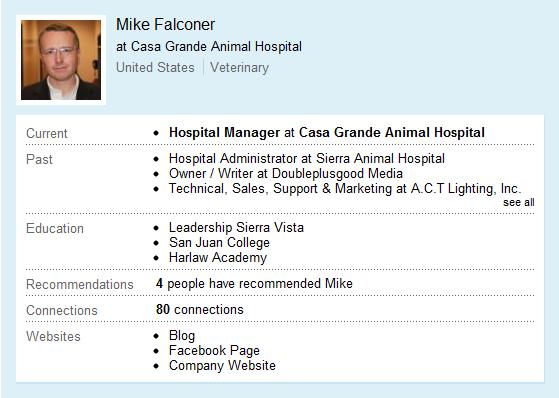
LinkedIn, is often called the professional Facebook and with good reason. Like Facebook, LinkedIn revolves around a profile. The difference is that your LinkedIn profile is essentially your resume. You can find mine here. Users of LinkedIn can then make connections with current, and former, colleagues to create a network. It is then possible to reach out to colleagues of colleagues more easily because you know which of your network knows them. LinkedIn has an introduction feature specifically for this. It is also possible to recommend, and get recommend, which also then appears on your profile.

Mike's LinkedIn Profile

Part of my LinkedIn Profile

Groups on LinkedIn are pretty much just like other web forums, but by being directly in LinkedIn it is possible to be a member of large numbers of different groups, on different subjects, without having to login to multiple sites. The additional functionality of being able to make connections that can help you professionally in the real world is obvious.

 A questions section does pretty much what you’d expect – allows for users to post questions and then other users to answer them. The advantage that LinkedIn has over other sites with a similar model, such as Quora, is that you are able to research the person giving the answer to see whether they know what they are talking about. You also then have a mechanism for connecting with them.

 A recent, and extremely innovative feature from LinkedIn has been news. This allows users to browse and share news items with their connections based on popularity within professional categories. It also allows users to share these news stories via Twitter – expanding the reach of your network yet again.

 LinkedIn does allow companies to have their own profiles, a bit like pages on Facebook, and this is interesting from a recruitment perspective. Groups are also being used successfully for recruitment and many feature a jobs section. LinkedIn also recently launched an “apply via LinkedIn” button that can be used for online job postings outside of the main LinkedIn site.

LinkedIn is a business to business tool (B2B), rather than the B2C tool that Facebook, Foursquare, and Twitter can be; however, don’t be surprised if LinkedIn does not become more and more a factor in recruitment of even minor posts in organizations. LinkedIn does have many issues (their mobile app is hopeless for anything other than news for example), but is a great professional tool for anyone interested in their career, or profession.

YouTube

YouTube is the video sharing site on the web and although being social it not at its core, it is still social media. Users uploaded material which they, and other users, can then share and comment on. Users can even create their own channels of material making it easier for other users to find similar videos. YouTube also has a number of great tools allowing you to embed a video directly into a website or blog. Video dramatically increases your website’s visibility to search engines, like Google and clients love it – a win all round!

Where YouTube really comes into its own, however, is that it is very easy for a video to go viral – spread around the internet like a virus. Of course, the video has to have some kind of merit; be funny, very dramatic, or even just be very bad, but if your brand is attached to this video it can be great publicity or almost zero cost. For example, it is not unusual for clips of TV shows on YouTube to have dramatically higher ratings that on the channels they were produced for!

Above is a great example of a viral pet video – 10 1/2 million views as of this writing and massive mainstream media attention for Denver’s owners. All from a video shot upon getting home and finding someone got into the cat treats!

 A great test of YouTube’s power is to pick any subject you like and search for a video on it at YouTube. Your are almost guaranteed that someone has shot and posted a video on that very subject. Thank you Corey for showing me this!

 Video production is really outside the realm of this already overly long post, but it is simple, very low cost and an extremely effective way to market your business.

Some of these social media tools may appeal to you, and other may not. There is definitely a take it or leave it feel to the services that we have talked about today but it is important to understand that to not be involved in social media, particularly Facebook, Twitter and to an extent Foursquare does not mean that your brand and business are not affected by these mediums. Your clients are using these tools and so might your competitors you should at least have an awareness of what is being said and why. The genie is out of the bottle and without getting involved, it is possible for you to loose influence over your brand – the control probably went some time ago as it is now the customer who ultimately defines what your brand means.

Next week, a change of pace: Up to your neck in traditional media!