Want to read a takedown of the leaders of the tech world, that calls them out for their hypocrisy and recklessness?
Of course you do.
Burn Book is, for the most part, that book. A book that at its most fundamental says “you promised us a brave new world – and what you delivered us was a more rapacious form of capitalism.”
The author, Kara Swisher, is a long-time journalist and analyst of the “tech sector” – particularly in Silicon Valley. She is also the co-founder of the Recode conference and the co-host of the Pivot podcast.
Burn Book, through the narrative of an autobiography, is her journey into the San Fransisco technology sector and her gonzo view of the events that, for better or worse, have shaped the world we currently live in – particularly its technology.
Where Burn Book really scores is in its view of characters such as Elon Musk, Bill Gates, Mark Zuckerburg, Steve Jobs, and Sergey Brin. From their early days, the beginnings of their success, through to their either refusal to accept the damage of their legacy, or the issues with how that legacy was formed, but also for some of them; their efforts to make amends. One is left with a sense of these figures riding waves that they barely understand or control. That often these figures are deeply flawed individuals who’s flaws have help lead to their success, but that long term they themselves are unrecognizable from the people they once were. Changed by wealth and power and all its trappings.
As Swisher mentions in the introduction; “move fast and break things” is in retrospect indicative of the tech scene entrepreneurs and their willingness to not think through the consequences of their actions. (Move fast and break things was an early internal Facebook slogan that was widely adopted by the tech sector).
Where the book becomes annoying is the author’s habit of “I told you so.” While this may well be true, and the whole purpose of the book is essentially to name drop, and let’s be honest that’s why we are reading it, it can become a little frustrating and seemingly self-aggrandizing. Swisher has earned the right to trumpet her vision and does have a record of putting billionaires on the spot, however, she does seem to fail to see the larger picture of the issues with this kind of innovation model.
Swisher is a self-proclaimed “believer in tech,” and this leads to the impression that she feels if only developers and tech titans were nicer then the world would be a much better place. This is quite possibly true, but one has to wonder about an industry who are happy to undermine industries and even societies, while failing to follow the basic rules that everyone else follows.
To Swisher’s credit she recognizes how close she has become to the tech sector and how that potentially impacts the objectivity of the analysis she gives. Of late she has made efforts to put distance between herself and her subjects. It would be easy to see this book as one of those efforts.
Burn Book is for the most part an enjoyable read with lots of moments to savor for those who want to see the self-proclaimed “Masters of the Universe” taken down a peg and be held to account. It does also do a pretty good job of exploring the duality of some of the complex individuals who run or formed some of the largest companies on the planet with little to no oversight. The author lauds Steve Jobs, for example, but does point out some of the flaws and cruelty that mars his legacy. It is not an in-depth analysis of all that is wrong with tools such as Facebook and the tech sector as a whole, but then it does not set out to be.
This is an autobiography and a story about being in love with an industry. The all too predictable break up, with the realization that who you were in love with is not quite the person you thought they were, is just another part of that love story.
It seems that everywhere one turns today artificial intelligence (AI) is being added to every aspect of daily life. Whether it be the arts, education, entertainment, search, or the workplace – AI is everywhere.
Often, those of us who are distinctly dubious about the claims that are being made about the current generation of AI, more appropriately labeled machine learning, can often feel like Cassandra of myth – fated never to be believed. At worst we are labeled as luddites, rather than as people who believe that technologies should earn their places in our lives and societies rather than being instantly adopted after being told by people hoping to get rich that they work great and everything will be fine.
Ms. Schellmann’s exhaustive exploration of AI in the workplace is pretty damning.
It catalogs how Human Resource (HR) departments have been adopting technologies that are often little understood by their users and are often working under misapprehensions as to the scientific backing of the ideas behind these tools. The fundamental problem is often one of garbage in – garbage out; a phrase that has been with us from the dawn of the computer age. For more on this I recommend the excellent “Weapons of Math Deception” by Cathy O’Neil which I reviewed here. The majority of AI tools are black boxes that we can’t look inside to see how they work. The manufacturers consider the algorithm’s inside these black boxes proprietary intellectual property. Without being able to look inside the magic black box, it is often impossible to know whether an algorithm is biased inherently, whether it is being trained on biased data, or just plain wrong.
One of the things that comes up again and again in “The Algorithm” is AI’s, or the people that program it, inability to know the difference between correlation and causation. Just because a company’s best managers all played baseball, does not mean that baseball should be a prerequisite for being a manager – particularly if it means that an AI would overlook someone who played softball – which is essentially the same sport. When one considers the fact that men tend to play baseball, and woman tend to play softball, it is easy to see just how problematic these correlations can be.
The problems with correlation and causation are of course magnified when junk science are involved. Tones of voice, language usage, and facial expressions, are being used in virtual one-way interviews for hiring and have little to no science behind them. In one highly memorable section of the book, Ms. Schellmann speaks German to an AI tool, reading from a Wikipedia entry, which is assessing her customer service skills and quality of English. The tool rates her highly in customer service and English even though she is speaking a different language and does not even try to answer the questions being asked.
Where the book falls down a little, but probably says more about the sad state of business thinking, is on personality testing. The author seems to accept as scientifically valid that employees can be categorized as one of a few simple types. You can read my review of “The Personality Brokers” by Merve Emre here for more on this nonsense and dangerous business tool. As Ms. Schellmann rightly states in her take down of how AI handles personality testing, but could actually just apply to all personality testing; “we’d be better off categorizing by star sign.”
It is disturbing just how much AI has already invaded the hiring space in the HR offices at large companies and gives one pause as these tools become more mainstream. While it is true that it is often not the AI software itself that is the problem, but how the humans that wield such technologies choose to use them. There is also the problem of how hard it is for a human employee to challenge a decision that is made by an algorithm – which by its very nature is a secret. The developers will often say that these tools should not be the final word in hiring or firing; but the knowing wink and smile behind these statements tells us everything we need to know.
Ms. Schellmann’s work is laser focused on human resources, an area where bias has been and often is a significant problem. The idea of a tool that can be used to eliminate bias, and that companies want to use tools like this, is not inherently a bad idea – in fact it is admirable. The problem is that bias in hiring is often unconscious bias and tools that are wielded by those who are not aware of their own biases are most likely fated to continue to have these biases and therefore affect the process. In addition, it is often difficult to impossible for candidates or employees to challenge decisions by managers which they may feel have been affected by bias. How much more difficult is it when it is not a human making the decision or recommendation? A tool of which we cannot ask the most basic of questions: what were you thinking?
This is an important work for our time – hopefully one not fated to be a Cassandra.
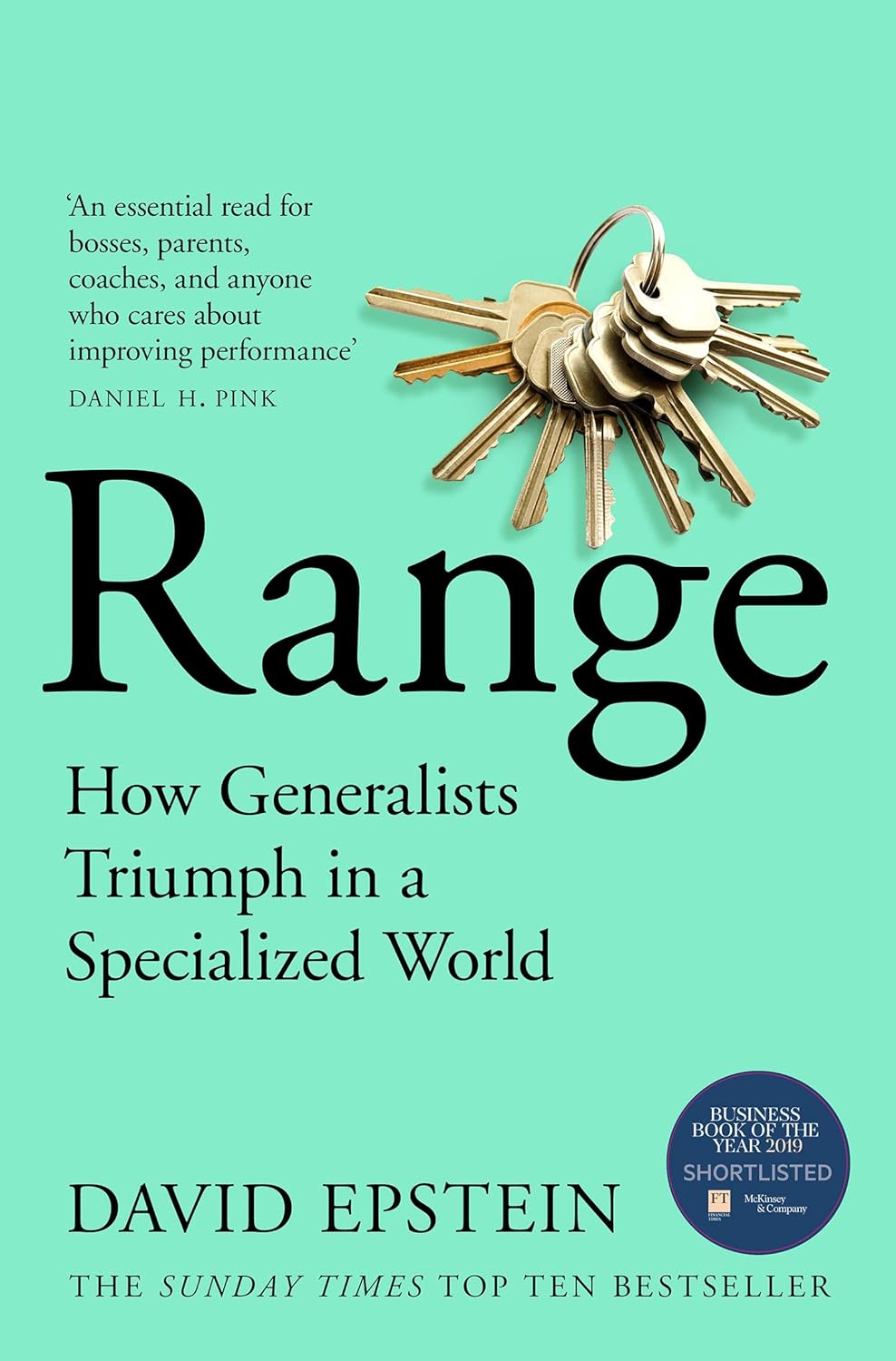
As a society we tell ourselves stories that, while convenient, are not always, or even ever, true. In what is probably Malcom Gladwell’s best book “Outliers” (which I can’t believe I have not reviewed) the author tells of the often decade long stories, and tales of extraordinary advantage, of seemingly overnight successes. David Epstein, in “Range: Why Generalists Triumph in a Specialized World”, is also debunking one of the stories we tell ourselves – that to be really good at something, or to have great success at something, we have to have focused on that thing for a long time – if not forever.
Before I go any further a word to my veterinary and human medicine readers. In this post, and indeed in Mr. Epstein’s book, when we talk about “specialization” we are using it in the general sense as opposed to the legal (small “s” rather than capital “S”). Although, I do believe that there are lessons for students from Mr. Epstein’s excellent book. Don’t be in too much of a hurry to map out your career. It’s a good thing to try out different interests and to change your mind – you’ll be better in the long run for it.
The pressure to focus on one thing, whether it be in sports, music, or entrepreneurship is all pervasive and often has business interests behind the marketing of “hyper specialization.”
It is a good story.
The Tiger Woods story is one that the author highlights. It is a story of the very young Tiger playing golf before he could talk and spending all day at the golf course. It is a story of winning tournament after tournament and having an unflinching goal of winning more titles than anyone else. Mr. Epstein juxtaposes the “Tiger story” with the far less well-known story of Roger Federer. Federer’s mother was a tennis coach but she refused to coach him and actively tried to dissuade him from playing tennis. A young Federer also seemed far more interested in soccer, basketball, skateboarding, handball and skiing. It was not until his teens that Federer started to gravitate towards tennis and then his goals were not lofty, but the rather quaint “meet Borris Becker” and “play at Wimbledon.”
This wide range of experience and lack of focus is the author’s main argument – that, more often than not, it is range that leads to success rather than specialization. That depth of experience of different fields matters more than depth of experience in just one. Interestingly, the evidence that Mr. Epstein quotes, rather persuasively, is that while early hyper specialization can lead to children getting a head start in that chosen area, they tend to fall into line with their peers rather than stay ahead as time goes on.
Where the book misses, for me, is that it seems to continue to fall back to specialization being a worthy goal via a route of different experiences, rather than the range of experiences being a worthy goal in itself. However, this minor quibble aside. The book makes a very strong case for experience in general and for following one’s interests. A great example is the idea to not ask kids what they want to be when they grow up, but rather to ask them what they are interested in. Our education, and in our careers, we often ask others where they are headed and penalize them for not knowing. This may be a mistake.
When I look at my career, I’ve had very specific goals at different times and while I have met some of them, I have taken some spectacular left turns that has led me to areas I would never have even considered just a few years earlier. No one is more surprised than me that I live in Las Vegas, watch a lot of hockey, and write poetry.
This is an important book for those who mentor, or lead, others. How we choose to guide – matters. We are often a deciding factor in whether to specialize in an area or to follow seemingly unconnected interests. There is value in a range of interests and experiences that benefit both the person and the employer.
A more enlightened view of the goals of mentoring will benefit everyone.
Why on earth am I reviewing a field manual on sabotage by the OSS (the predecessor to the CIA) from World War two?
Well, there are a couple of reasons other than the most obvious one that someone suggested it.
This very short reprinting, which would usually only be of interest to historians or those with underground bunkers and very full larders, is glimpse into the mind of a someone who wants to disrupt or destroy an organization both physically and psychologically.
There is not much that the average person could not have thought of themselves when it comes to physical sabotage, but it is interesting to note how just not doing simple things in the workplace can create serious problems and should therefore be taken seriously by managers. Most disgruntled employees are not quite so literal in showing their displeasure, but one does become aware, through the numerous examples, of just how vulnerable most workplaces and organizations are.
There is an illuminating passage early in the book.
“It should be pointed out to the saboteur where the circumstances are suitable, that he is acting in self-defense against the enemy, or retaliating against the enemy for acts of destruction.”
I, and most modern managers, do not think of employees, even problem employees, as the enemy. However, it is not a far stretch to think that there have been times when an individual employee on a disciplinary path may feel that they are in a battle of wills. This might not lead to outright sabotage, one hopes, but “quiet quitting”? Quiet quitting is the phenomenon of an employee doing just enough not to get fired – but no more. As the book says a couple of sentences on…
“The saboteur may have to reverse his thinking… Where he formerly though of keeping his tools sharp, he should now let them grow dull…”
Where the book really becomes of interest for managers, however, is in the final seven pages where it discusses what steps managers and supervisors can take to disrupt an organization’s psychology. If you recognize your organization within these pages – it is time for change. It is also a great reminder of seemingly well-intentioned actions by leadership teams. Insisting on perfect work where it does not matter, for example. Or “see that three people have to approve everything when one will do.”
There is even guidance for meetings and committees to be found in this later section. Warnings to try and increase the size of meetings or committees to the point where they become unwieldy is reminiscent of the often-told Jeff Bezos, the CEO of Amazon, anecdote that he will not attend meetings that cannot be fed by a single pizza.
A thoughtful reading of this short book by managers should act as a warning and a reminder both to themselves and about others. I think is also a good training tool for new managers to show what not to do and to be aware of the traps of self-sabotage that managers can often fall into. It is also a good reminder of where the line exists between performance problems and being a disruptive influence in the workplace.
Eighty years old it may be, but this short book still has some things to teach us.
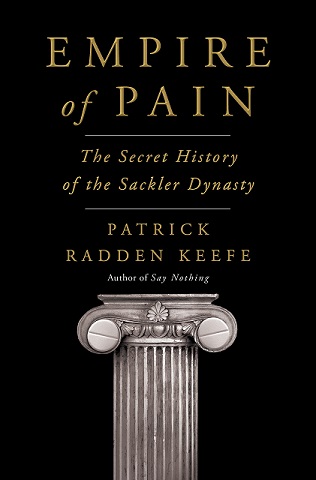
Empire of Pain is superb in its scope and breadth.
It is not just the story of the rise of prescription opioid use and abuse and OxyContin and Purdue Pharma in particular, but it is also the story of the Sackler family. The owners of Purdue Pharma. Their rise to wealth and power and their role in not only bring OxyContin to market, but their role in setting the stage of the opioid epidemic and crisis, and the multitude of lawsuits.
There is a lot to unpack in this book and a lot of lessons for society. However, what is of particular interest to me in Patrick Radden Keefe’s outstanding work is what Empire of Pain teaches us about company culture and values.
The Sackler’s have never admitted any wrongdoing for their role in the selling and distribution of Oxycontin, although Purdue Pharma has. This does not just stem from not wanting to go to prison, but from a cultural belief, both inside the family and at the highest levels of Purdue Pharma, that the Sackler’s could do no wrong. Even when marketing strategies inside the United States and outside the United States contradicted each other, the lack of any moral reevaluation of what they were doing to the detriment of millions, never seems to give any of the family pause or cause for reflection.
Even members of the Sackler Dynasty who had little to no involvement with Purdue Pharma were not prepared give thought as to the moral questions surrounding their wealth. Even when their work would seem to be directly involved in reflecting the human costs of the opioid crisis they seemed oblivious or to deliberately obfuscate. Madeleine Sackler is a filmmaker, who in 2018 made a fictional drama, O.G., and a documentary It’s a Hard Truth Ain’t It, entirely inside the level four Pendleton Correctional Facility. However, as the author states, Sackler “was able to weigh in, sagely, on the plight of America’s prison population without being asked to account for her own familial connection to one of the underlying drivers of that crisis.”
What is so surprising about the Sackler Story was the extent to which the Sackler family, while in theory only being board members of a private company, were able to co-opt and influence. This was not just decision making, marketing, and research on a day-to-day basis inside a company that others were supposed to be running, but the Sackler’s were able to influence the culture and thought of those at Purdue Pharma. Of course, money, power, and influence all played a part, but what is most remarkable, and disturbing, is just how much they were able to value loyalty above all else, and that loyalty meant thinking the same way.
It is clear from Empire of Pain, that while there are few who support the Sackler family today – they are virtual pariahs today in the art world, a world where their philanthropy had made them famous – there are still those who are colored by what Hanna Arendt called “the banality of evil.”
These were salespeople, marketers, CEOs, lawyers, secretaries, doctors, and researchers, who all bought into a view of the world so out of step with reality that it led to a crisis that some have stated is “bigger than the HIV epidemic.” The author even notes in his epilogue that the Sackler family story is bereft of whistleblowers. A testament to the family’s power? Or testament to how all-encompassing the culture was at Purdue Pharma.
For those wanting a proof positive macro view of why culture and values matter, you will be hard pressed to find a more glaring example.
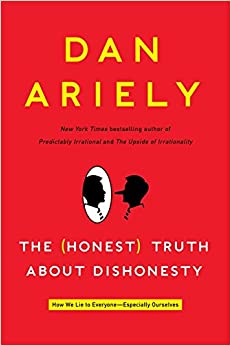
While The (Honest) Truth About Dishonesty: How We Lie to Everyone – Especially Ourselves; covers similar ground, and even features some of the same studies as Predictably Irrational, to write it off as a retread would be a huge mistake. What this this book focuses on is the balance between honesty and dishonesty. Most people hold a belief that dishonesty and theft are a mixture of temptation and a cost benefit analysis with regards to getting caught. What Dr. Ariely shows, however, with a mixture of empirical data and real-world examples, is that things are a lot more complicated.
Our own self-image plays a large part in instances of dishonesty and not in the way you may first believe. While people do weigh whether they are going to be caught before being dishonest, how we weigh that risk, and whether to act on it can often be influenced, by simple measures. Placing a space for a signature at the top of a form, for example, can significantly increase the truthfulness in the answers on that form compared to just having a signature line at the bottom that is filed out once the form has been completed. Likewise having students reminded of a school’s honesty oath dramatically reduces cheating on an exam, even when there are no other preventative measures, and the school does not actually have a honesty oath. The mere act of reminding someone that something is wrong can be enough to prevent dishonesty – even if just for a short while.
What seems to happen here is that we have our own self-image of how honest we are. However, we can over tax our sense of honesty, which then makes us more susceptible to temptation. The longer we resist temptation, the easier it is to justify be dishonest to ourselves. We “fudge” the truth depending on circumstance. But we can temporarily change our circumstances with simple reminders or independent oversight.
Of even more interest to companies, is the fact that dishonesty can be contagious and feeds into group dynamics therefore feeding into a company’s culture. The need to belong to the group can be enough to tempt us into being dishonest. One bad apple can spoil the entire barrel it would seem as the norms of group culture shift the individual’s perception of honesty. Likewise, decision fatigue can also impact our honest self-image and thereby lead to actions of questionable judgment.
This is a fascinating book with significant implications for managers and owners of companies. Told with wit, humor, and devastating evidence, The Honest Truth About Dishonesty changes our understanding of ourselves and more importantly those around us. By understanding dishonesty, and what gives rise to it, we can better understand what we can do to prevent it happening in the first place.
Unless you have been living in an underground bunker for the past three years, not as unlikely as it might have seemed ten years ago, you might have noticed that QR codes are back.
Menus, adverts, buildings, and trade show booths are once again adorned with them.
Other than the pandemic, another reason for their renewal is the imbedding in the camera functions of most smart phones, a QR code reader allowing links to websites be opened by visually scanning the code with your phone.
What is also back; however, is bone headed implementations of QR codes because they are “cool.”
DO make sure that your website is mobile friendly if you are going to use QR codes. I can’t really believe I have to say this, or that anyone still does not have a mobile friendly website, but they do; and QR codes are a mobile technology. Therefore, as a mobile technology, if you are sending people to a website that is not mobile friendly all you are going to do is frustrate people who know how to use a technology better than you.
DON’T put QR codes in emails. QR codes need to be scanned by a mobile device. Putting a QR code in a email which is then opened on a desktop requires the user to scan their computer monitor or laptop screen with their smartphone. This is nonsense. It is particularly nonsense because a QR code is just a fancy way of getting someone to click a link and links can be easily embedded directly into emails. Also, an email opened on a mobile device cannot read a QR code in that email. There are a few workarounds for this which I go into below; however, a link is simple straight forward, and we have been using them successfully for decades.
DO make sure that the site your QR code links to is clear simple and easy to use. Having ambiguity on a target page, after someone has gone to the trouble of scanning your QR code, is just silly. It is snatching defeat from the jaws of victory. Test your QR codes. Make sure your landing pages are simple, easy to use, and above all, working. There is nothing wrong with having multiple QR codes when it comes to directing your target audience.
DON’T put QR codes in Instagram posts. For some phones this actually works – they have a built in QR code scanner for photos and there are also apps users can download to allow for the scanning of codes. However, one of the reasons why QR codes had such problems with adoption in the past was the need to download an app. But for most users, who almost exclusively looking at the platform on their smart phones, QR codes on Instagram are useless as there is no way to directly scan them. “Link in Bio,” which directs users to look at the Instagram bio, and click the link there, is a simple workaround for the Instagram imposed limitation of only allowing a single link in an Instagram users bio. There are also multiple tools, including just a website, which allows users to have that single link lead to a page where there are multiple link options. I should also add that all Instagram users can now just add links in their Stories negating the whole issue.
DO put QR codes on flyers for things that require a sign up. Flyers that get printed out and put on notice boards for meetings etc., that require an RSVP, are a great use of QR codes. Much easier than the target audience having to type in a URL or email address. Just ensure that the landing page is simple and easy to use. However…
DON’T make the QR code on a flyer the only way to RSVP / sign up. Flyers for meetings etc. are often emailed to multiple people. If a QR in a pdf document is the only way to access the link to sign up it is massive over complication for the end user. A link in an email works great. A link in the PDF also works. Hell, you could even make the QR code itself a clickable link (I don’t recommend this). QR codes are supposed to make things easier not harder.
DO make QR codes simple. The more complicated the URL that the QR code is linking to, the more complicated the QR code itself needs to be. URL shorteners can help here; however, one should use these sparingly as security conscious users may be unwilling to got to a site blindly.
DON’T make QR codes too small. The vast majority of sensible QR code implementations are to add links to paper. A user sees something that interests them on a piece of paper, and they can then scan the code for more information, to sign up for something, or even to buy something. However, tiny QR codes can be difficult for some smartphones, or users, to scan. Since QR codes are about reducing barriers to getting users to click on a link, making the link too small is just a case of shooting yourself in the foot.
DO put QR codes in videos and digital signage. But only if you are going to give users enough time to get out their smart phones, open their camera app, focus on the screen, and scan your code. If you are not going to devote enough time to allow the QR code to be scanned, and allow for the QR code to be a sensible size, then what is the point of having the QR code in the first place? Also, if the QR code is being including in content when the user can just pause the video to scan a QR code then the likelihood is that they will find clicking a link much easier. Just put the link in the description.
DON’T think you must have a computer to display a QR code. I have seen a laptop on a tradeshow booth being used solely to display a QR code. How about a piece of paper? A QR code on a computer screen does not make you look more technically savvy. It makes you look like you forgot the sign, or the piece of paper, with the QR code printed on it.
QR codes can be awesome, particularly with smartphones having the ability to scan them built in. However, like any technology, it is only as good as its implementation. Bad implementations are just bad – they don’t get better because they have a QR code involved. Having a QR code to have a QR code is a prime example of bad implementation. They are a tool – try not to bring back 2012.
Why would we be offended if someone offered to pay us after we invited them to Thanksgiving dinner? What is the cost of zero, and why is it far more expensive than $0.01? Do we really need to tell our waiter our order in secret if we really want to feel that it is okay for us to have our first choice from the menu?
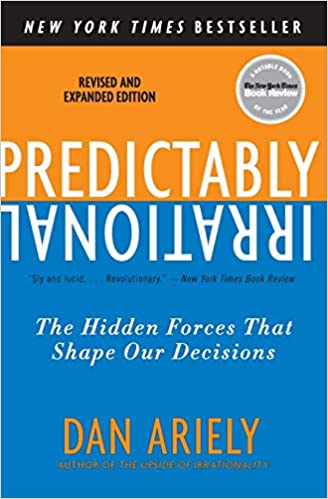
Subtitled; “The Hidden Forces that shape our Decisions,” Dr. Ariely’s superb book has the potential to change dramatically how we think about business and our personal lives.
With the use of subtle yet easily understood experimental data, Dr. Ariely exposes humans as often acting against our own interests due to societal or market norms and that we just do not understand our own personalities and the role that emotion plays in shaping decision making – spoiler its usually for the worse.
So why would we feel offended if someone offered to pay for Thanksgiving dinner? Dr. Ariely not only explains but also shows with examples and experiment data that we humans have social exchanges and market exchanges of behavior. Social exchanges we use with friends and family. They are the norms that govern daily life and allow us to bond with other humans. Market exchanges are, as they sound, the exchange of money for goods and services and also the money we receive in exchange for our labor in the form of our working lives. When one offers to pay for Thanksgiving dinner were mixing social norms with market norms. We are indicating that we are rejecting the social acceptance of those who may be friends or family in favor of an exchange that we could expect to have with a stranger. A commercial transaction. What becomes interesting in breaking these social norms is that we find it is difficult to go back. Trying to pay for Thanksgiving dinner may never get us invited back because a social exchange has been turned into a market exchange. Employers who do not have social exchanges with their employees may find that employees therefore treat the relationship as a purely market exchange and leave for an employer who offers a better market exchange – usually more money or better benefits. This also explains why employers who do embrace a social exchange in their workplace culture become frustrated and angry when an employee uses only market norms in their decision-making process to leave.
Likewise, when companies use a social exchange to bond with clients they may find when they resort to a market exchange when it suits them – policy over the relationship with the client – they have unleashed a Pandora’s box of problems with someone they once may have considered a friend of the business. Business can’t have it both ways, and if we try to, we are storing up trouble for ourselves.
Debunking of personality testing, without mentioning personality testing, is in this book with a discussion of priming and setting expectations. There are also volumes of data showing that making something free rather than reducing a price – even if the reductions are the same, can make a dramatic difference in the uptake of an offer. Buy one get one free really does work!
There is also a highly disturbing chapter on the affect of sexual arousal and decision making and morality. While I will spare you the details here it is difficult as a guy to read this chapter without recognizing oneself and feeling ashamed of the implications. This chapter does not give guys and excuse; however, it should make us pause and understand that we have the capability to be highly irrational in the right circumstances.
And that is really the crux of the book.
By recognizing that we can be irrational beings and what triggers that irrationality, we can know ourselves better and make better decisions. It also allows us to spot irrationality in others and how that has come about.
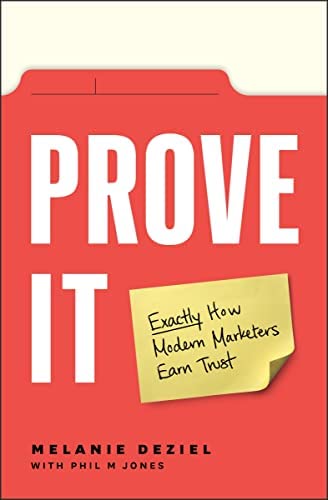
Like its predecessor, Prove It is a how to guide that many marketers will find familiar for the ideas and concepts are not really new and are the fodder that modern marketing is based on. However, like her previous book, what Ms. Deziel and Mr. Jones do in Prove It is to create an overarching framework and concept that put these ideas into context and provides a guide to future ideas and processes.
The main thrust of Prove Its is that today’s customers don’t want to be told why they should buy a product or service but to be shown why they should with concrete and provable examples. This process then becomes the underpinning for a brand as a whole. Where Prove It really works its magic is by showing rather than telling. It uses the slogans and catchphrases that the reader will be all too familiar with to make its points crystal clear. “Fifteen minutes could save you 15% or more on car insurance” for example is Geico’s way of proving that they are easy and convenient to deal with while also potentially being able to save the customer money – ‘give us a little of your time and we’ll lower your car insurance rate.’
Prove it is full of these examples for every type of business or service and how these claims can be discovered about your business, and how that discovery process in turn leads into a marketing / branding strategy. The book also encourages the reader to back up these claims with documentation and to use this a method of re-enforcing the brand’s identity by doing so. Where Prove It really scores on this front is by pointing out that businesses often already have access this documentation in other forms. Reviews on sites such as Yelp, customer service surveys, or just by talking to customers themselves can yield not only great content but can also provide witness to the claims that a brand is making and therefore backup the branding process itself.
What I personally found very interesting was a dissection of how Apple ‘coached’ its client base to not necessarily believe the claims of its competitors when it came to the differences between using a Mac or another computer brand with its “I’m a Mac and I’m a PC” series of TV ads. The idea that an ad can be coaching a customer to ask the difficult questions that the competition may not want to answer is fascinating and subtly brilliant.
Prove It is a short and engaging book for both marketing professionals and beginners alike. It demystifies how modern advertising and content marketing work. This is not a nuts and bolts “place this type of ad at this type of time” kind of book; but more about mindset. This is a book to understand how to sell a product or service so that a customer can easily identity the ‘why’ they are prepared to buy.
To sum up it so very worth your time and its place on your bookshelf.
Digital signage is something I have embraced more and more over the years and this post is an attempt to share some of those technological solutions. Managing multiple veterinary hospitals, these solutions are obviously geared towards the needs of the veterinary hospitals as are the pictured examples; however, these examples will also work with any business trying to achieve the same goals. I also only use PCs; however, most of these solutions should work with Macs or other platforms.
Delivering Video Content
The simplest and cheapest way I have found to deliver video content is to use Apple TVs. These are a simple “set top” boxes that allow for the streaming of video content from the internet or from a networked server computer running iTunes. Please note this would not be your main network server, although I guess is could be, but is more likely just be a conveniently located computer running iTunes that acts as a content server. A monitor can just be plugged into the Apple TV using an HDMI cable and the Apple TV can access the network via an ethernet cable or Wi-Fi (I would recommend the ethernet cable.)
Apple TV
Rear of the Apple TV
For example, a playlist of video content can be created on YouTube and then streamed to the Apple TV. Alternatively, content is stored on a local computer, categorized Music Videos instead of Home Videos, and then put in a playlist. The playlist can then be selected, on repeat, from the “computer” icon in the Apple TV setup and then streamed.
Please note that you should always have permission, or own the content, that you are displaying to the public for copyright reasons.
Theses days most “Smart TVs” have a built in YouTube app meaning it is possible to not use the Apple TV boxes at all and just stream directly from YouTube. YouTube allows for the creation of playlists and content can be unlisted so that only those that are logged into your account or who have a direct link can video those videos. The downside to this is that it means uploading all content and then continuously streaming it from the internet. That’s a lot of bandwidth and time moving around very large files. It obviously also means replying on an internet connection for delivery and an outside service which may change its policies on advertising at any time.
The upside to streaming content like this is that multiple new playlists can be created from a central location and then played back whenever ready from the display using the Apple TV remote or the smart TV remote.
The downside to using streaming, whether directly to a smart TV or to an Apple TV box and then a to a display is that multiple displays cannot be synced. In my experience this is not a problem for most applications, but if having the same thing displaying on multiple displays at the same time is important then combining an Apple TV system with a Wolfpack system (see below) will achieve this.
Displaying a Computer Screen
Many computer programs have dashboards, censuses, electronic whiteboards, PowerPoint, or even just CCTV feeds that it would be helpful to displayed around a building. One can obviously just use individual computers and monitors for this job. However, this can be expensive in terms of software and hardware, and often is just not ergonomically satisfying due to the size of the PC and needing a mouse and keyboard to make changes and general maintenance.
Using individual computers to run displays from Practice Management Software (PMS)
HMDI over ethernet is a possible solution. There are a few different systems out there, but I really like the Wolfpack system from HDTV Supply.
The Wolfpack Matrix Switcher with Transmitter and Receiver boxes
The Wolfpack system does not send HDMI signals over a building’s network, rather it converts HDMI signals to Ethernet and then back again. A central matrix switch allows the administrator to route inputs to outputs as needed.
A Computer running PMS displayed at multiple locations using the Wolfpack system
As you can see in the above image, the display HDMI signal from a computer is sent to a Wolfpack transmitter box and converted so it can run over Ethernet. In turn, this Ethernet cable is plugged into the matrix switch which then sends the signal to as many receivers as needed. Each outlet will need its own Ethernet cable / route. These Ethernet outputs are then plugged into Wolfpack receiver boxes and converted back into HDMI which can then be plugged into the displays.
If setting up a system like this, I strongly recommend having a display local to the computer rather than just replying on the remote displays. This can be achieved by having a second video card in the computer or by having an additional Wolfpack receiver box and monitor where the computer is.
A more complicated wolfpack system with two different computers displaying different information from the PMS to multiple locations
These systems are extremely flexible, but please be aware that since each display requires its own Ethernet route existing ethernet lines can get used up fast and therefore cause problems for your traditional computer network. Another advantage of this system is that adding a new display is only as expensive as the display itself and a new receiver box.
It is possible to combine both the Apple TV system and the Wolfpack system to allow for content displays to display the same content in sync with each other. The HDMI output of the Apple TV plugs into a Wolfpack transmitter box and from there the signal is routed to Wolfpack receiver boxes and the attached displays. Again, I would strongly recommend if setting up a system like this to have a display local to the Apple TV for setup and maintenance purposes.
Screen Savers as Digital Signage
Although the need for screen savers on modern computers is not longer the requirement it once was, the tools offered by screen savers on individual PCs makes for great static digital signage. Images, not video as of this writing, can be displayed sequentially or in a random order on some or all of a building’s computers. Indeed, it is even possible to have multiple different sequences running on different computers depending on the companies needs or where those computers are in the building itself. The huge advantage of using screen savers is that there is no hardware or software to be purchased; the screens and computers already exist.
Screen savers as digital signage also has the added advantage of the simplicity of using images and is therefore a great starting point for beginners trying to introduce other team members to the benefits of using digital signage.
Screen savers being used to display new employee information throughout the building
The way to achieve screen saver digital signage is to use the “photo” screen saver tool on each individual computer. This is time consuming but only needs to be done once. The photo screen saver tool is generally found under “settings” and then “display” on PCs and needs to point to a folder on the network, preferably the server, that contains the images to be displayed. Windows, displays images in numerical and / or alphabetical order of the file name. If a particular order is needed, then the naming convention of the images in the folder needs to be considered. To have a separate set of images for a different set of computers or area of the building simply have second folder and point those computers screen savers to that location on the network.
Screen savers in an exam room being used to deliver marketing information while clients wait
With a probably configured system, adding new images into the screen saver is merely a matter of dropping new images into the correct folder. To remove images, just remove them from the folder. A discussion of what is trying to be achieved is probably worth having with the network administrator or IT vendor as the networked folder for the images will probably require access adjustments.
Screen savers being used to deliver staff bios to clients in an exam room
Pro tip – getting the speed at which images change, particularly if those images contain a lot of text can be tricky. Most screen saver tools just have slow medium or fast as options. However, duplicating images and giving them sequential file names (1a.jpg and 1b.jpg for example) will allow for an increase in the time spent on any one image. Please note this does not work if the photos are being displayed in a random order.
Digital signage is a great dynamic tool; however, it is only as good as the content that is displayed on it. Consideration as to what is going to be displayed, how it is going to generated, and who is responsible for updating are all key questions that need answered before jumping into the world of digital signage.