Archives for category: Marketing

Why does being a customer suck?

Does it at your business?

Are you being honest?

How would you know if it did?

What happens when you walk into a restaurant you’ve never been to before? Do you stand there for a moment wondering whether you need to seat yourself or wait to be seated? Do you go up to the counter and order? How open are they going to be to changing one of their dishes to meet your needs?

O.K., enough question marks.

As a restaurant owner, or any business owner for that matter, it is obvious how your business works to you, but your clients almost certainly don’t walk through those doors every day -mores the pity.

Education of the client is often held up as a key component in a lot of service industries to solve these issues (yes veterinarians, I’m looking at you). Our job, as delivers of services however, should be to hold our clients hands through this process and make it as painless as possible. Clients should not need to become experts in how to deal with us, or the industries in which we work.

As I discussed at some length in this post about marketing and branding, what you sell is not necessarily what your clients are buying. The customer experience should reflect this. I had a recent customer service experience that brought this all into sharper light. Because the owner of the business is a friend, I’m not going to go into that particular experience directly, but it did cause me to re-evaluate what I do, how I respond to clients who do have issues, and do some thinking at length about what “customer service” actually is. Instead, let me tell you about my bathroom…

A while back I had a bathroom tiled. I spent a significant amount of time picking out exactly the right shade of tile that I wanted and the size. At the end of day one of the installation however, I come to find out that the tiles are actually two slightly different shades. I talk with the installer and the answer is “Well that is how they come – It is to give the effect of real marble.” Well, I did not want two tone tiles, I wanted them all the same color. Who is right here, and who is wrong? The store, and the installer, are both perfectly right – the tiles are manufactured that way and I’m sure that for most installations it would have made lots of sense, but that was not what I was purchasing! I was purchasing my bathroom tiled in a particular shade!

Interestingly, I was was in a locally owned and operated store a little while later and happened to look at their tiles. Their display was actually setup so that for tiles of the type I was looking at, all the shades of the same batch of tile were shown together as a single piece rather than just an individual tile. This removed the “different shade shock” that I had experienced when I had bought tiles for my bathroom.

Other than showing my bad taste in tiles, what does this experience tell us? It tells us that it is very difficult to forget information or view things as if we don’t know about that information. Chip and Dan Heath, in their book “Switch – How to Change things when change is hard,” have an excellent exercise that you can use with staff – or even just friends – that shows this in action. Give a volunteer a piece of paper with the name of a very common tune written on it and get them to ‘knock’ out the rhythm of the tune on a table and see if the others in the room can guess what tune it is. Try it with a number of different tunes and people. Those knocking the tune out will find it really hard to understand why everyone else in the room can’t guess correctly. The reason for this is that they are hearing the tune in their own heads along with the knocking. They have knowledge which everyone else in the room does not. Not only are they unable to communicate that knowledge, but they don’t understand how or why everyone else in room does not have that knowledge – it is an alien perspective to them.

This is just like my tile sales man and installer who could not understand why I did not know what they knew about tiles. It is also the same phenomenon that has you hesitant and unsure in the lobby of a restaurant you’ve never been to before – the big sign saying “please wait to be seated” can be a huge relief. I’d also argue that this is one of the reasons why chains are so successful. Familiarity is easy!

So what does this all tell us?

Well perhaps we need to start really listening to our clients and thinking about their experience and how it is not our experience. It might sound trite but customer service is about serving the customer. If we have a lot of education deliver to a client, perhaps the problem is that we have not made things simple enough. Of course, if the client wants more information they need to have it, and we need to have the resources to hand to help deliver. But we also know, from numerous studies, that very little information is actually retained when we deliver large amounts of it in person. We also know that lots of choices actually result is less decisions being made.

Clients are not stupid, but they don’t have, and shouldn’t need, a manual to use our businesses or get the services we are trying to deliver to them. One of the reasons why Apple’s iPod, iPhone and iPad are so successful is that anyone can use them from day one with the minimum of instruction. Our businesses and services should be the same way.

Being a customer can suck – but it is our job to ensure that it doesn’t!


A check list for removing suckyness from the customer experience

  • If we have have to explain things over and over how can we stop the need for explaining?

  • Do we get frustrated with our clients lack of knowledge – perhaps they are not the problem?

  • What do our clients complain about?

  • How successful are we with our recommendations?

  • Do we have compliance issues?

  • When issues arise, how could they have been avoided?

If you have any additions to this list, or have any customer service stories to share, please let me know in the comments!


Violated Online is a interesting book for a number of reasons. But by far the most interesting thing is the quandary at it’s heart.

Wyer runs a company that specializes in Search Engine Reputation Management (SERM) and Violated Online is essentially a 200 page pitch for the SERM industry. In case there is any doubt, SERM is essentially the same as the Search Engine Optimization (SEO) practiced by online marketers to ensure that search engine results reflect the results that they want.

The fundamental idea at the heart of Violated Online is that we live in a connected world and that information is easy to find or publish. That this world can be a scary place, and that things have changed, should really come as no surprise to anyone.

It is hard not to feel while reading this work that the author would rather go back to the “good-old-days.” By its own admission, Violated Online states that a lot of personal information was always available offline, but that now this information is a lot easier to access and somehow this makes the internet is a bad thing. It is interesting to reflect that only 10 years ago we gladly gave our social security numbers to department store clerks, or any other number of people, to bring up account information. Just like we have all learned to control our personal information, we also have to take responsibility for our online presence.

To be fair, Violated Online, makes this exact argument. However, most people reading it will only take away from the near hysterical tone is the idea that to protect themselves they need to stay off the internet or employ a SERM company. For example, some of the advise is practically useless for the average person – registering every single web address permutation of you and your families name. Great advise for a business, or someone in the public eye, but more than a little over the top for most people. It is easy to forget that in the days before the internet, if the major media misquoted or focused on an individual, there was very little recourse. The internet can magnify these problems but it also provides an avenue for correcting those mistakes. Violated Online makes no such comparisons or admissions.

However, the biggest issue with this book is that on the one hand it bemoans that individuals can be anonymous online, and then rails against social media’s use of proper names and identities. You can’t have it both ways! The online identity issue is significant, but it needs to be handled with education about when you can and can’t rely on online information and who posted it.

Violated Online is an important book and is well worth reading, despite its problems. Just don’t buy into the end of the world scenarios and take away its most important message – take control of your life online before someone else does.

(Clicking on the cover above will take you to the book’s Amazon page and contribute to my book buying habit / problem.)

2011 has felt like the year of the Bayer Brakke Study. Most of what has been written in the world of practice management, seminars, and conversations between managers, have ended up talking about the Bayer Brakke study.

This was finally summed up for me when attend a one day workshop held at VSCoT by Butler, Bayer, and Jessica Goodman Lee, CVPM of Brakke consulting, on the study itself and what to do about it’s findings.

I felt it might be interesting for me to give my personal view point on some of what I took away from this presentation, the Bayer Brakke Study in general, and what it means for the veterinary profession, clients and pets, as a whole.

1: The profession needs to change and it needs to take the change seriously.

The 1998 Brakke study made 19 recommendations and the only one that was adopted by almost all veterinary practices was to raise fees. Now that was a good thing – fees need to rise, but the other recommendations we’re also important. Inventory management and reducing expenses, for example, were the recommendations with the next highest adoption rate and they were adopted by less than 50% of practices.

Just raising fees is fine when the economy is doing well, but does not bode well recessionary times and helps explain why visits are down and some practices are have had a significantly hard time over the last couple of years.

What was valid five years ago is not valid now – never mind 10 years ago.

2: Normalcy is not an excuse for inaction.

One of the elements that the study points out is that many practices believe that all they have to do is “weather the storm” and everything will get back to normal. What is currently being misunderstood is that the industry has changed. New competition, with different business models, have arisen partly in response to these challenging times, and who is to say that these will end anytime soon? Only 20% of practices expressed serious concern about the changing market place.

The other major issue is that business itself has changed. As Jim Lecinski points out in his book “Winning the Zero Moment of Truth” buying, consuming and even reviewing habits have changed. As a business you ignore these changes at your peril.

3: We Live, or Perish, by Communication with our Clients.

59% of dog owners and 56% of cat owners would bring their pets in more often if they could prevent problems and extensive treatments later on. The figures are almost identical when owners believe that their pet will live longer by bringing them to their veterinarian more often.

In addition, 56% of clients feel that their veterinarian does give them clear instructions as to when they should bring their pet in.

4: Cats – the Great Opportunity.

As I personally experienced while helping with the pet evacuation due to the Monument Fire in Sierra Vista, cats are woefully undeserved by the veterinary community. The bottom line is that cats do not get brought into the vet enough or sometimes ever. It is difficult for the owner, difficult for the cat, and difficult (from the client’s perspective) for the veterinary practice.

If a veterinary practice sees 25% cats and 75% dogs, and there are 13% more cats that dogs in the U.S. the opportunities are enormous both for the business of the practice and in improving feline health.

5: It is all about money – except when it is not.

Getting inventive about payment options, whatever they might be, are seen by clients as needed services. That does not nessecerally mean that veterinarians have to become banks, but it does mean that we can’t wash our hands of the financial issue. The practices that are able to provide options will find clients flocking to them. It is also important to note that choice is not always a good thing. It can send a a mixed message to clients who are looking for a recommendation. Pet insurance is an obvious area where having a practice provider of choice in terms of recommendations can make a big difference to clients.

Trumping the financial issues, however, is communication as mentioned above. If we do not explain the value of what we do and why we do it (exhibit A: the lack of feline visits) how can we ever expect clients to?

I can sum a lot of what I have written above by one word: Management.

The industry needs to embraise management (this may seem like a self serving argument as a practice manager, and to an extent it is, but it does also does not make it any less true) as a key ingredient for practice health. It is no accident that the Bayer Brakke Study shows that the variables most constistant with increased visits were: seeing the same veterarian every time, wellness exams considered the most important service, marketing and advertising as important to practice success, and the active use of social media. The variables most consistent with decreased visits were: advertising undermines credibility as a veterinarian and lack of referral arrangements with shelters, groomers etc. These are all areas where good management can make a significant difference. Managers have to be allowed to manage, but they also need to manage well.

Proper practice management is not just the responsibility of the managers. Of course, managers must manage, but there has to be a sea-change in understanding that proper practice management actually effects patient health and outcomes.

Just ask all those cats!

These are just my take always, any others or any other ideas? Lets here from you in the comments. Abuse, as always, very welcome.

For a field supposedly bereft of metrics, social media is full of them.

I have more Facebook fans / Twitter followers / blog subscribers than you do. My tweets get re-tweeted more often, more people are talking about this on Facebook, and every blog post has a hundred comments. And, of course, the crowning achievement, my Klout score is higher than yours.

I’ve had a couple of run-ins lately with social media envy. The first was a blog post that was very popular for all the wrong reasons – I took a position that lots of people disagreed with. I don’t regret that post (or the sentiment it contained), but it did get me thinking on the nature of why that post was so “popular” compared to others on my blog. Certainly, it has been a long understood concept that controversy boosts readership (just ask a tabloid journalist). However, what really made me start thinking on this topic was why would readers engage more just to tell me I’m wrong? Does this kind of thinking carry over into more corporate blogging? Should I start my next vet practice blog with the words “I hate pets?”

Obviously, you won’t find any anti-pet blog posts from me any time soon. But it led me to start reassessing as to why I decided to start blogging in the first place.

The next thing that really set off the social media envy was Facebook. Working in small communities, and have having a very successful Facebook presence on the two major pages I have run as a veterinary practice manager, I believe I am justifiably proud of both the number of fans and the level of engagement, without vast sums of cash being sunk into the pockets of Mark Zuckerberg. My pages have had significantly better engagement, and fan bases than my competitors, or other local businesses. Of course, it is therefore disheartening to come across others who seem to be doing a better job – with more fans and better engagement, even if they are not in your market. Social Media envy I hate you.

The bottom line, however, is that social media envy, like envy and jealously in general is pointless and stupid. The real questions to be asking ones self when faced with social media envy are:

1: Does my presence achieve what I want it to achieve?

2: If someone else is achieving more than I am how can I learn from them and is it even possible for me to do something similar? There is a big difference, for example, in running a Facebook page for a rock band versus running a page for a veterinary hospital or a restaurant.

3: Am I making forward progress and do my clients, and potential clients, like what my online presence delivers for them?

Social media, is a element of a marketing strategy, not a marketing strategy in itself. It is a tool to achieve your goals. And those goals can be quite ethereal. If social media is not working for you, then it is time to try something else or learn from those who doing what you want to be able to do.

It is not a race.

It is not a competition.

It is a tool.

It makes no sense to judge yourself, or even the tool, by how others use it.

Comments, good, bad, and indifferent are always welcome – flame away!   

For those who do not use Twitter, you might not know about Friday Follows. The idea is that on Fridays, Twitter users recommend other Twitter users to follow.

It has fallen out of favor of late a little, the Twitterverse can be fickle, and I’ve never been a big believer anyway – preferring to retweet (repost others messages) on a regular basis. But it has always been nice to get one.

Yesterday, however, I got the best Friday Follow ever from Jim Dougherty who goes by the name @leaderswest on Twitter.

Jim’s Friday Follow took the form of a short – talking to camera – video, explaining to users why they should follow me, and others, on Twitter. The genius of the idea is that each subject gets their own short video making it very easy to view and share by the subject.

This is great content marketing.

Easy to consume, relevant, and selfless – which of course reflects very well on the content creator like all great content marketing. It would be interesting to see if all recommendations will eventually be like this: personal, short, and on video. It has certainly got my wheels turning considering just how effective I find the video below. Interestingly, Jim used Keek for this project. Keek is hoping to be video Twitter.

Please follow @leaderswest on Twitter, after you follow me!

Video Friday Follow about @mike_falconer from @leaderswest

(Keek's embedding does not work very well in WordPress yet - just click on the image to take you to Jim's Keek page and his video post about me!)

Well, what did you think?

Let me know in the comments and take a look at Jim’s other Friday Follows in the same page.

Bad feedback, subtle (and not so subtle) digs on Twitter, your mistakes pointed out for all to see, and then you go make it way worse…

In your online life, just like your business life, it can be hard to take criticism. We are not married, after all, to our peers – business is personal. But just like in person, going ballistic certainly does not help the relationship, how you are perceived by other people, or even your own equilibrium.

I seemed to attract a deluge of criticism online and off recently. In addition, I had a management issue that felt like backhanded criticism. Although my first instinct was to react as if these were attacks, by standing back, taking a deep breath, and actually trying to see what the other person was saying, I realized that they all had merit – and in some cases, there were things that needed addressing.

What is so odd, for me, is that, I consider it a key function of my job to address client issues when they come up about my practice. I survey every client who visits us, so thanking clients for positive feedback, and trying to address negative feedback, is part and parcel of what I do.

Learning the lesson that bad, even unjustified, feedback about your business is not a personal attack was an easy lesson to learn. Understanding, that personal business criticism should be handled in a similar vein is harder to learn, but ultimately even more important.

Comments welcome (please be gentle…)

This week, I take pot shots at webinars and why I think they are a waste for speaker, and the virtual attendee.

Webinars, where a speaker presents over the Internet, at a predetermined time to an audience sitting at home or at their desks, have always seemed to be a classic example of having your cake and eating it too. By the way – that expression makes no sense whatsoever. If I’m having cake you better believe that I want to eat it!

Anyway, I digress…

The problem with webinars is that they have all the disadvantages of actually going to see someone speak, with none of the advantages. The timming of the webinar is decided by the speaker, or organizer. The transfer of information is limited to that timing window and whatever notes are issued.

From the speaker side, webinars offer the possibility of actual interaction with participants. However, because the interaction is one way, unless initiated by the viewer, the speaker has no idea as to how well the presentation is going and therefore how to tailor it to address potential issues.

I also cannot help shaking the notion that webinars are, for the most part, the lazy way out. If online delivery is what is required, let’s have proper content. Presentations that can be downloaded, shared, and watched again and again on the viewers schedule. YouTube, Slideshare, or even PowerPoint all make this very easy.

While saying all this, I do think there is great value in physical meetings and presentations- particularly for the conversations that happen before and after the meeting. Social media, is an excellent way of approximating this offline interaction of a physical meeting- online, but the realtime contraints of a webinar don’t really lend themselves to this interaction.

Plus, who doesn’t need more great content.

You build a marketing strategy, craft your brand, have a good grasp of your online identity, lots of likes and followers on the various social media platforms, and even have developed great connections to your local media…and then you do something really stupid that could potentially blow it all.

Nobody is perfect, and we all makes mistakes – I’ve made some doozers. But there is a real difference between making mistakes, admitting those mistakes and then trying to fix the problem, as opposed to declaring war on your customers and ultimately your own business.

Lets take this little Twitter gem for starters courtesy of the Daily Mail. A customer in your restaurant overhears a waiter being rude about another restaurant owner who the customer happens to know personally. Your customer is not to thrilled with the service already, and finds this behavior to be rather off, so they Tweet about it. What you do not do, as a restaurant owner, is call up from home, ask to speak to the customer in question, curse at them down the phone, and then demand they leave. That, however, is exactly what happened. In the ensuing Twitter onslaught, the restaurant came off far worse and created a massive (the restaurant is in Texas, the Daily Mail is a UK newspaper as an example) amount of negative publicity over a customer service issue. An apology, and a courtesy meal or bottle of wine, could have turned this incident into a minor win instead of this major fail.

Next up, the auto-body shop that after using a photographer’s work on their Facebook page without permission, proceeded to threaten and abuse the photographer on their own Facebook page for all to see. Needless to say, the page went viral over Twitter and Facebook. With the almost universally courteous, and intelligent, posts from supporters of the photographer, and gangsta inspired vitriol from the body shop it could only be seen as a massive marketing failure right in front of the businesses own 500+ fans. I believe the page is now been taken down as I can no longer find it, but if anyone knows if it is still up please drop me a line so I can share the link.

The Airbnb saga, has been done to death but is instructive because even very smart people can do really dumb things. The basic outline is that Airbnb is a service that allows homeowners to rent out a room on a short term basis like a hotel. Unfortunately, when an owner returned to find their apartment trashed, and their identity stolen, Airbnb basically stuck their heads in the sand and appeared to try and discredit the victim to stop her blogging about her experience. After a major backlash, Airbnb added safeguards, an insurance policy, and tried to do the right thing by the victim. But it could be too little too late considering their model is very easy to copy and already has a number of competitors. Most people had never even heard of Airbnb until this story exploded.

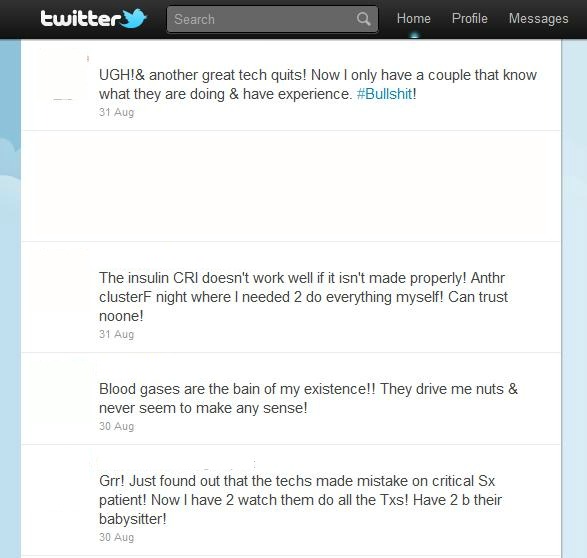
Finally, something a bit closer to home, how would you, or your staff, feel about having this tweeted from your hospital by a doctor, or about your pet?

Twitter vet image blanked out

Not only is this amazingly unprofessional, but all it will take is a single person to make the connection between hospital and Twitter account (the account does not identify the hospital, or the doctor, but I have still blanked out what is there in the interests of fairness) and this will become a huge problem. I’m sure it violates the hospital’s social media policy and I’m sure you could make an argument for it also being damaging to the profession to boot!

The bottom line is that your reputation and your brand are fragile. It is very easy for it to be damaged by just forgetting the basics of customer service. Never do anything, or say anything online, that you wouldn’t want on the front page of the paper or on a billboard. This is an age where it is easier to get your message out than ever before, but it is also just as easy for everyone else. And nothing travels, or goes viral, quite as well as scandal or bad news.

Does anyone have disastrous stories they would like to share or other examples they have seen online? Share with the rest of us in the comments!

Everyone wants good PR (public relations) or good press to put it simply. But how to get it?

The answer is actually really rather simple, and follows a lot of the same rules as social media and content marking: give your audience what it wants!

Your audience in this case is that odd mixture of reporter, editor, and reader. For the most part, in this blog post, I’m discussing newspapers and magazines. But the same rules generally apply to radio, television and web-based news sites.

Your Target

I often hear the complaint from businesses that it is impossible to get the major media interested in small business. It is not impossible, just hard. It is also making sure that you are targeting the right reporters, and right media outlets in the first place. Small local papers are much more likely to be interested in things that will affect the local community. Magazines, and in some cases television, are much more likely to be interested in “human interest” stories. Business journals, including industry specific magazines, are probably most interested in ideas or services that other business can use or learn from.

If you are a small business in a distinct community – as opposed to the big city – focus on your local newspaper or area paper. That might be a free weekly paper, or a daily traditional newspaper. If you are a major business for your community, it is quite possible that your reach will be greater and you can aim higher.

The Press Release

A press release is exactly what sounds like – a release of information to the press. They tend to be short, written in the third person (as if a reporter had written them) and should include quotes from key people involved as well and any and all information that might be considered pertinent to the reader. Remember this is about what a reporter, or editor, will think their readers will be interested in – not what you think is interesting. Long scientific diatribes filled with difficult to spell words are probably not going to work for the local free paper. A press release needs to be newsworthy, or it needs to comment on something that is newsworthy. If you can provide some background to a major story that is already being covered, you have an excellent excuse for a press release!

It is not the goal of a press release to have it reprinted in full – although that would be nice – but rather to give a reporter a jumping off point for their own article or to give additional information for something that they are already working on.

These days emailed press releases are the way to go – preferably with pictures. But don’t send gigantic photos through email. Attach medium sized images and link to high resolution ones.

The Pitch

Journalists are always looking for story ideas. If you have a good one, even if it is a little self serving, you can always call, email, or even write in miniature a “pitch” for how you imagine the story working. I’ve found that pitches work best when you can talk with the writer concerned and then email over some quotes for them to use. Pitches also work best if you can target a particular reporter. Read / watch / listen to your target media outlets and find out which reporters like writing about subjects that align with your interests. Perhaps there is a business reporter who writes about interesting business models. Perhaps another reporter likes writing about pets and animals – if you are a veterinarian that is probably someone you want to get acquainted with.

Information When They Need It

Over the years, the single biggest thing that has allowed me to get great press is the simple act of returning phone calls and responding when I’m asked. A reporter calls up on a busy day and wants to interview someone about the dangers pets face during the holiday season – that reporters request is now my number one priority. I might give that interview myself, email some quotes over or drag a veterinarian out of what they are doing for five minutes, but I will get that reporter what they are asking for. The simple truth is that reporters work to deadlines and simply don’t have the time to mess around and wait for a couple of days for you to get back to them. Most newspaper articles are written that day for the following days paper or maybe the following day of you are lucky. If you respond, the chances are they will call back the next time they need something because they know you’ll work with them and not let them down.

I’ve actually had letters to the editor, in a local paper, complaining that my hospital was always in the paper and what was the connection between the two businesses. I was in the paper, because I would issue press releases when I had news, and I was always respond when asked. Reporters know that the exposure from a newspaper article is important, so they are not going to beg for your input.

Bad Press

If you talk to the press there is a chance of bad publicity. And if you don’t talk to the press there is a chance of bad publicity. There is some merit in the idea that by making yourself more visible, you become more of a target and it is easier for reporters to inquire about something that you would just as rather they forget. However, any reporter worth their salt is going to chase a story down that involves issues or problems, because that is what sells papers and other media.

I’ve found that, on the whole, local media are pretty good about sorting out the normal disputes that occur with all businesses from time-to-time with the real stories that might have “legs.” Having good relations with your local media will not insulate you from bad press, and reporters will bristle at even if inference that it might, but decent relationships will make it easier to get your point across.

Never, under any circumstances, use the words “no-comment.” It sounds awful, and just makes reporters much more interested, because if you are saying no comment that means you don’t want to talk about something that is probably very interesting. Simple, straight forward, and above all short answers to questions are your best defense when being asked about something you’d rather they didn’t. If you genuinely don’t know, say; “I don’t know at the moment, but I’ll be more than happy to find that out for you.” or “Let me put you in touch with someone who can answer that better than I can.” Of course, make sure that you get back to them, because if you don’t now you’ve just made them mad.

And I hope it goes without saying that nothing is ever off the record, even when it is.

Crisis

Crisis management is really beyond the scope of this blog post, but I wanted to briefly touch on it as it really an extension of bad press. When a crisis, that involves the press, happens it is important to get out in front of it – just like with any bad press. No waffling – either in terms of your response or your statements. Don’t hide – it is very easy to feel like the world is collapsing around you, but the media are going to report something and it should be that you are dealing with the situation – not that you are holed up and not speaking. It is far better to give to much away too soon, to try and defuse a crisis, than to give away too little and have to increase it later after the press have had a field day with your reputation.

Toyota’s handling of their recall is often help up as a prime example of doing too little at first. In the end, Toyota were able to recover but only by doing what they should have done in the first place and untold damage to their brand in the process.

The media will always find you should problems occur in your business that they deem to be newsworthy. Building bridges to the media, however, will allow you to open a dialog for both good and bad news. The media can definitely be your friend, and for the most part, they are not looking to be your enemy – so why not create those relationships to help build your business?

Have had good or bad experiences with the press? Have you had crises that you have been able to handle well? Let me know in the comments section I’d love to hear from you!  

Next Week: Please don’t do this…