(Click on the image above to download the book from Amazon!)
Being, essentially, 128 pages long (the appendix takes it up to 163 pages) and a free download it would be difficult to complain too much about the e-book: “Winning the Zero Moment of Truth.” Luckily you really don’t have to, as it makes for an engaging, and brief, read. It also has the potential to become an important work for those of us who care about marketing our businesses and the tools that we use to achieve that.
The Zero Moment of Truth is an attempt to update a model, first coined by Procter and Gamble in 2005, used to describe the marketing’s effect on the consumer. The model goes something like this: Stimulus; in the form of an advertisement, First Moment of Truth; when the consumer sees the product on the shelf in the store, and Second Moment of Truth; when the customer experiences the product they have bought. Although the terms were coined in the 21st century, the concept would be understood by a character on the TV show Mad Men. Zero Moment of Truth is an attempt to explain and define how search, and social media, has changed our buying and consuming habits as now there is now an additional step to this marketing model. This additional step is that advertising is now prodding us, the consumer, to research, ask our friends, and ask even complete strangers, about the product online before we get anywhere near the store or an e-commerce site.
Inter-spaced with video introductions to each chapter by marketers and search professionals, the book neatly dissects what the Zero Moment of Truth means for all of us – including consumers. It particularly, has no time for manufacturers who feel that their product does not generate the interest for social media – I wish my business had as many fans as “Bounce dryer sheets” to give you an example!
Another, potentially even more important, concept in the book is the idea that customers do not talk about bad experiences online. Obviously, it is not always the case, but Mr. Lecinski puts forward a compelling case that in the majority of circumstances, clients want to give good reviews far more than they want to give bad ones – preferring to forget about bad experiences. This being the case, the book argues, that unless you have a serious problem in your business (and you’d probably want to know about it if you did) reviews and comments are a chance to engage your clients and should not be ignored.
Since Mr. Lecinski is managing director, U.S. Sales & Service, for Google a book that extolls the virtues of search and reviews (Google places anyone?) could be seen as a little self-serving. This is probably fair, but it does not make anything that is said in the book any more relevant and important. Although, it does have to be said that the lack of mentions of Facebook (mentioned five times) and Twitter (mentioned twice) can be a bit jarring when compared to Google (mentioned 72 times). This is a minor gripe, however, and a great book from a very clever marketer.
I do, however, have a major gripe about this book and others of its ilk.
I read a lot, and when I do I listen to music – like I imagine most people do. Adding video into the mix is a logical extension of the e-book medium and I think it has a place – particularly in a book such as this – is logical. The problem with video content in books, however, is when the producers decide that they have to add background music as they would if they were producing a spot for television. Some basic understanding of the way your product is being consumed please people! I don’t want to have to mute what I’m listening to at the start of each chapter just so I can listen to someone speak!
This is still a very good book and well worth your time even if you never watch the videos – which I suggest you do – just remember to keep the remote for the music handy.
Over the past few weeks we’ve looked at creating a marketing strategy, branding, social marketing and the various ways of creating an online presence, whether it be websites, social media and some of the other online tools that allow you to market your business. Traditional advertising, however, should still have a place in most marketing strategies.
Where traditional campaigns fail is when they are not part of a much larger effort which includes online social media efforts and the client’s experience in your business. Think about how you, or even better, your clients, find businesses and products. They will probably see a traditional ad, and then do some research online. But if there is not an ad for them to see then this initial driving force never happens.
A well designed ad, whether it be online, in a newspaper, on the radio of television will solve a problem that your potential client has. Your entire branding strategy, in fact, should be geared around this not enough to tell customers that you exist – you have to tell them why and why that matters to them!
Newspapers
Yes, there are people who still read newspapers, and even some who buy them.
In smaller towns, newspapers are still the main source of local news which can be difficult to find from the major media outlets. Newspapers in smaller towns, also recognize that the game is changing and have pretty comprehensive websites with pay walls. If you are in a major metropolitan area you may not have experienced this, however, even in bigger cities, newspapers still have their place.
Ads in newspapers can have a spotty reputation, but a lot of this has traditionally been due to badly designed campaigns and a lack of metrics to track results. Lucky, the internet and new technology is there to help you. A specially tailored URL (website address) for your campaign, or a QR code (bar codes that can be read by a smart phone), in a traditional printed ad that leads the reader to a specially designed landing page on your website makes for easy tracking. A good example of this is on my desk in front of me. It is a piece of junk mail trying to get me to subscribe to the Arizona Republic and offering me a special price for Sunday delivery. If I want the offer, I am told that I should visit “J7.AZCENTRAL.COM,” scan the QR code or call a special number. If I go to that address I am taken to a special landing page with an electronic version of the prepaid card I might have filled out in the past.
Where you appear in the newspaper is incredibly important. I personally stay away from any special section like TV listings or “weekend” sections, unless they are targeted at your audience – pet adoptions sponsored by a veterinarian or pet shop are a good example of what can work. The main part of the paper is where you want to be – that is why people are buying the paper! That is the bit they, in general, read the most. It does tend to cost a little more – that alone should tell you something – but it is worth it.
Radio
Radio, although facing some serious competition, can be a relatively inexpensive way to reach a large part of your client basis. Your radio station will look after production of your ad and can make some really helpful suggestions. Small radio stations may also be willing to work with you on infomercials, which can dramatically increase your exposure for little increase in costs. The trick with infomercials is to have a great idea. I’ve used a weekly vet tips section, which combined with lost and found pets from the local shelter gave dramatic exposure at an excellent price and also gave the radio station some great content that their listeners were interested in.
The great advantage that radio has is that listeners tend to like the station, not the individual programs. That means your ad / program has a far greater chance of being heard because it will not get glanced over (newspapers), or fast forwarded through (Television).
Metrics and tracking with radio can be tricky, but again a URL that is geared to your campaign can work wonders.
Television
With the advent of cable and the fragmentation of the television market it is now possible to have a TV spot running on a popular network for less than you used to pay for a yellow pages ad. This, of course, varies greatly on the market, the cable company and the channels and show you want to be associated with. If you do get an ad – make sure that the cable company will let you use it on YouTube – thereby you can embed it on your website and get the maximum value for your television budget.
A word of warning about YouTube, Facebook, and combining them with traditional campaigns. Don’t make your potential clients go to Facebook or YouTube to get “exclusive content” or to view your new ad. Because once they are there, the chances are that that website will entice them onto something else and they’ll forget about your website that you were hoping you would go back to. Embedding is your friend, and it helps keep the customer where you want them – looking at your content or advertising.
Yellow Pages
As my friend Dave Nicol puts it so sucictly in the title of his excellent book: “The Yellow Pages are Dead” (you can read my review by clicking on the title but not until you’ve finished this article please!)
With all the respect in the world to Dave, I think it is probably nearer the truth to say they are dying. When was the last time you picked up a yellow pages? And if you did, did you then go look at them online to see what you could find out about them? Being in the main yellow pages directory for your area is important, however, the days of the full page ad are over. A listing – maybe a small box ad, depending on your target customer, will be more than enough. Of course, ask your customers, or look up your existing measurements of how people find you and then make your own decision. In areas where there are multiple books pick the best one, or if you can find out, the one your customers use.
Do not buy enhanced online packages from the yellow-pages companies. They are not very good at it, on the whole, and you can find much lower cost solutions. If your marketing budget is an issue the yellow pages are a great area to cut. Don’t be swayed by the “your competition is in our book” argument. Let your competition waste their advertising dollars – be smart about where you place yours.
Directories, Maps, Etc.
These really are a waste of money and probably always were. My favorite I saw recently was a printed directory which had an enhanced picture of smart phone on the cover show what was inside the guide. And no they did not have an app. This cover, all sense of irony removed, was just trying to be hip, and was actually showing off why the publication was irrelevant.
Finally, the Internet
The internet is an incredibly powerful tool, and it is possible to have a marketing strategy and a marketing campaign only using just it. A traditional marketing campaign, however, must have an internet and social media component and all the elements show be designed and work cohesively.
It is also important to remember that ads, even if not very successful in their own right, can help with your general brand awareness – your internet and social media components should be able to tell you if this is the case.
I believe that a good marketing strategy combines lots of elements and disciplines – including the running of your business. If your potential clients know the name of your competitor, but not yours they are not going to be looking for anything other than your competitors name online, …or even in the phone book.
It is interesting to note that in retrospect the lessons of “Stick” have had such an impression on the authors that their follow up “Switch” (which I reviewed here) is all the better for it.
The concept of “stickiness” is lifted wholesale from Malcolm Gladwell’s The Tipping Point, but its practical applications go further, from my understanding that Galdwell’s popular work.The basic premises is that stories, personal connections, are what make ideas stick not great raw facts. This has huge implications for marketers and managers. The book delves very deep into why this concept works and does give some great real world examples as you would expect from a book with such a central theory.
Where the book really succeeds, is in it’s ability to predict where ideas will work or not. There is a great example about a journalism class and being able distill ideas, or stories, down to their most basic essence. Another frequently used example is Southwest Airlines who’s most basic mission statement “The Low Cost Airline” informs everything they do. This mission statement becomes a simple idea, that can answer complex questions and can direct behavior.
An intriguing part of the book, and also an excellent framing device, is the use of urban legends and why they succeed where other news items, education, and presentations don’t. If we could make our ideas like urban legends our work as managers, marketers and educators is 90% done.
Switch is the better read, but stick is the more intellectual and deeper work and also have the potential to be significantly more important.
(Clicking on the cover above will take you to the book’s Amazon page and contribute to my book buying habit / problem.)
There are other social media tools out there which can be of significant benefit. For Business to Client (B2C) businesses such as veterinarians, Facebook and Twitter are the ones to be using. However, having a strategy for some of the other sites can set you apart from your competitors and provide some interesting opportunities.
A personal favorite of mine, Foursquare is a location based social media tool with game elements. What does all that mean? Well, Foursquare allows users to “Check-in” to businesses and other venues using their smart phone’s GPS functionality. By “Checking-in,” users of the service let friends, via the service itself or by sharing on Facebook and / or Twitter. know where they are and why they are there. The game element comes from trying to rack up the most check-ins, and there by points and “badges,” than your friends. Users of the service can also compete with strangers for the title of “Mayor” of businesses or locations. The Mayor title does not mean anything other than bragging rights and more points when checking in. Badges can sometimes be difficult to get and so the competition can drive behavior. An example of this is the “Gym Rat” badge, that can only be achieved by checking in at a gym 10 times in 30 days.
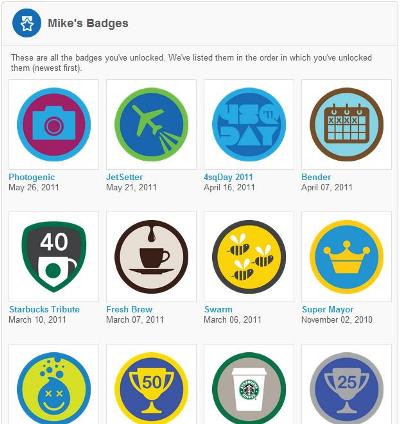
A selection of Foursquare badges
Businesses can offer specials to Foursquare users when they check-in. Chilli’s, for example, offers free chips and salsa to anyone checking in on Foursquare – customers just show their smart phone to their server. Businesses may also reward the mayor of their business, making the title more coveted and therefore create competition around their brand.
The grand theory of Foursquare is that it creates loyalty. If users have a choice between two businesses, one of whom there trying to become mayor of, they will choose that business or one is running a special for Foursquare users. Users of Foursquare can also leave tips, good and bad, about locations helping other users to choose where they might want to eat – for example. Because it is location based, it only offers places that are nearby, and allows the user to filter the results by type. This solves the information overload that can occur if smart phone users just trying to use Google.
Foursquare definitely has the potential to create a community of loyal users, and it has personal benefits (I use it to help keep track of my expenses!) However, the user base is small compared to other social media sites – particularly outside of major metropolitan areas. There are a number of other competitors in the location based world, the largest of whom is Facebook Places. The advantage of Facebook places is that it is part of Facebook, but it lacks a lot of the game elements that makes Foursquare fun and does not have the same controls on sharing.
Foursquare and other location based services have come under fire for the potential safety implications of letting your social media “friends” know where you are. This has been way overblown and as long as users are sensible, not creating a venue called “home” and checking into it for example, location based services will be around for a long time to come.
LinkedIn, is often called the professional Facebook and with good reason. Like Facebook, LinkedIn revolves around a profile. The difference is that your LinkedIn profile is essentially your resume. You can find mine here. Users of LinkedIn can then make connections with current, and former, colleagues to create a network. It is then possible to reach out to colleagues of colleagues more easily because you know which of your network knows them. LinkedIn has an introduction feature specifically for this. It is also possible to recommend, and get recommend, which also then appears on your profile.
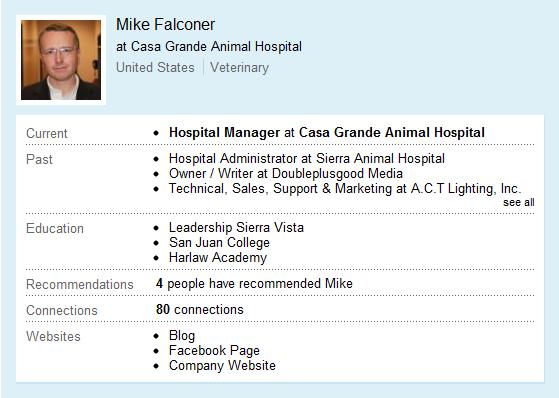
Part of my LinkedIn Profile
Groups on LinkedIn are pretty much just like other web forums, but by being directly in LinkedIn it is possible to be a member of large numbers of different groups, on different subjects, without having to login to multiple sites. The additional functionality of being able to make connections that can help you professionally in the real world is obvious.
A questions section does pretty much what you’d expect – allows for users to post questions and then other users to answer them. The advantage that LinkedIn has over other sites with a similar model, such as Quora, is that you are able to research the person giving the answer to see whether they know what they are talking about. You also then have a mechanism for connecting with them.
A recent, and extremely innovative feature from LinkedIn has been news. This allows users to browse and share news items with their connections based on popularity within professional categories. It also allows users to share these news stories via Twitter – expanding the reach of your network yet again.
LinkedIn does allow companies to have their own profiles, a bit like pages on Facebook, and this is interesting from a recruitment perspective. Groups are also being used successfully for recruitment and many feature a jobs section. LinkedIn also recently launched an “apply via LinkedIn” button that can be used for online job postings outside of the main LinkedIn site.
LinkedIn is a business to business tool (B2B), rather than the B2C tool that Facebook, Foursquare, and Twitter can be; however, don’t be surprised if LinkedIn does not become more and more a factor in recruitment of even minor posts in organizations. LinkedIn does have many issues (their mobile app is hopeless for anything other than news for example), but is a great professional tool for anyone interested in their career, or profession.
YouTube is the video sharing site on the web and although being social it not at its core, it is still social media. Users uploaded material which they, and other users, can then share and comment on. Users can even create their own channels of material making it easier for other users to find similar videos. YouTube also has a number of great tools allowing you to embed a video directly into a website or blog. Video dramatically increases your website’s visibility to search engines, like Google and clients love it – a win all round!
Where YouTube really comes into its own, however, is that it is very easy for a video to go viral – spread around the internet like a virus. Of course, the video has to have some kind of merit; be funny, very dramatic, or even just be very bad, but if your brand is attached to this video it can be great publicity or almost zero cost. For example, it is not unusual for clips of TV shows on YouTube to have dramatically higher ratings that on the channels they were produced for!
Above is a great example of a viral pet video – 10 1/2 million views as of this writing and massive mainstream media attention for Denver’s owners. All from a video shot upon getting home and finding someone got into the cat treats!
A great test of YouTube’s power is to pick any subject you like and search for a video on it at YouTube. Your are almost guaranteed that someone has shot and posted a video on that very subject. Thank you Corey for showing me this!
Video production is really outside the realm of this already overly long post, but it is simple, very low cost and an extremely effective way to market your business.
Some of these social media tools may appeal to you, and other may not. There is definitely a take it or leave it feel to the services that we have talked about today but it is important to understand that to not be involved in social media, particularly Facebook, Twitter and to an extent Foursquare does not mean that your brand and business are not affected by these mediums. Your clients are using these tools and so might your competitors you should at least have an awareness of what is being said and why. The genie is out of the bottle and without getting involved, it is possible for you to loose influence over your brand – the control probably went some time ago as it is now the customer who ultimately defines what your brand means.
Next week, a change of pace: Up to your neck in traditional media!
As I’ve discussed previously here, being online is an incredibly important part of any business marketing strategy and social media is key part of that. It should not be mistaken, however, as a marketing strategy itself. It is a powerful and extremely useful tool, but like any tool, if welded by the wrong hands it can be dangerous! Social media is about engagement – having a conversation not about shouting or making speeches.
Social media is really pretty easy when it boils down to it. The problems arise when people do not understand the tool or try to apply 20th century marketing to what is very much a 21st century tool. Also please stay away from people calling themselves social medial gurus. There are very few people who actually qualify for the title, and the social media landscape keeps changing, that only the most general principles apply. For this reason I strongly advise everyone who asks about how to get started with social media to not use their business’s online reputation as an experimental playground. Get a feel for all the spaces we are going to talk about before launching on your grand social media adventure!
For business to client businesses (b2c) such as veterinary practices or retail / service establishments Facebook is the social media site that you have to be part of if you are going to explore social media. A word about terminology: people on Facebook have profiles, businesses and famous people have pages. You cannot create a page without a profile. Profiles are friends of other profiles and are fans of pages. Confused yet?
The difference between profiles and pages is important because profiles exchange information between each other. With pages the flow of information is one way- from page to profile. There are businesses out there that have profiles. This is problem because it violates Facebook’s terms of service and because your clients might not want to open up their family photos to a buiness they frequent a couple of times a year!
If you have never been on Facebook, then sign yourself up and spend a significant amount of time getting used to the site. I’m not talking about a hour of two here, I’m talking about 10-30 minutes everyday for a couple of weeks. This is how people who use Facebook, use Facebook. Search for old and current friends, become fans of other businesses – even the odd movie star or TV program and see how others are using the site. But stay away from employees or bosses – too much to go wrong on all sides.
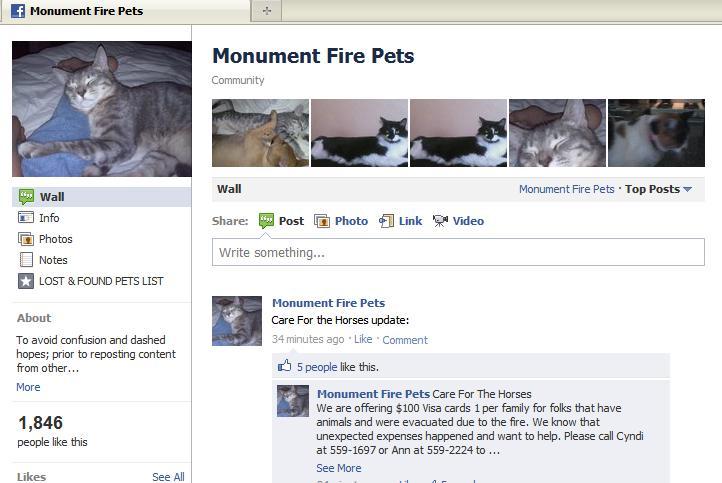
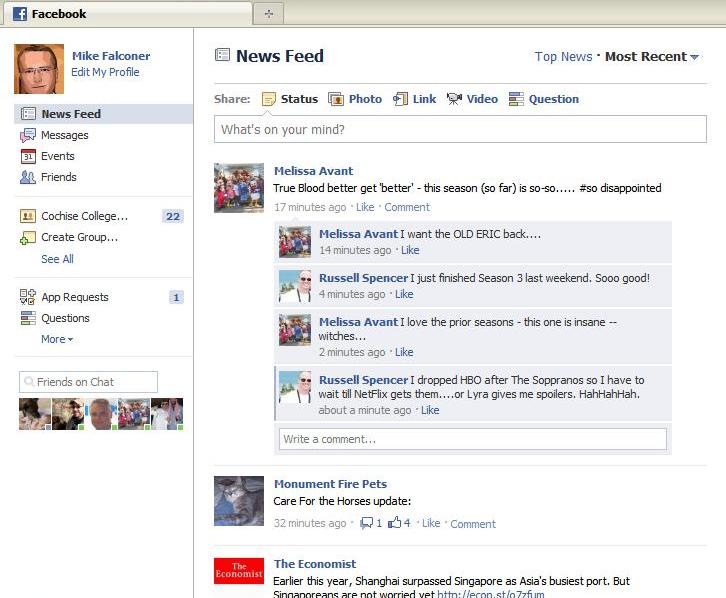
The biggest thing to understand about Facebook is that it is not a website in the traditional sense. Clients will rarely look at your business’s page or friends at your own profile for that matter. Facebook users look at their wall. The “wall” is like a notice board that constantly updates with information that is relevant to you – the pages you have “liked” and the profiles of your friends. As these profiles and pages are updated, those updates automatically appear on your wall. I take time explaining this because, as you will see, there plently of businesses who forget this and post 20 updates one after the other and then pat themselves on the back for all the information that is now on their Facebook page.
When you post to your page - you are looking at your page. But this is almost certainly not what your fans are going to see.
The problem is that this may as well be spam: who wants to read 20 posts all on the same buiness and on similar subjects all at the same time!? Also, Facebook users tend to respond to what is at the top of their wall, something that is a day or even a couple of hours old may get skipped over. Spreading those twenty posts over ten days will work far better for only slightly more effort.
Your fans are going to be looking at something like this. Note the small post at the bottom of the page - it is easy to get overlooked but becoming a spammer is worse!
We will talk more about content in future posts, but it is important to have something to say when starting a Facebook page. Remember, this is the voice of your business talking to your clients. Be friendly, but be professional. See what other businesses a doing and then do your own thing. Facebook is constantly evolving both as a website but also in how people use it.
Twitter is a micro-blogging service. With only 140 characters with which to broadcast a message to your followers! Twitter is an excellent business to business (B2B) tool and can be used quite successfully as a B2C communication tool. Twitter, however, is not nearly as popular as Facebook and is demographically quite different. Twitter users tend to be younger and Twitter seems to be much more popular in major metropolitan areas than in smaller towns.
Unlike Facebook, Twitter does not have the same restriction on accounts having to be linked to a real person. Like Facebook, I strongly recommend getting a feel for Twitter by signing yourself up and seeing how other people and businesses are using it. Something to really keep in mind with Twitter is that everything, unless it is a direct message which you have to specifically select, is public.
Everything is public with Twitter - engagement is the name of the game.
There are few new conventions you’ll need to learn for Twitter: @ before someone’s name is how you specify that a message is for someone – it is still public, but allows you to flag the message for someone’s attention. A # before a term is a way of identifying that term as the subject of your message. It can also be used to provide context and helps with searching for messages on a subject. The message “I’ve been waiting for 2 hours” #thisvetsucks” would be a good example of context and providing a message that is easy to find by others – even if you might not want it to be! Retweeting the term used to describe the way twitter allows you to rebroadcast someone else’s message to your followers (similar to sharing on Facebook). Sometimes retweets are prefaced with RT for clarity.
Twitter is a lot of fun and although can take a bit more getting used to that Facebook, and it’s B2C benefits are less easy to see that Facebook, it is ultimately the tool which many find themselves turning for everything from advice to the latest news (Twitter regularly beats the major networks on breaking stories).
Google+
Very much the new kid on the block, Google+ is an interesting mix of Facebook and Twitter. The problem is that it is so new that no one has any idea how it is going to be used and It does not even cater to business at the moment. People who have Google+ accounts (it is still in closed tryouts at the moment) do seem to like it, but like everyone else, are not quite sure how it fits into the mix. I for one don’t even know if I want another social media network and find Google+ pretty limited due to how few of my friends and colleagues are on it.
I’ll cover a few other social media sites, briefly, next week but the bottom line is that social media is a significant part of today’s marketing landscape. If you a marketing, you need to be using Facebook and you need to be thinking about Twitter. Social Media really is a lot of fun. Discover the fun part first and then then work will not seem like quite such a chore.
Still confused? Social media not for you? Post a comment and I’ll see if I can help.
You might have heard, but getting your business online is kind of a big deal. It is not everything when it comes to marketing, but it is a significant component of any, and all, marketing strategies in the 21st century.
An online presence, more than any other area, is the one piece of marketing you must have. You must have a website, period. No ifs, no ands, no buts.
An online presence, more than ever, has always been about content. Even in the days when there was no term “content marketing” you could have someone build a website for you, but someone who knows your business inside out (that means you) still would have had to write the content. These days content, and particularly, new content, is king. The return on investment of a website is directly related to the effort, not necessarily money, that is poured into it. Your clients will be much more impressed by the effort, and the creation of a useful tool, than by flashy graphics. There was a time when a website could be a “set it and forget it” proposition (however the good websites were never this) and today that is almost impossible to do unless you want to be thought of as irrelevant. Your website will need to included the tools, and you will have to devote the time and energy, to keep it updated on a regular basis.
A lot the content of your website will be informed by your marketing strategy, branding, and your ability to market to your strengths. But it is also worth talking with your staff, and clients, about what they want to see and what they would find useful to have access to. Make a plan of action consisting of what you must have, what you would like to have, and things you might want to experiment with at some point. This will allow you to have a real idea of what you will be buying from your website designer. It will also give you some stages to work with so you can get started, see how it all works, and then make any tweaks before moving on.
Notice I said “what you will be buying from your website designer,” not: “what you will be buying from your website designer- if you use one.” If you are thinking of breaking out the books and learning to code your own website to save a few bucks, please stop. If you are bored with your current job, and web designer is your new passion, then please go for it. If not, please spare the internet, your customers, and yourself, the pain – do not go there. I’ve made quite a number of websites in the past, and today I just do not do it enough to be remotely good enough to satisfy myself – let alone anyone else. There are just too many browsers, platforms, search engine optimization tools, social media plug-ins, user interface issues, and a host of other magic things, to make it worth your while. Hire a professional and get something that you might actually want to use.
Spend your time actually writing the website content and thinking about how that tool, that you can direct customers too, is going to be best used. If you really know what you want, and have the content ready to go, your designer will quite probably cut you a deal on the price of the site. The content of a new website is always the killer, from a designers point of view, when creating a website – particularly when it is not your business.
How much is your new website going to cost? Well that is a good question, and one to which I do not have a good answer. The bottom line is that you can spend as much money as you have building the world’s greatest website or you could spend very little indeed. I’ve always used as a rule when it would just be cheaper to employ someone, with then all the added benefits of having them around, it probably means it is too expensive (or i should just hire someone). That is, of course, unless you want something really special, in which case you’re paying a premium because of what that designer can offer you. Another good barometer is to look at what you are paying, or have been paying, for a yellow pages ad. Take all that money you have been paying to the yellow pages and make it your website budget. The only issue you’ll have is that your yellow pages rep(s) will be mad, and you’ll have a website – which will serve you a lot better in both the short and long term (we will address the yellow pages in a future post; but I don’t thing I’m spoiling any surprises by saying it will not end well for the yellow pages.)
If you must do it yourself, please use one of the blog creators, such as WordPress or Hubspot . They will give you a good looking website (this is a wordpress site) will hold your hand through the process, and do allow for a certain amount of customization if your really want to go there. If you can’t do what you want to do with these tools, then you need a designer.
Finally, I’ve started seeing a habit of businesses having only a Facebook page and not having a website. This is a disgusting, lazy habit and your clients will see it as such. Search engines will have a hard time finding you, and many people do not think of searching Facebook when looking for a business – maybe your existing clients might but they are already your clients. Facebook is also quite limited as a platform, unless you a going to go to the same level of trouble that you would encounter building a website.
Have fun and if you have questions please leave a comment!
As big as the pile of paperwork on your desk might be, getting out of the building is an important part of any marketing strategy. Marketing is, after all, a discussion with your clients and potential clients about your business. It is not always possible to do that from behind your desk.
What do I mean by getting out of the building? Where will you go? Well that very much depends on your community, your business, and your marketing strategy in general. The idea is to engage with your clients on their own turf – so were is that? If you are a veterinary practice, you might find that there are pet oriented events in your community on a regular basis. Can you go along to them? Can you have a little information booth? Can you sponsor the event?
Once you start looking for events you’ll see them all over your community, and as long as you can come up with a connection to the event, the organizers will always be happy to have another booth. In retail and service industries, the businesses are often recognized just by their brick and mortar exteriors. Getting out into the wider community allows you to meet with your clients, and potential clients, on ‘neutral’ ground and for them to see the people who are in that building. It also proves your commitment to being more than just a business, but to actually being part of the wider community.
In addition to events, become a good corporate citizen. Join the local Chamber of Commerce, or other similar organizations, and actually go to some of the networking events and meetings. Yes, it can sometimes seem like an ‘old boys club’ at organizations like the Chamber of Commerce, but go anyway. You’ll be surprised at the wide cross-section of your community who attend, you’ll find out a lot about what is going on in your town, and how that might affect your business. You’ll also make connections with local officials, the media, and other business that may become useful. If you are in a larger metropolitan area, there may even be industry specific groups, or groups that relate to your daily tasks (like marketing) you can join.
It is easy to say “I’m too busy to go to that!” Make going to events just another part of your job – like doing payroll. You can’t say “I’m too busy to do payroll” – or at least I hope you don’t say that.
Before embarking out in the big wide world do have, for want of a better expression, and elevator speech ready. An elevator speech is basically a distilled version of your marketing strategy, and branding efforts, that only takes up a couple of minutes to recite. Why should someone come to your business in other words. The the good ones don’t sound like that is what you are saying, but at the same time they hit all the salient points. If you are going out and doing events you probably need a little more than that – a reason, beyond just self-promotion, to be out in the wider community. Of course, if someone asks about your business, that is when your elevator speech comes into play. In the veterinary field, zooanosis awareness (the transmission of disease from pets to humans) or the importance of vaccination are great examples of public information subjects. Fire departments, often do outside events with excellent themes such as the importance of emergency plans or checking the batteries in smoke detectors.
A booth for a vetererinary practice that includes a dog to pet, information about zooanosis and the promotion of a pet ambulance.
Whatever you choose, don’t try to do too much. Have a theme and stick with it. It is also important that this theme resonate with your strategy in your business as a whole. There is not point, for example, in having staff promoting the importance of zooanosis awareness out in the field if you also do not promote that in the veterinary clinic itself.
Social marketing and networking, which is effectively what this entire blog post has been about, is an excellent way connect with the community and promote your business without promoting your business. It can pay huge dividends in the long term, is inexpensive as long as you are sensible, but it is a long term strategy – don’t expect immediate returns. That way you’ll be pleasantly surprised when you get them!
This great little (free) e-book is a collection of quotes from some if the great marketers of recent times. Coupled with some beautiful images, this PDF makes excellent use of the tablet format, but is also suitable for viewing at your PC or even printing our your favorite quotes.
Short, elegant and easy, this e-book is not so much about delivering information as it is about inspiring you to go do something or to help you inspire others.
Marketing your business is all very well, but what are you marketing?
As we looked at here, developing your marketing strategy should have given you some ideas as to what your clients are wanting to buy. By marketing to what your clients are wanting to buy, as we looked into here , you are already defining certain things about your business. But what about your competitors? How are they marketing, branding,and running their business? You need some business intelligence – don’t just assume you know what is going on actually take the time to find out for sure!
Step one: Online Research. The great thing about the Internet is that you can now research a business to your heart’s content, for the most part, online. Look your competitors branding, how do they sell themselves? Are their hours better than yours? Do they promote how low their prices are? Do they have much of an online presence at all? Is their style very informal, or very corporate?
Step two: Physical Research. There is nothing wrong with sticking your head in, say hello to one of your local competitors, as long as there is not huge animosity between the businesses. You can learn a lot by just waiting in the lobby. There is nothing sneaky about this, this is the store front – essentially a public space. If you are in the veterinary business you can tell a lot if the building smells nice- you can bet the clients can too! Do the staff greet you as soon as you walk in the door? Is the waiting area comfortable? Is the waiting area well laid out? Does the office seem like a model of efficiency, or is everyone running around like chickens with their heads cut off? Take the time to phone your competitors – not from your business, use someone else’s cell phone. How is the phone answered? How do their prices actually compare? They might say they are low cost but in reality…
Step three: Opinion of clients. Hopefully, when planing your strategy, you already figured a lot of this out already, but there is nothing wrong with talking discreetly some if your clients about why they like your business over your competitors. You might be surprised by the responses! What can this tell you about your business and your competitors?
Step four: Look at yourself and your plans. How does your business compare? How can you differentiate yourself? Maybe you need to be the low cost option in town? Maybe you need to be the premium option in town? How do your clients currently think of you? Are there simple things you can change about your business, now that you know all about your competitors, that will make a difference in the minds of your clients? These don’t have to be huge changes, but the more you can neutralize and respond to what your competitors are doing, the more you will begin to control the marketplace and define what it means to be in that market.
A couple of short examples:
Do you close for lunch? Do your competitors? Would your clients like to be able to come in during lunch? A staggered schedule could mean that you become the known as the business that is open and available at lunch time – that could be huge in the veterinary world, where if a pet is sick, and your client has to work, their lunch hour may be all the time they have! It is not a lot, but it is those little things that can start to differentiate your business.
Do you encourage communication? Do you make it easy for clients to come and talk to you? Do all the principles in your business have email addresses? Will they use them? Sounds strange, but the mere concept that businesses want to communicate with their clients – on the clients terms – can be seen as quite a radical concept.
If you have ideas along these lines feel free to add them in the comments section.
Branding can seem like a dirty word – particularly to industries which seem to believe they should be above such things. But branding is simply a way of identifying your business to your clients, and more importantly, for clients to identify your business in their own minds.
Branding itself is neutral. Crass and badly implemented examples can certainly lead to customer confusion or downright rejection. However, the world if full of examples of businesses that embrace branding, find it a useful tool in their marketing strategy, and clients responding in an overwhelmingly positive manor. How else do we explain clients paying money to advertise brands on the clothes they wear rather than the other way round? The brand becomes such a powerful image that clients, and would-be clients, will pay to be associated with it because of what the client perceives that will say to other people about themselves.
As a business, excellence in branding is a key element in any marketing strategy; however, the marketing strategy itself is a critical part of that brand. The brand is method of communicating the goals and ideas contained in the marketing strategy to clients. The brand can’t do it all, but it is an important step and should re-enforce in the mind of the client these goals and ideals until they become synonymous (see last week’s post on creating a marketing strategy here for more information.)
Branding your business is about consistency and simplicity. Walk down the high street and look at the major brands you see there. It is highly unusual to see complex logos or extreme color palettes. By and large most chains use a logo that consists of their name, which ideally is short, and easily identifiable. Chilli’s, Subway, and Wal Mart are all good examples. Even target, which does use a separate logo, uses such a simple logo that is does not detract from their name.
Moving on from the name / logo of a business, other elements of the brand become even more apparent. In Target’s case it is the color red, which is reflected in color if the stores themselves both inside and out, the uniforms that associates wear, the carts, baskets, the carrier bags, the list goes on. Every item where a decision about color has to be made, or can be made, it is made with reference to the brand. But there are other more subtle color choices going on at target as well. There are two other colors that are being used – white and kaki. White is used as a secondary color wherever red is used. When it is not practical to use white, such as the color of trousers that associates wear, it is kaki a neutral white equivalent. Even the Target dog is white.
I find it useful when creating a brand to create a brand bible, or style guide if you prefer, which defines these types of decisions so that everyone can be on the same page when it comes to branding the business. Primary fonts, secondary fonts and general text fonts are all defined, primary and secondary colors are defined and most importantly the business name and / or logo is created in color and black and white and any additional ways if using the logo are defined in detail. Please also remember that when you are defining a brand: work with what you have. If you don’t work with existing elements the process needlessly expensive – unless a complete identity change is what is required in which case make sure that your budget is up to the task. For example, I once defined a brand’s color scheme, in part, because the business’s building happened to be painted those colors.
The web’s restricted color palette and choice of fonts, although becoming less of an issue as the web becomes more and more sophisticated, should still inform your branding decisions. To ignore them would be needlessly short-sighted and potentially very expensive.
Having photographs to hand which help define your business that are online with your brand are incredibly important. When you need a picture of your building, it does not necessarily have to always be the same picture, but it should have a consistent style so that potential clients know they are looking at the same building if they see two different pictures.
Your business’s mission statement may also be able to inform your branding choices. If not then I would argue it is time for a new mission statement! To use Target again the “Expect More, Pay Less,” tag line effectively distills their mission statement into four words, defines what they are about as a company, and even takes a pot shot at their competitors. Not bad for four words.
Finally, be intolerant of off message paperwork, business cards and even staff interactions. In terms of an
Animal hospital is your name ” X animal hospital” or is it “The X animal hospital?” Clients who are familiar with your brand should be able to spot your website, paperwork and even your building even if they forgot your name – because it will feel inconsistent with the identity you have created.
Clients ultimately control your brand’s identity because of how they perceive your business and the interactions they have with you and others about that brand. However, you can set the agenda and shape the discussion by having a consistent and identifiable brand that clients can latch on to and be proud to be associated with.
Next week: Marketing your Strengths and Overcoming Weaknesses



 Mike Falconer