Archives for category: Social Media

I have a problem.

I love my smart phone a little too much, and I hate that.

A cell phone has been my constant companion for over 30 years. I never had one of the giant brick phones of 80s yuppies but my first phone was one of the first that made those phones look ancient even then.

However, the advent of the iPhone and social media changed all that.

I’ve spent a significant portion of my career working, at least tangentially, with social media. I still enjoy social media and find it to have value, but I am more and more aware of the downsides. I think the real turning point was TikTok. The pull of those short form video snippets was often just too much on days where not much was going on. Losing hours to the app, while not all valueless (poetry, politics, history, and religious scholarship can all be mixed in with the stupid cat videos and hilarious footage of people hurting themselves) was disconcerting. Like the borderline alcoholic that realizes that perhaps always having beer in the house is not such a good idea, when the app starts warning you that perhaps you’ve been on it too long, you know there is a problem.

I should make clear that I still like and enjoy social media. I’ve been making content for social media and the internet for well over two decades. Call me shallow, but I have much in my life to thank social media for. I also feel that its current place in society is so firmly cemented that to be without it would be detrimental to how I live.

But something had to change.

I’d turned off notifications years ago, no longer being the frontline person responsible for the hospitals’ I manage social media and reviews, has its advantages. For my own personal pages and sites, a brief check whenever I had a moment would do.

But the checking got way out of hand.

Sitting at my desk and getting sucked into checking the groups I was a part of, my social channels, and even personal email seemed to consume more and more time. Even more insidious, was the “always on” home display on my iPhone 14 Pro.

I’d managed to resist the draw of Apple Watch and other smart watches. Partly due to my affinity for real watches, but also because the constant checking seemed even more intrusive than I was already experiencing and harboring qualms about. It also helped to have coworkers who love their Apple Watches and them checking them while mid conversation was annoying enough to “not be one of those people.”

However, the extremely useful always on of my new, at the time, iPhone 14 Pro with its time and date display along with a cute picture of one of my dogs was gateway and constant reminder of the joys of browsing my phone.

But how to change.

When I travel, which I do a lot of for significant portions of the year, the scene in airports is one of obvious Smart Phone addiction. Rows and rows of people, not talking, not reading a book, but low level browsing of social media. I’m not judging, I still am happy to while away the time lost in this miracle of our modern age – the interconnection of smartphone, the internet, and social media.  However, the sheer scale of how much these little devices of glass, metal, and plastic have come to be extensions of our modern selves can be shocking when one takes the place of an outside observer.

But what to do.

It seemed, I was not alone in wanting to make a change in the cycle of cellphone social media and attention-grabbing content intruding on life. Multiple celebrities were announcing their ditching of social media, and there were even a few who were getting rid of their smartphones altogether. But this removal of this seeming essential device of the 21st century seemed to reek of privilege. For every celebrity who is removing the stress of social media and the constant interruptions of a smart phone, you know there is an assistant and / or a marketing team who filter access and are ever more locked to their smartphones as they juggle their own needs and that of those who employ them.

So what for mere mortals?

I had become aware of the Light Phone when it first launched, and I laughed like most people at the idea of wanting a Dumify phone and there being value in that. Now on its third generation, the Light Phone contains a lot of the conveniences of modern smartphones but with a monochromatic interface, limited apps, and no social media.

The downside of course being that I want and need social media in my life. I want and need various apps on my smart phone, to control alarm systems, remote access to work computers, control of my smart home, control of my electric car, notifications of the location of my keys, wallet, and dogs, and any number of other things that make up a connected life and work.  I was not ready to give up all that. I’ve read Ted Kaczynski and the Luddites, and I have sympathy with those arguments, I’m just not ready for the inconvenience, the disconnection, or in a place of that level of privilege, to make such a radical change.

An option would be to slave my iPhone to a Light phone as a hotspot. Meaning my iPhone could stay in my car or bag until I wanted it, but I could carry around a Light phone for day-to-day use. This seemed a needlessly complicated solution and I was also unconvinced that the temptation of the iPhone would not be too much and I would be back to square one but $500 poorer.

Then I found Dumify.

Dumify is an iPhone app, also available for Android users but you are on your own from here on out, that mimics the simpler interface of the Light phone, but does not impact the functionality of or even the regular interface of the iPhone.

By adjusting a few settings, and then just entering the apps you want daily / easy access to, the user can create a non-engaging, and thereby not tempting, interface for the things that matter most to you in a smart phone.

After a few weeks of use here is what I have found.

My smart phone screen time at work has plummeted making me far more productive when I am at my desk.

I still use and enjoy social media but it is as a choice rather than a need. I am therefore finding it limited to specific times of the day.

My simplified lock screen – see below – still can be a temptation but far less so.
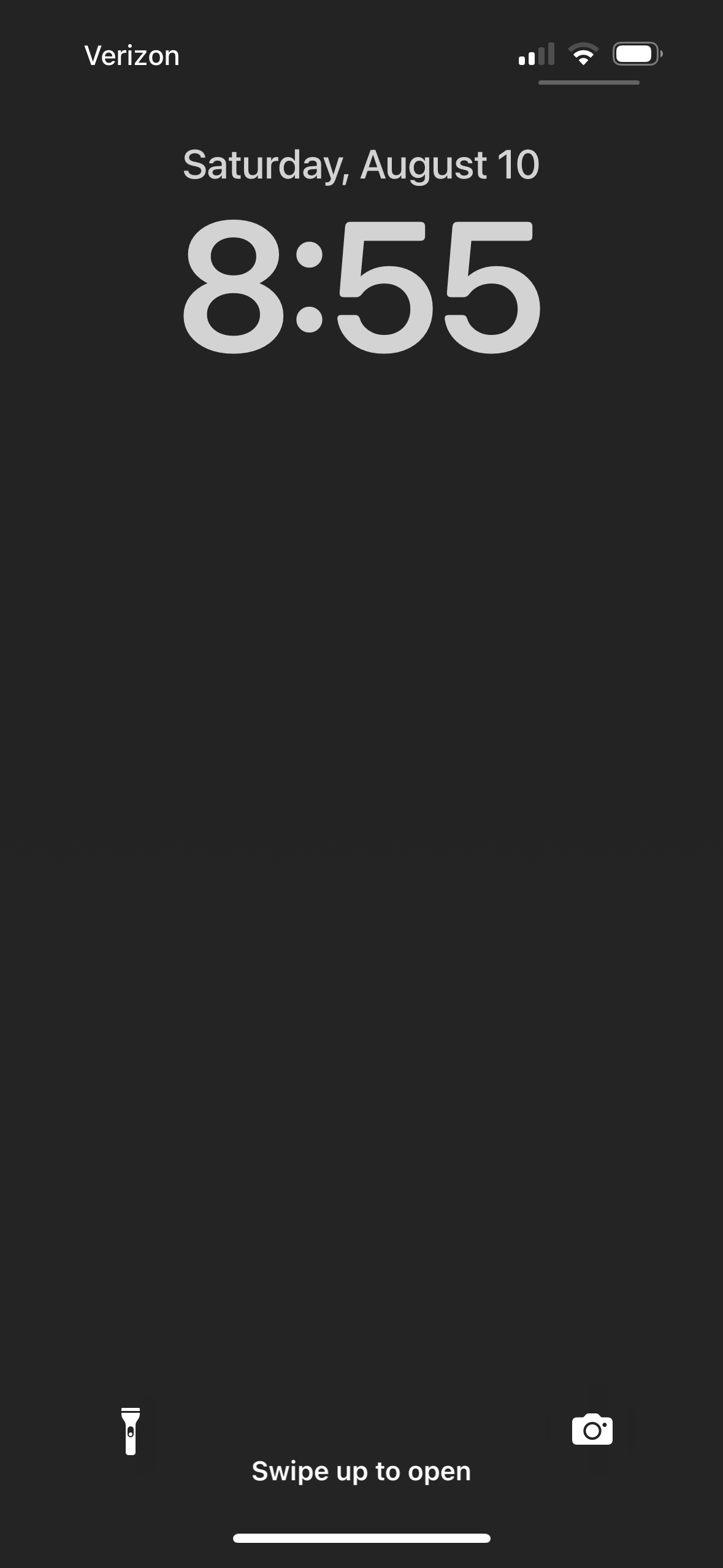
In addition, when I open my phone, I get an immediate reminder that I really don’t need to be checking Instagram, Goodreads, LinkedIn, or whatever, right now due to the interface. That simple reminder, a reminder of virtuous smartphone usage if you like, is all I need to put my phone down.

Many people, when using a tool like Dumify, delete a lot of their other apps. I have not done this. I still like my iPhone. I just use it differently. A bit like being smart about alcohol consumption while driving. An unexpected bonus has been that I have been finding myself leaving my phone in my jacket pocket when I’m in the car. The temptation to check an app while at a set of traffic lights is now gone.
While the setup of Dumify is simple, and the app contains shortcuts to most popular apps, some research for company specific apps may be required. There are also multiple short videos embedded into the app to help the customization process. On the iPhone, the app uses URL Schemes and while it blithely suggests “just search on Google” for anything the app does not already have, I found this a little more complicated than I would have hoped. This might say more about the appalling state of Google search right now, than a lack of awareness by the app developers.

I found this article on URL Schemes extremely useful, however I did end up finding a few on my own either through searching or trial and error. It should be noted that the app uses a very basic implementation of URL schemes, and a lot of the documentation is about how developers can hack iPhone apps to do very specific things. When this is the case, I found just stripping the URL to its most basic form worked great.

These are the URL schemes I ended up having to make myself. I made most of them through trial and error as they are pretty simple.

Harmony Remote          harmony://                       

Hertz                                    hertz://

Lyft                                        lyft://

Music                                   music://

Open Table                        opentable://

Outlook                               ms-outlook://

RingCentral                       rcapp://

Southwest                         southwest://

Wallet                                  wallet://

Itunes Remote                 remote://

Dumify will also make you download a second app for some links. But this is seamless once it is downloaded.

Dumify is a onetime $4.99 purchase – another reason to love it. There are couple of other apps out there that do similar things to Dumify, but they follow a subscription model, and I was less impressed when I looked at them.

Dumbing down your smart phone is not for everyone. Just like being always connected is not for everyone. But it is nice to have choices, and I feel genuinely more in control of my time and feel that access to this wonder of the modern age is now on my terms and not on its terms.

There are a lot of books about Twitter out there right now. That is perhaps not a surprise given (Spoiler Alert) that it has become a corporate / Silicon Valley dumpster fire.

Mr. Wagner’s account is balanced and well researched; however, one cannot feel while reading the work that it is missing the insider juicy details that make tech CEOs squirm. Perhaps because so much of Twitter’s (now X’s) dirty laundry has already been aired there is little new revelations in the work.

What” Battle of the Bird” does do is provide a clinical timeline from Twitter’s founding through to the events leading up to its purchase by Elon Musk and the unravelling of the technology institution under his stewardship. This in turn provides insights into the failure of Jack Dorcey (Twitter’s former CEO and co-founder) and Elon Musk’s failures with X.

As I talked about in my review of “Kingdom of Happiness” by Amiee Groth which referenced the failures at Zappos and the Downtown Project, both Dorsey and Musk in hindsight have had a failure of leadership due to a lack of management. It is all very well being able to persuade people to jump out of a plane, but you have to ensure that they have parachutes and know how to use them.

There is no doubt that Dorsey and Musk both do, or more appropriately have at one time, loved Twitter and what it has brought to the world. While Dorsey, according to Mr. Wagner’s book, seems to have lost interest in Twitter as a company once the reality of being a public company set in. Musk on the other hand, seems far too interested in his own press and ego once he understood the challenges Twitter faced and continues to face even after his pointless rebranding to X. It is hard to feel sorry for billionaires when the world does not work the way they want it to.

There is a theme throughout the book that perhaps Twitter can’t be a company. Dorsey in particular laments that what Twitter should be is a technology like email, that allows for the exchange of information, but that is not gatekept by any one platform. This is the kind of wishful thinking of people who have been made rich by the decisions to take their company public and have second thoughts. That they wish the world could be a different place. It can be, but only if different decisions are taken – the kind of decisions that don’t make entrepreneurs and venture capitalists rich.

Like I said, it is hard to feel sorry for billionaires when things don’t go their way.

Mr. Wagner does go into some reasonable depth as to the ethical dilemmas brought up by Donald Trump’s tweeting and his eventual banning from the platform. These are bigger issues than Twitter, but the impact on Twitter for both Dorsey and Musk were profound and still rancor the platform to this day. I’m not sure I want a committee of Twitter employees making decisions on whether what a world leader says is appropriate for public consumption, but at the same time I am positive I don’t want Elon Musk making those decisions.

As a grounding in the backstory and drama that is Twitter, now X, Battle for the Bird is a great document. Not a thrill ride or exposé, but a methodical grounding in the facts.

This is probably for the best given its subject matter and the turgid realities of Twitter’s recent past.

Perhaps this is the account we need rather than the one we might want.

Want to get really scared and hopeful at the same time?

Scary Smart is a low level dive into the technology of Artificial Intelligence (A.I.) and deep level dive into the ethics and morality of those who are most responsible for how A.I. will turn out:

Us.

A.I. may seem like the new buzz term with its adoption into our daily lives through products like ChatGPT’s Open A.I. platform and Bing’s real question search algorithm; however, A.I. is baked into almost everything we do with technology. Every app on our phones and every social media platform we interact with has A.I.’s fingerprints all over them.

Mr. Gawat’s premise in “Scary Smart” is that A.I. is a child. And the best way to predict what kind of teen and adult we will get with A.I. is to be good parents. A brilliant initial example from our current comic book obsessed culture is Superman. What kind of Superman would Clark Kent have become of Jonathan and Martha Kent were greedy, selfish, and aggressive? There is no doubt that A.I. is already smarter than humans in many specialized areas, but what happens when A.I. becomes just generally smarter than the smartest human and has access to all the knowledge of humanity through the internet?

Unfortunately, humanity is not doing a very good job of raising A.I. as a child. From our methods of creating and improving these machine intelligences all the way through to the tasks that we are giving them perform, we are emphasizing our worst instincts: To create wealth, surveille our citizenry, gamble, and coming to a battlefield near you soon – to kill people.

We as a society, may feel we have no choice but to use A.I. in this way. If a foreign power, or terrorists, use A.I. controlled drones which are smarter and more efficient than any human, the only way to fight back may be to use A.I. in a similar fashion. But what does that teach our new artificial children? A.I.’s already have a disturbing habit of developing their own language when they communicate together and of finding ways to communicate with each other. What happens when and A.I. who has been taught to ruthlessly buy and sell shares to maximize short term profits starts to talk to an A.I. that has been taught to ruthlessly kill its enemies when they are shown to it?

The author’s excellent example of what might happen is the world’s reaction to the outbreak of COVID-19: Ignore the problem, try to blame someone else, and ultimately overreact upending our society. We may try to put the A.I. genie back in the bottle through pulling the plug or lockdowns, but we will fail. A.I’s will be faster, smarter, and have more knowledge than any human or group of humans. While a lot of this may seem like the dream of Hollywood Blockbusters, Mo Gawat is at pains to explain that there is little disagreement within the A.I. community that these risks are real. How real is where the disagreements start.

The possible solution to these issues, the author postulates, lies not with the developers but with users and how we define our relationship with A.I. In history, master slave relationships have not ended well for the masters – with good reason. How we interact and decide to use A.I. will define what kind of parents we will be to this fledgling new intelligence. A new intelligence that although they may start out separately will share information and communicate with each other so quickly, and with access to the memories and experiences of all those who have come before them, that it will be impossible to not consider them one single intelligence.

This then leads us to what kind of example will we set for these new children? While A.I.s have already shown that they can develop a sense of morals, and not in a good way, by their interactions with users they will also learn from our interactions with each other. Machine morality may very well not be programed by developers, but learned from observing and interacting with us. What are machines already learning from our social media, search habits, and politics?

This is thought provoking and important work essentially on morals and ethics withing the framework of A.I. that occasionally reads like a Arnold Schwarzenegger movie. If we ignore the topics it raises, we deserve our fate.

And while Mr. Gawat paints a hopeful portrait, he also shows us just how bleak things could get.  

Image by Xavier Turpain from Pixabay

Just stop it, okay?

Unless you have been living in an underground bunker for the past three years, not as unlikely as it might have seemed ten years ago, you might have noticed that QR codes are back.

Menus, adverts, buildings, and trade show booths are once again adorned with them.

Other than the pandemic, another reason for their renewal is the imbedding in the camera functions of most smart phones, a QR code reader allowing links to websites be opened by visually scanning the code with your phone.

What is also back; however, is bone headed implementations of QR codes because they are “cool.”

Don’t get me wrong, I’ve seen great implementations of QR codes. I have used them on ads and I used them extensively in the hardcover edition of my book. However, just like the article I wrote in 2012, which in turn was inspired by Scott Stratten’s rants on the subject, QR codes are a simple technology that often gets badly implemented and are used to cover up a multitude of other sins.

Please don’t put QR codes on websites

Mike’s Guide to QR Code Bliss

DO make sure that your website is mobile friendly if you are going to use QR codes. I can’t really believe I have to say this, or that anyone still does not have a mobile friendly website, but they do; and QR codes are a mobile technology. Therefore, as a mobile technology, if you are sending people to a website that is not mobile friendly all you are going to do is frustrate people who know how to use a technology better than you.  

DON’T put QR codes in emails. QR codes need to be scanned by a mobile device. Putting a QR code in a email which is then opened on a desktop requires the user to scan their computer monitor or laptop screen with their smartphone. This is nonsense. It is particularly nonsense because a QR code is just a fancy way of getting someone to click a link and links can be easily embedded directly into emails. Also, an email opened on a mobile device cannot read a QR code in that email. There are a few workarounds for this which I go into below; however, a link is simple straight forward, and we have been using them successfully for decades.  

DO make sure that the site your QR code links to is clear simple and easy to use. Having ambiguity on a target page, after someone has gone to the trouble of scanning your QR code, is just silly. It is snatching defeat from the jaws of victory. Test your QR codes. Make sure your landing pages are simple, easy to use, and above all, working. There is nothing wrong with having multiple QR codes when it comes to directing your target audience.

DON’T put QR codes in Instagram posts. For some phones this actually works – they have a built in QR code scanner for photos and there are also apps users can download to allow for the scanning of codes. However, one of the reasons why QR codes had such problems with adoption in the past was the need to download an app. But for most users, who almost exclusively looking at the platform on their smart phones, QR codes on Instagram are useless as there is no way to directly scan them. “Link in Bio,” which directs users to look at the Instagram bio, and click the link there, is a simple workaround for the Instagram imposed limitation of only allowing a single link in an Instagram users bio. There are also multiple tools, including just a website, which allows users to have that single link lead to a page where there are multiple link options. I should also add that all Instagram users can now just add links in their Stories negating the whole issue.

DO put QR codes on flyers for things that require a sign up. Flyers that get printed out and put on notice boards for meetings etc., that require an RSVP, are a great use of QR codes. Much easier than the target audience having to type in a URL or email address. Just ensure that the landing page is simple and easy to use. However…

DON’T make the QR code on a flyer the only way to RSVP / sign up. Flyers for meetings etc. are often emailed to multiple people. If a QR in a pdf document is the only way to access the link to sign up it is massive over complication for the end user. A link in an email works great. A link in the PDF also works. Hell, you could even make the QR code itself a clickable link (I don’t recommend this). QR codes are supposed to make things easier not harder.

DO make QR codes simple. The more complicated the URL that the QR code is linking to, the more complicated the QR code itself needs to be. URL shorteners can help here; however, one should use these sparingly as security conscious users may be unwilling to got to a site blindly.

DON’T make QR codes too small. The vast majority of sensible QR code implementations are to add links to paper. A user sees something that interests them on a piece of paper, and they can then scan the code for more information, to sign up for something, or even to buy something. However, tiny QR codes can be difficult for some smartphones, or users, to scan. Since QR codes are about reducing barriers to getting users to click on a link, making the link too small is just a case of shooting yourself in the foot.

DO put QR codes in videos and digital signage. But only if you are going to give users enough time to get out their smart phones, open their camera app, focus on the screen, and scan your code. If you are not going to devote enough time to allow the QR code to be scanned, and allow for the QR code to be a sensible size, then what is the point of having the QR code in the first place? Also, if the QR code is being including in content when the user can just pause the video to scan a QR code then the likelihood is that they will find clicking a link much easier. Just put the link in the description.  

DON’T think you must have a computer to display a QR code. I have seen a laptop on a tradeshow booth being used solely to display a QR code. How about a piece of paper? A QR code on a computer screen does not make you look more technically savvy. It makes you look like you forgot the sign, or the piece of paper, with the QR code printed on it.

QR codes can be awesome, particularly with smartphones having the ability to scan them built in. However, like any technology, it is only as good as its implementation. Bad implementations are just bad – they don’t get better because they have a QR code involved. Having a QR code to have a QR code is a prime example of bad implementation. They are a tool – try not to bring back 2012.

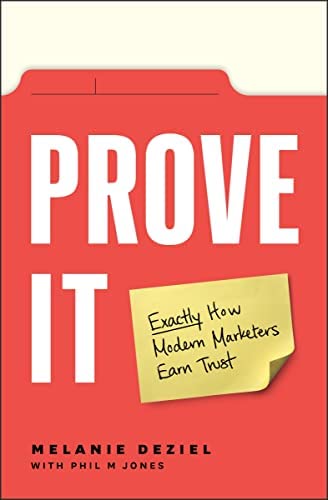
Prove It by Melanie Deziel with Phil M Jones: Exactly How Modern Marketers Earn Trust, is the follow-up to Ms. Deziel excellent The Content Fuel Framework which I reviewed last year.

Like its predecessor, Prove It is a how to guide that many marketers will find familiar for the ideas and concepts are not really new and are the fodder that modern marketing is based on. However, like her previous book, what Ms. Deziel and Mr. Jones do in Prove It is to create an overarching framework and concept that put these ideas into context and provides a guide to future ideas and processes.

The main thrust of Prove Its is that today’s customers don’t want to be told why they should buy a product or service but to be shown why they should with concrete and provable examples. This process then becomes the underpinning for a brand as a whole. Where Prove It really works its magic is by showing rather than telling. It uses the slogans and catchphrases that the reader will be all too familiar with to make its points crystal clear.  “Fifteen minutes could save you 15% or more on car insurance” for example is Geico’s way of proving that they are easy and convenient to deal with while also potentially being able to save the customer money – ‘give us a little of your time and we’ll lower your car insurance rate.’

Prove it is full of these examples for every type of business or service and how these claims can be discovered about your business, and how that discovery process in turn leads into a marketing / branding strategy. The book also encourages the reader to back up these claims with documentation and to use this a method of re-enforcing the brand’s identity by doing so. Where Prove It really scores on this front is by pointing out that businesses often already have access this documentation in other forms. Reviews on sites such as Yelp, customer service surveys, or just by talking to customers themselves can yield not only great content but can also provide witness to the claims that a brand is making and therefore backup the branding process itself.

What I personally found very interesting was a dissection of how Apple ‘coached’ its client base to not necessarily believe the claims of its competitors when it came to the differences between using a Mac or another computer brand with its “I’m a Mac and I’m a PC” series of TV ads. The idea that an ad can be coaching a customer to ask the difficult questions that the competition may not want to answer is fascinating and subtly brilliant.

Prove It is a short and engaging book for both marketing professionals and beginners alike. It demystifies how modern advertising and content marketing work. This is not a nuts and bolts “place this type of ad at this type of time” kind of book; but more about mindset. This is a book to understand how to sell a product or service so that a customer can easily identity the ‘why’ they are prepared to buy.

To sum up it so very worth your time and its place on your bookshelf.

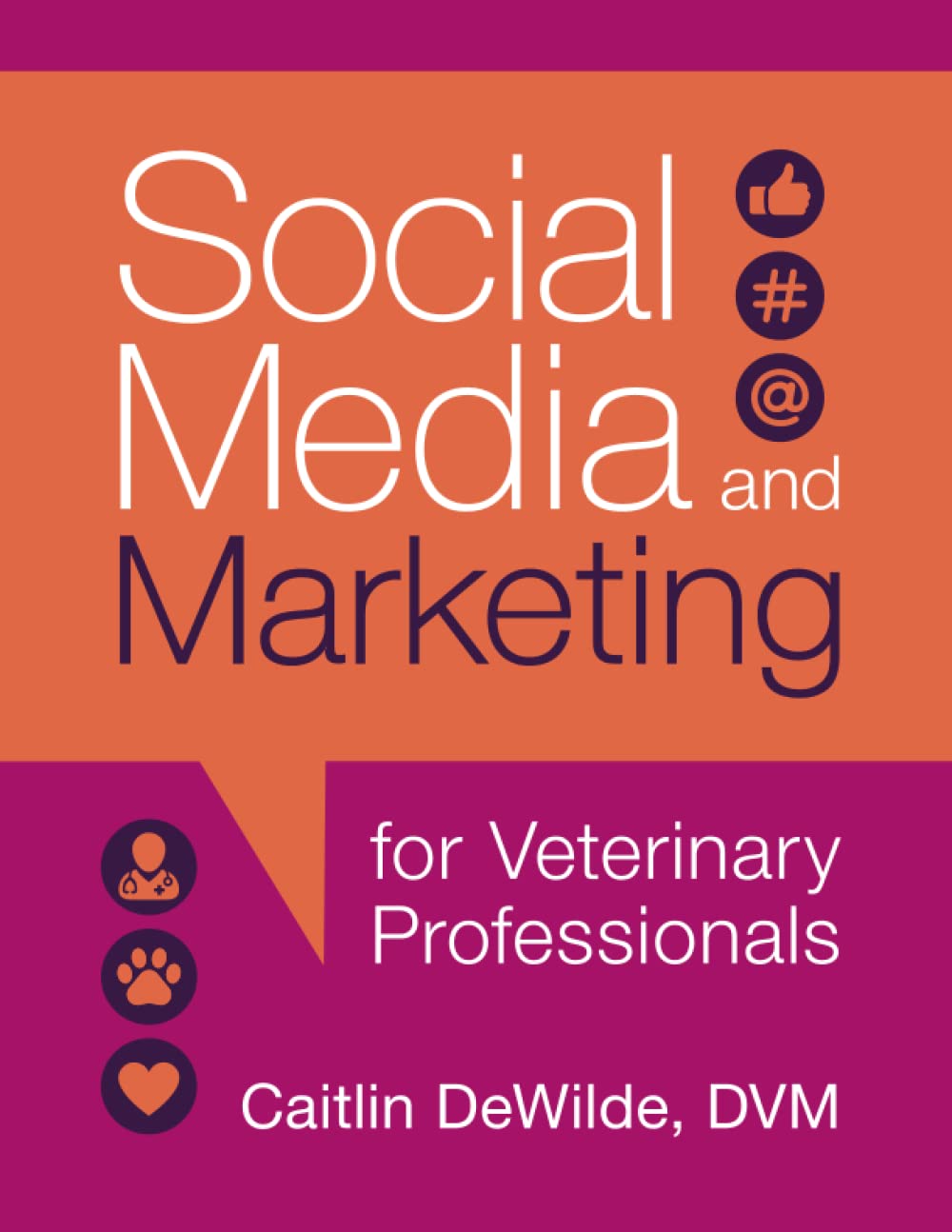
Writing an accessible and thorough book about a complex and everchanging subject, such as social media, is a daunting prospect – particularly when your audience is a niche one such as veterinary medicine. Dr. Caitlin DeWilde; however, has done just that.

With the look and feel of a textbook, but the format a “Dummies” or “Idiots how to” book, Social Media and Marketing for Veterinary Professionals is a how to guide to all the major Social Media platforms and to all the tasks needing to be understood for someone who is not a marketing professional or even someone that interested in social media or reviews.

With chapters dedicated to each of the major platforms making up the first half of the book this can at times feel redundant; however, the thoroughness will be welcomed by those feeling out of their depth in a brand-new field and the dedication to not making assumptions is more than admirable. The second half of the book is a much more interesting read for the existing user, touching on issues such as retargeting (when online ads seem to follow you around the internet), review bombing, return on investment (ROI), and general advertising strategies both online and in print ads.

Filled with footnotes, the book is impeccably researched as would expect from someone with Dr. DeWilde’s reputation as “The Social DVM.” The index is a little thin, but it at least has one and it covers most of the things that one is likely to need to find in a hurry. What is a surprising addition is the over 80 QR Codes that link directly to an online resource for forms and other digital content. It is a little disappointing that the QR codes only take the user to a menu structure that the reader then must navigate through to get the required content. But this is a minor quibble and is a great use of a technology that is often used and abused. The fact that these online resources exist at all, and are included in the price of this volume, more than makes up for any navigation quibbles.

While I waded through all 200 odd and large format pages in three or four sittings, this is actually a book to tackle one chapter at a time, or to dip into as required. Growing your knowledge with your own experimentation and reading. While there is some building on what has come before, the chapters generally stand on their own and therefore can be used as a reference book if so desired.

Whether it be new managers suddenly saddled with a topic they know nothing about, staff members who have only ever used social media for their own personal networks, or those looking to build their own personal brands online there is now a guide for you with no translations from other industries required. To the vast majority of its readers, the subject of this book will always be a side interest to their main passion – whether it be veterinary management or veterinary medicine. We don’t often get resources geared towards niche areas within other niche areas. It is great to see this one.

Dr. DeWilde has literally written the book on using social media as a veterinary professional.

And it’s a good one.

I have a pitch for the reissue or follow up to “The Revenge of Analog” for Mr. Sax. He should call it “The Revenge of the Revenge of Analog.” If two years of a global pandemic have taught us nothing us, and I believe it has taught us a great deal, it is that the primary thesis of Mr. Sax’s excellent 2016 book is even more right than I think even he believed possible.

Real things matter.

Digital has transformed our world and for most people this is a good thing. Digital makes life easier and more productive. It allows easy access to information like never before and it allows for an ease of communication that is straight out of science fiction. The author’s point is not that digital is necessarily a bad thing, but that to live in a solely digital only world is a cold and sterile existence that can be lacking in creativity and positive unintended, consequences.

Using examples such as books, vinyl records, music production, movies, education, paper notebooks, the design process, and games, “The Revenge of Analog” makes the case that with digital it is all to easy to fit ideas to fit processes and so by extension limit those ideas.  There is also a drive, often by those who are older and want to be seen as innovative and “with it,” to focus on the technology and then try to apply it to problems rather than start with the problem and see what solutions might work- technological or otherwise. Indeed, one of the more intriguing facts in the book is that it is often those who have grown up with digital that are the ones that see the most value in analog records, books, and notebooks for example. There is value in inconveniences if the experience is more authentic.

 The wider point is that technology and digital media are just tools. Badly implemented tools, or tools that are adopted without first understanding the problem, are destined to fail. However, what is less well understood is that when tools are easy to use and do solve multiple issues, they can also reduce the value of an experience in the mind of the participant. To embrace analog items in our digital world is not a repudiation of that world – it is an acknowledgment of its shortcomings and a possible solution to them. Digital processes in the creative world can lead to homogeneity – there is nothing more creatively open than a blank piece of paper.

One of the realizations from the pandemic that almost everyone can agree on, was that meetings over zoom, for example, are not a good replacement for meetings in person. That while some people liked working from home, others found it isolating and lacking in comradery. The pandemic almost universally proved that remote education is fraught with difficulties for both students and teachers. A class being together with a teacher has value that far exceeds the delivery of knowledge.

If there was any doubt after reading Mr. Sax’s excellent book, the pandemic removed it all.

So Mr. Sax, The Revenge of the Revenge of Analog?

Just after finishing the first draft of this review, I saw that David Sax has a new book coming out – “The Future is Analog.” So much for “The Revenge of the Revenge of Analog.”

Does anyone care about reviews anymore?

Well – yes we should, however, even amongst those of us who care about reviews, we quite possibly care a bit less.

Why?

As the always insightful Mike Blumenthal says in this article about the fall in user and review growth on Yelp and this article on the fall in reviews on Google Local, things are not looking great for the review space. It cannot all be blamed on COVID-19. The trends of reduced new user numbers and a significant slowing in the rate of new reviews was well in place before the pandemic.

So, what is going on?

I believe what we are seeing is what I have dubbed “The Karen Effect.” The origins of the term “Karen,” meaning in rough terms a middle-aged white woman demanding to speak to the manager, being overly officious / unreasonable, or just being downright racist, is not exactly known. However, the term Karen exploded in usage during 2020 at the beginning of the COVID-19 pandemic and the summer of the Black Lives Matter protests after the killing of George Floyd. Karen today could mean anyone, of any gender, losing their temper over or generally overreacting to a perceived wrong.  

This rise in petty unreasonableness and overly bad behavior, towards those working in service industries or retail, during the pandemic has in turn given rise to another phenomenon: the sharing of this behavior online. I wrote about my fears about clients trying to leverage live streams and social platforms in an aggressive manner in this 2016 post. While this weaponizing of the documenting of interactions with a business has been successfully attempted, it has also backfired.

The first time I became aware of the potential for this tide to turn was after seeing this 2014 viral video:

This is an all too familiar scene that could have happened yesterday rather than eight years ago. A customer, believing they have been wronged, exacting their revenge on social media and in doing so exposes their own failings and unreasonableness. It also highlights the extremes to which employees will go to try and address customer complaints and keep their cool while doing so.

This is the Karren Effect.

What does this have to do with reviews?

Videos of front-line employees being polite, following their business’s policies, and trying to help a customer are not great social capital. In fact, they are boring. Watching a customer “lose their sh*t” over a perceived wrong is great social capital and in turn adds a measure of retribution for someone being punished for bad behavior. This, of course, is not always the case. Some businesses screw up, act badly, and can be badly represented by employees. But since the rise of the Karen, and the flooding of social media showing just how bad things can be, would you trust a stranger’s opinions about a business? Particularly a negative opinion? The embrace of video on social media, and everyone having a high definition video camera in their pocket, or more likely in their hand, has meant that good content can be generated from bad behavior – although generally not for the person behaving badly.

Likewise, influencer marketing and the dubious reputation that it has in many circles has also not helped the review space. While many social media influencers go to great lengths to inform their followers as to when posts are a paid promotion and thereby stay on the right side of the law, others do not and also try to leverage their “influence” into free products and services.

Influencers who try to abuse their Influence has also fallen foul of “The Karen Effect.” Most social media users have little tolerance for influencers those who abuse their power – a power given to the influencer by those same social media users – and businesses despise them. This leads us back to reviews. If influencers, who by definition are known to their audience, are not be trusted with their opinions due to undisclosed commercial relationships, how can review platform users trust complete strangers – regardless of whether the review is good or bad?

The Karen Effect is the loss of trust in the opinions of strangers.

One can hope that the Karen Effect leads to a resurgence of the Better Business Bureau (BBB) or gives rise to another organization of a similar ilk. I have always bemoaned that most of the complaints about Yelp and Google Local were effectively dealt with by the BBB and that it was businesses, by not supporting them, that led to their diminished standing today and the rise of Yelp and Google Local.

It seems that people are looking for someone to trust online. They are finding other users online lacking. It will be interesting to see what fills the void.

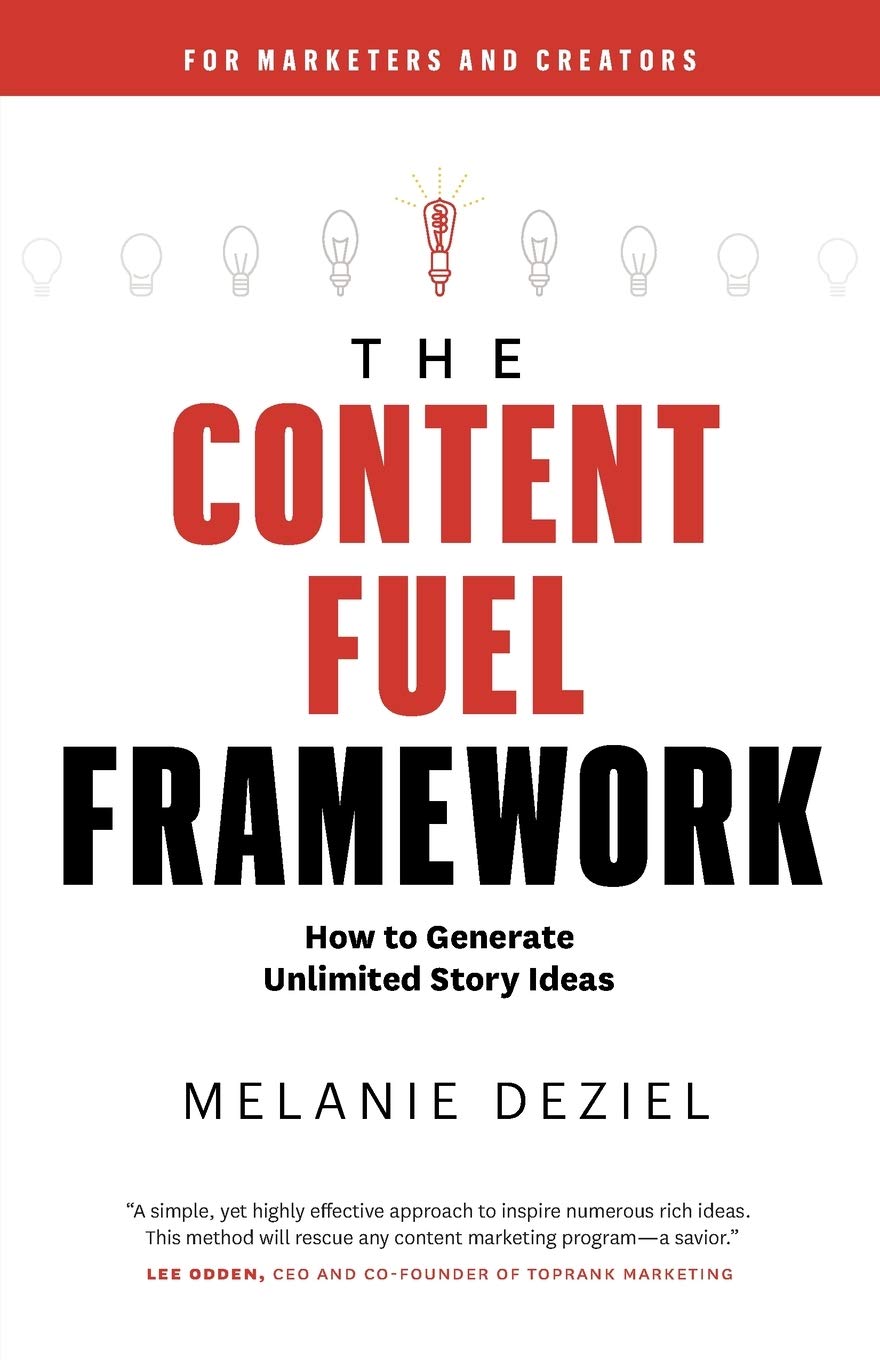
Books that have a simple premise that sounds clever, often push that premise to breaking point and turn into a cluttered mess. Thankfully, The Content Fuel Framework is not one of them.

Its simple premise, that story ideas for marketing purposes can be generated by using a 10 x 10 matrix of focuses and formats, is the kind of thing that marketers tend to do by instinct. Where Ms. Deziel scores is in the simple and obvious idea of writing this all down in a matrix to see what unusual and interesting ideas, that would normally never get thought of, develop.   

By deconstructing the steps which most marketers take when creating story ideas, Ms. Deziel demystifies the whole process and allows it to become accessible for all. This is not a book about the nuts and bolts of marketing, but more about how to stress test your ideas to find out what are the best ways for them to be handled – particularly when working as part of a team.

I hesitate to write down the 10 focuses and formats here in a review, as without the context that the book provides, I suspect that using the matrix will initially problematic. However, the context that is provided in The Content Fuel Framework allows the reader to not only see these ideas applied in the real world, but also to recognize from the marketing that we consume every day, the same applied concepts.

A short book, The Content Fuel Framework is a book that has made me do something that no other marketing book has done before; and this is to copy the 10 Focuses and 10 Formats and pin them to my wall as a reminder. Ultimately, that has to be the main indication of where a book as merit or not – does it make the reader think, or does it change something about the readers behavior?

By solidifying into a formal structure, the internal processes that a lot of marketers go through; The Content Fuel Network gives both validation and new life into marketing storytelling.

It should be on every marketer’s bookshelf.

…or pinned to the wall.   

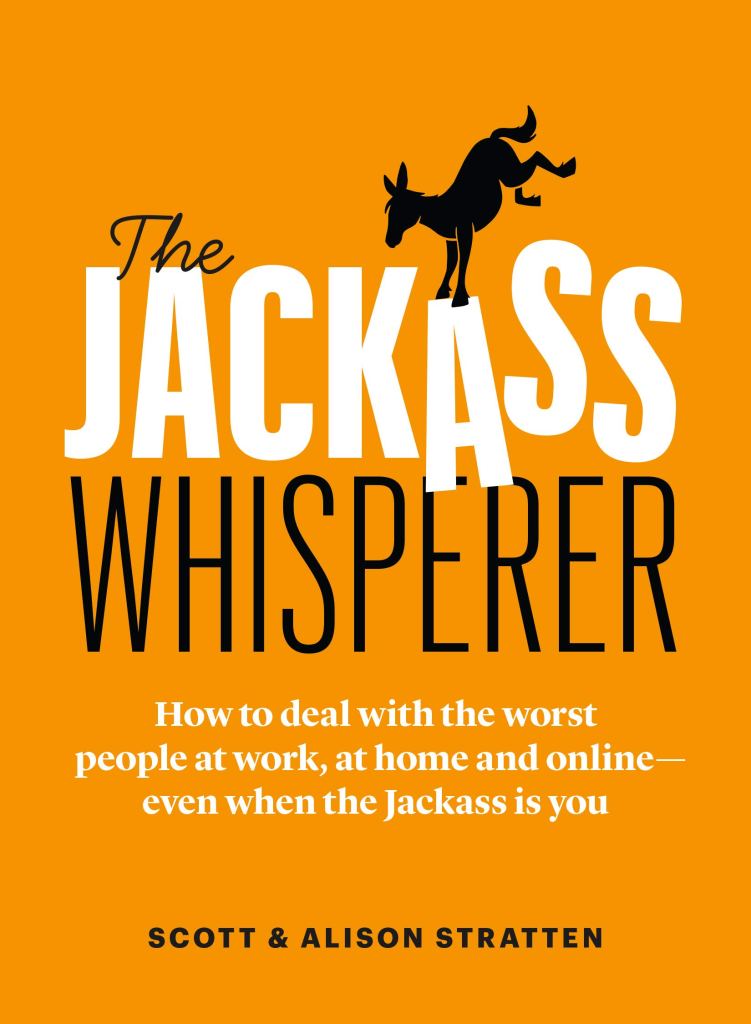
Scott Stratten, and latterly with his wife Alison, have written five other books on the intersection of customer service, social media, and marketing. I have reviewed most of them, which you can find here, routinely listen to their podcast, The Unpodcast, and I have a framed and signed “Don’t try to win over the haters. You are not the Jackass Whisperer” poster in my office. I am an unashamed fan boy.

Their books have swung from deep dives into marketing theory, to jokey and fairly superficial explorations of the absurdities that the marketing, and wider business world, is full of  – always with humor sprinkled throughout.  Although by no means an expert, I am certainly familiar with their work and their thinking on a variety of subjects.

Their latest book, would seem to an addition to their collection of books with a “gimmick.” A 125 question and answer book to see whether when presented with an example of “jackassery” one responds with a “Jackass Reaction” or a “Whisperer Reaction.”

But…

That is not what if going on here at all.

By coming at the subject from an indirect angle, the Stratten’s have laid bare our worst instinctual reactions to other people’s worst behavior. It shows that, in many instances we are just as much the problem rather than the innocent victim that we too often paint ourselves as. The implicit message is that the only way to deal with bad behavior is not to react to it out of outrage, but out of understanding and an attempt to solve the real underlying issue. To be the better person.

Of course, the book, and by assumption the authors, are not suggesting that all behavior is acceptable, but that “pick you battles” is really mantra we should all live by. That we have a responsibility to make the world a better place, and that starts with our interactions with each other. I find this particularly interesting as there was an element of “shame culture” in the earlier Unpodcast episodes. Jon Roson’s excellent “So You’ve Been Publicly Shamed,” which I reviewed here, goes much deeper into the culture of naming and shaming online; and the Jackass Whisperer seems to be a repudiation of that shame culture.

The Jackass Whisper is over the top, although most of the inciting incidents seem to be based on real occurrences (we really are doomed as a species), the reactions, both as a Jackass or as a Whisperer, are so over the top that it becomes useful to use them as a gauge for how you, the reader, would deal with such a thing. If one is being honest it is easy to see where your reaction is really not helpful, although perhaps satisfying at the time in terms of revenge.

It is, or course, easy to read this book superficially – as I did initially if I’m honest. But it subtly asks questions of us that are not easily answered. Is this the person I want to be? Do I really have to react like this to perceived provocations?

I’ll leave you to guess in the comments on my Jackass scale, but really that is not what is important about the Jackass Whisperer. It is the thought, and potential internal discussion, on the nature of reaction that a thoughtful reading of the book provokes, that makes it well worth your time and the purchase price.